dailynewsnblog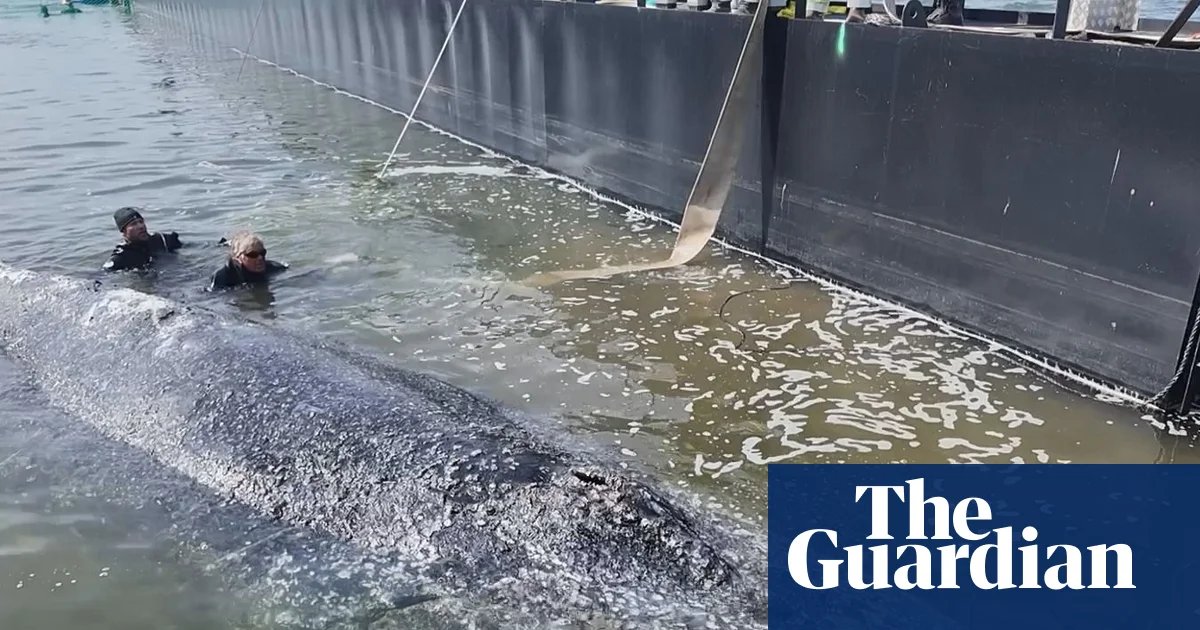
Timmy the whale has been confirmed dead by Danish authorities two weeks after the beached humpback was transported to the North Sea in a rescue attempt criticised as “pure animal cruelty”.
Denmark’s Environmental Protection Agency said a whale had been found dead on Friday near the small island of Anholt in the Kattegat, a broad strait between Denmark and Sweden, and confirmed it was Timmy on Saturday.
Jane Hansen, division head at the Danish Environmental Protection Agency, said in a statement: “It can now be confirmed that the stranded humpback whale near Anholt is the same whale that was previously stranded in Germany and was the subject of rescue attempts.”
She added that conditions on Saturday made it possible for a Danish Nature Agency employee to locate and retrieve a tracking device that was fastened to the whale’s back, and “the position and appearance of the device confirm that this is the same whale that had previously been observed and handled in German waters”.
The 10-metre long calf became a global sensation after it was spotted stranded on Timmendorfer beach, a sandbank in shallow waters off the coast of Germany, nearly two months ago.
As its health deteriorated, German officials gave up trying to rescue the mammal, saying they believed it could not be freed.
But after a national outcry, two millionaires in Germany said they were prepared to pay “whatever it costs” to release the creature.
The rescue attempt – which is believed to have cost about €1.5m (£1.3m) – involved floating Timmy away from the sandbanks and into a water-filled barge, which was pulled by a tugboat from Wismar Bay near the German city of Lübeck to deeper waters off the coast of Denmark.
It was criticised as “inadvisable” by the International Whaling Commission because the male juvenile, nicknamed Timmy after the beach where he was stranded, appeared to be “severely compromised” and was unlikely to survive after its release.
Experts from the Oceanographic Museum in Stralsund on Germany’s Baltic coast also recommended Timmy should be left to die in peace.
The young whale was described as lethargic, weak and covered in blister-like blemishes after spending weeks in water with low salinity. Parts of its mouth were believed to have been caught in a fishing net.
The museum’s director, Burkard Baschek, warned that trying to save Timmy amounted to “pure animal cruelty”.
After being released from the barge into the North Sea on 2 May, the whale was observed blowing through its blowhole and swimming freely “in the right direction”, according to Karin Walter-Mommert from the rescue initiative.
Later, however, it emerged that a tracker intended to monitor Timmy’s progress was not working. In a joint statement earlier this month, Walter-Mommert and her co-financier, Walter Gunz, one of the founders of a leading electronics chain, distanced themselves from the manner of the whale’s release.
“We hereby expressly distance ourselves from the events and the manner in which the whale was abandoned,” they wrote, calling for “any consequences” to be borne “by the owner, the operators, and any crew members of the ships Fortuna B and Robin Hood”.
The whale was found dead about 70km (45 miles) south of the location of its release two weeks ago.
Hansen said the Danish authorities had “no concrete plans to remove the whale from the area or to perform a necropsy, and it is not currently considered to pose a problem in the area”.
She urged people to stay away from Timmy’s body, due to the possibility it may carry diseases.
Speaking to the Guardian on Friday, before the identity of the dead whale was confirmed, Amy Dickham, a professor of wildlife conservation at the University of Oxford, said there were many lessons to reflect on from the case.
She said: “It’s really striking that there’s been such a focus on this individual animal at such great cost during a time of great crisis for wildlife funding around the world.
“It is really questionable whether it was a good use of funds, particularly compared with issues that impact much greater numbers of whales, such as collisions with vessels and entanglements with fishing gear.”