dailynewsnblog
The Boeing 747 entered commercial service in 1970 and spent the following five decades reshaping long-haul aviation. At its peak, the Queen of the Skies carried more passengers and more miles than any other aircraft in history, and its sheer size made it the defining image of the jet age for an entire generation of travelers. By the mid-2010s, the economics of twin-engine widebodies had begun to overtake it, and the major passenger airlines started retiring their 747 fleets in earnest.
But retirement from passenger service is not the same as the end of the line. A Boeing 747 leaving a commercial airline’s fleet can follow several distinct paths depending on its age, condition, and the state of the market it enters. Some are converted into freighters and return to service hauling cargo for another two decades. Some go to desert storage facilities in the Mojave to await a buyer that may or may not arrive. Some are dismantled for parts, with up to 85 percent of the airframe recovered and reused in some form. And a small number end up in places no one would have predicted, such as a high-rise office building in Seattle.
The Freighter Conversion: The Most Common Second Life

For most retired Boeing 747 passenger jets, the most likely next stop is not a museum or a scrapyard but a cargo ramp. The 747’s conversion pathway from passenger aircraft to freighter is the most economically viable post-retirement route for the type, and it is the one that extends the airframe’s working life the most. Converted 747-400s have been operating as freighters for decades, with the conversion process typically adding ten to 20 years of active service to an airframe that has already completed a full passenger career.
What makes the 747 particularly well-suited to freight operations is a design feature that was built into the original aircraft in 1968: the nose door. The 747’s hinged nose section swings upward to reveal a full-width cargo opening, allowing outsize items to be loaded straight onto the main deck without the dimensional constraints imposed by side doors. That capability makes the converted 747 freighter genuinely difficult to replace for certain cargo categories, including turbine engines, aerospace components, military vehicles, and industrial equipment that cannot be broken down to fit standard cargo doors. No current production freighter replicates the nose-loading configuration.
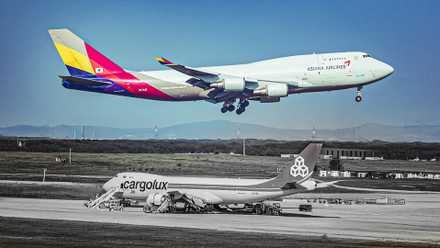
As of early 2026, approximately 80 to 90 Boeing 747-400 freighters remain in active service globally, operated by carriers including Atlas Air, Cargolux, UPS, and National Airlines. Some of those aircraft began their lives carrying passengers for major commercial airlines before conversion. Others were built as freighters from the outset. Together, they represent a working fleet that has long outlasted most predictions about the 747’s commercial lifespan, sustained by a cargo capability that the market has not found a reason to retire.
The Boneyard: Desert Storage And What Happens There

When a 747 is not a candidate for immediate freighter conversion and has not been acquired by a museum or scrapyard, it typically ends up in desert storage. The two most significant facilities in the United States are Mojave Air and Spaceport and Southern California Logistics Airport in Victorville, both located in the Mojave Desert of California. The choice of location is deliberate. The desert’s low humidity and minimal rainfall slow the corrosion process that would otherwise degrade an aircraft’s airframe, wiring, and control surfaces relatively quickly in a wetter climate. In practical terms, the arid conditions allow an aircraft to sit outdoors for years without the kind of structural deterioration that would make a return to service impossible.
Not every aircraft in desert storage is there to stay. Some 747s are placed in what the industry calls flyable storage, a preservation state in which the aircraft is maintained well enough to be returned to service if market conditions change or a buyer emerges. Engines are sealed against dust ingestion, flight control surfaces are protected, and periodic maintenance checks are carried out to keep the airframe airworthy in principle. During the COVID-19 pandemic, Mojave and Victorville filled rapidly with widebody aircraft that airlines had parked rather than retired, and a number of 747s that might otherwise have been scrapped were held in storage in case passenger demand recovered faster than expected.
The reality for many stored 747s, however, is that the return to service never comes. Once an aircraft has sat long enough that the cost of bringing it back to airworthy condition exceeds its market value, the economics shift toward dismantling. At that point, the boneyard transitions from a waiting room into the first stage of the parts harvesting process, with technicians beginning to remove components that still have value before the remainder of the airframe is scrapped.

What It Takes To Get A Big Jet Airborne: From Check-In To Gear-Up
Captain Chris reveals the secrets behind the perfect departure.
Parts Harvesting And The Recycling Chain

When a 747 reaches the end of its usable life and conversion or storage is no longer viable, dismantling is the final step, and it is a more structured and economically significant process than the word scrapping implies. Up to 85 percent of a retired 747’s components can be recovered and reused in some form. The most valuable items come off first. Engines, landing gear assemblies, avionics, auxiliary power units, and aircraft seats all have active secondary markets, with demand coming from airlines operating the same aircraft type that need serviceable parts at a lower cost than new manufacture. A single CFM or Pratt and Whitney engine from a retired 747 can be worth millions of dollars, depending on its condition and remaining service life.
The fuselage itself has value even after the reusable components have been removed. The aluminum alloy used in 747 airframe construction is a high-grade material that is melted down and recycled into new products ranging from aircraft components to automotive parts to everyday consumer goods. A scrap 747 fuselage section alone can be worth up to $55,000, indicating that even the raw material from a fully stripped airframe generates meaningful revenue for the dismantling operator. Specialist aftermarket brokers manage much of this process, acquiring retired aircraft from airlines and systematically working through the value chain from high-value components down to raw material.
Air India’s final four 747s illustrate how the process works in practice. When the carrier retired the type, the aircraft were transferred to US-based aftermarket broker AerSale. Two were earmarked for freighter conversion, keeping those airframes in active service. The remaining two were dismantled for spare parts, with usable components entering the secondary market and the remainder recycled.
Museums, Hotels, And Unusual Second Lives

Not every retired 747 ends its life in a cargo terminal or a boneyard. A small number have been preserved as permanent exhibits, and an even smaller number have found genuinely unusual second lives as architecture. The preservation pathway is the more straightforward of the two. Aviation museums across the United States, the United Kingdom, and Asia have acquired retired 747s as static displays, serving as physical artifacts of the jumbo jet era that reshaped long-haul travel from the early 1970s onward. For airlines retiring the type, donating an aircraft to a museum is an alternative to dismantling it, offering public relations value and preserving a piece of the carrier’s operational history.
The creative reuse pathway is rarer and considerably more ambitious. One of the most striking examples currently underway is in downtown Seattle, where developers have installed a retired  United Airlines 747-400 fuselage inside a new high-rise commercial complex. The fuselage was cut into 39 sections, transported by truck to the site, and reassembled inside the building, where it hangs approximately 14 feet above a pedestrian walkway and functions as usable office space. The project required significant structural engineering to suspend and integrate an aircraft fuselage into an occupied building, and it represents one of the more literal interpretations of adaptive reuse in commercial architecture.
A retired TWA 747 has taken a different but equally inventive route, with its wings and structural elements incorporated into a private residence in California. The wings form the roof of the home, giving a residential structure a span and profile that no conventional building material could replicate. Both projects reflect a small but consistent appetite for repurposing the 747’s distinctive scale and form into something functional rather than simply demolishing what remains after the aircraft’s commercial life is over.
Is A Boeing 747-8 Bigger Than A 747-400?
Discover the surprising differences between the 747-400 and 747-8 models.
Government And Special Mission Roles

747s have found specialist roles in government and military adjacent operations. Engine manufacturers have long used widebody airframes as flying testbeds, mounting development engines on modified wing pylons to accumulate test hours in real flight conditions before certification. The 747’s size and multi-engine configuration make it particularly suitable for this role, since a test engine can be mounted as a fifth powerplant without compromising the aircraft’s ability to fly safely on its four standard engines. Several 747s have also operated as VIP transports for foreign governments and as heavy charter aircraft supporting military logistics.
What the specialist role pathway illustrates is that the 747’s utility does not expire when its commercial passenger career does. The airframe’s size, range, and structural capacity give it relevance in certain applications that newer, more efficient aircraft do not replicate. For an aircraft that entered service in 1970 and was widely expected to be retired long before now, the range of roles it continues to fill in 2026 is a reasonable measure of what made it significant in the first place.