dailynewsnblog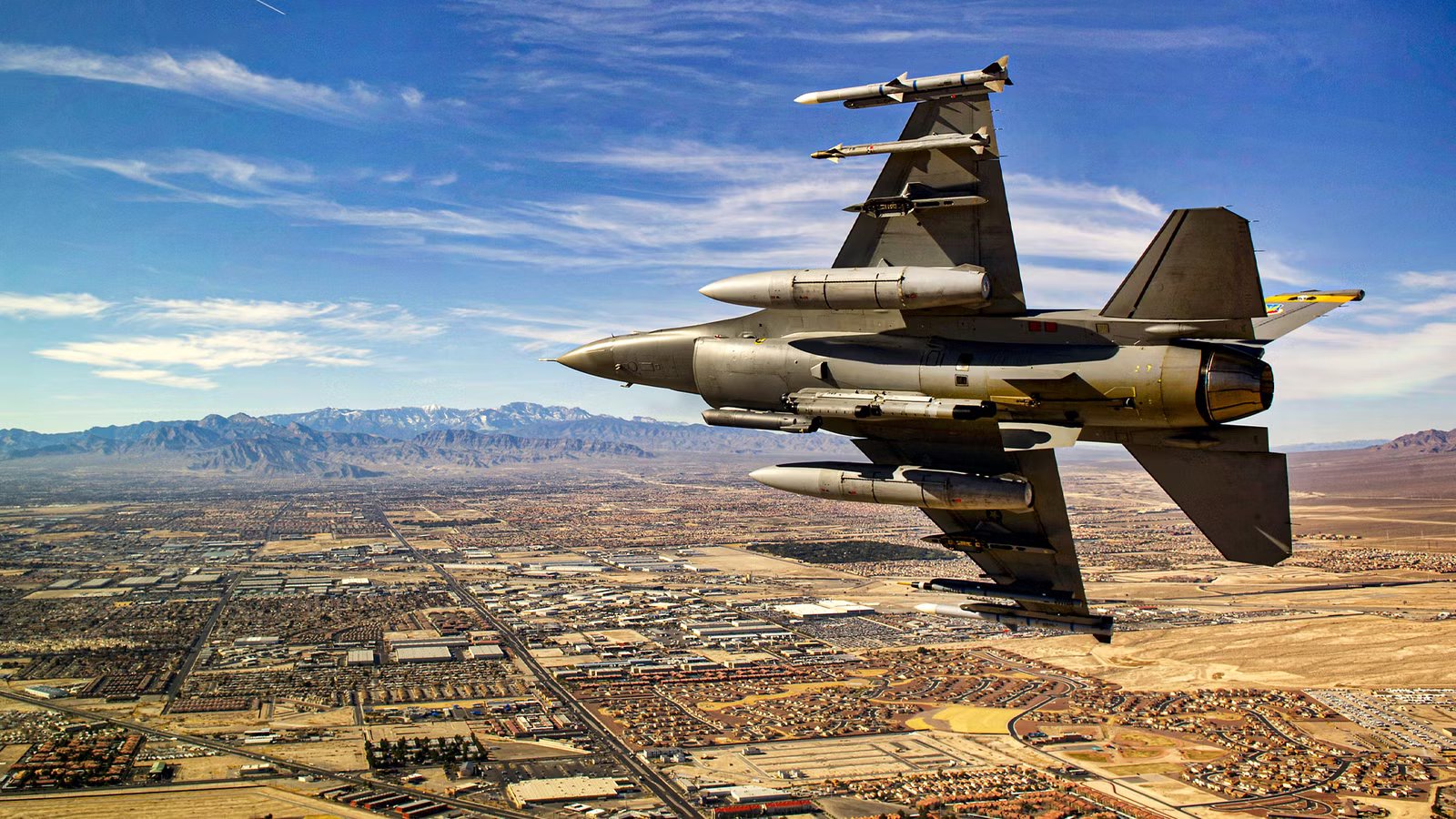
The General Dynamics (now Lockheed Martin) F-16 Fighting Falcon first flew in 1974. The aircraft was a result of (among other things) politics in Washington lobbying against the F-15 Eagle and other high-end jets, and innovation at General Dynamics. Notably, it incorporated fly-by-wire controls developed by NASA for its space program. Not only did the fighter jet change the accepted design and template for fighter jets, but it also became the most popular 4th-generation fighter jet.
To date, over 4,600 F-16s have been delivered with hundreds more on order (for export). The F-16 is set to remain in production into the 2030s and to remain in United States Air Force service into the 2040s. That said, the F-16 Viper of today bears little resemblance to the first Fighting Falcons that emerged in the 1970s beyond superficial appearance. In many ways, the F-16 Viper has become what the F-16 initially set out to avoid. Here is what to know about how the F-16’s early fly-by-wire systems changed fighter jet designs.
A Product Of The Fighter Mafia

Lockheed Martin says, “Conceived in the early 1970s by a small but vocal group of engineers and defense analysts known as the Lightweight Fighter Mafia, the F-16 was designed as an alternative to fighter aircraft that had grown increasingly heavy and unmaneuverable.” The Fighter Mafia is the nickname given to a group of influential US military reformers, officers, and analysts in the late 1960s and into the 1970s.
These people were against the USAF purchasing complex and expensive aircraft like the F-15 Eagle. Instead, they intensely lobbied for small, agile, and comparatively cheap fighter jets. They thought the Air Force had grown too dependent on missiles and advanced electronics, believing close-range aerial combat was still relevant. The two aircraft that had the biggest impact were the General Dynamics F-16 Fighting Falcon and the Fairchild Republic A-10 Thunderbolt II.
Ironically, the Air Force has been asking to retire its A-10 Warthogs since 1984, the date the final example was delivered. This is in stark contrast to the massive fanbase the A-10 commands. But while the A-10 remained a mostly simple aircraft, the F-16 did not. The F-16 is also ironic. The jet was envisioned as a lightweight day fighter that was small, agile, fly-by-wire, and optimized for maneuver combat. Today, the F-16 has grown into a medium-weight, multirole fighter with advanced 5th-generation systems. This is the mission creep that the Mafia was opposed to.
Designed For Maneuverability

The F-16 Fighting Falcon was designed to meet the Fighter Mafia’s ambitious goals. General Dynamics designed it to trade excess weight and heavy payloads for speed and maneuverability. It was to be a simple and inexpensive fighter; this was part of the reason for its massive export success and why it remains the most popular fighter jet in service today.
The Mafia’s theory was that the aircraft would be able to fly fast and turn quickly enough to avoid being struck by missiles and machine gun fire. To satisfy the Mafia, General Dynamics was forced to lean on new technologies that hadn’t been integrated into an aircraft before. The aircraft came with a slightly tilted-back ejection seat, a side-mounted control stick, a bubble canopy, and a head-up display.
Importantly, the F-16’s smooth blended-wing body provided extra lift and control, while its innovative fly-by-wire system allowed the aircraft to remain stable and increase its agility. Initially, the F-16 was designed for visual-range air combat, dogfighting, and air superiority. It was intended to counter contemporary Soviet fighters like the MiG-21 and MiG-23. As time went on, it would be almost none of that. It is now designed as a multirole aircraft built for beyond visual range fighting and as an affordable bombing workhorse.
Finally Able To Be Aerodynamically Unstable

For years, designers had a problem. A safe and controllable aircraft needs to be aerodynamically unstable, but a stable aircraft is also a less maneuverable one. Commercial airliners are designed to be strongly stable on purpose as they are designed to be a safe lumbering bus in the sky. A highly unstable fighter jet would be too difficult for a human pilot to constantly make the needed small adjustments.
In the Cold War, one compromise was to design variable geometry wings, which allowed aircraft to alternate between stability and instability and be more optimized for low and high speeds. Examples include the F-111 Aardvark, the B-1B Lancer, and the Panavia Tornado. A highly unstable fighter may need corrections many times a second, and this is impossible for a human, although it is possible for a computer.
General Dynamics/Lockheed Martin F-16 Fighting Falcon (per Lockheed, others) | |
|---|---|
Number built | 4,600+ |
Number on order | Well over 100 |
First flight | 1974 |
Entered service | 1978 |
Expected retirement (USAF) | 2040s |
Fly-by-wire (FBW) changed everything. As the pilot moves the stick, the computer interprets the command and continuously stabilizes the aircraft, moving the control surfaces rapidly and precisely. The General Dynamics F-16 was the classic breakthrough and one of the first production fighter jets built around a highly unstable, but agile, platform enabled by digital fly-by-wire controls.

What USAF Conflicts Has The F-16 Fighting Falcon Been Involved In?
The jet has an extensive service history.
NASA Developed Fly-By-Wire For The Moon Landing

Still, not all the credit for Fly-by-Wire goes to General Dynamics and the F-16; arguably, more credit goes to NASA, the F-8 Crusader, and the space program that pioneered the technology. As General Dynamics initially developed the F-16, the prototype YF-16 was found to be too dangerous and unstable for pilots to fly using conventional manual controls. They needed another solution.
NASA writes, “The first test of a DFBW [Digital Fly By Wire] system in an aircraft was in 1972 on a modified F-8 Crusader at the Flight Research Center, Edwards, Calif. (now Dryden Flight Research Center).” NASA then explains, “It was the forerunner of the fly-by-wire flight control systems now used on the space shuttles and on today’s military and civil aircraft to make them safer, more maneuverable and more efficient.”
The most visible early NASA uses of full fly-by-wire systems were on the Gemini 2 spacecraft, which led the way to the Apollo Lunar Lander. A fly-by-wire system was built around an Apollo Lunar-Lander computer and fitted to a Navy F-8 Crusader (NASA 802). The aircraft became the first US airplane to fly in 1972 without a mechanical connection between the pilot and control surfaces. Note that something similar had been done before with the Canadian CF-105.
F-16 First Production Analog Fly-By-Wire

According to F-16.net, taking note of NASA’s fly-by-wire, F-8 was one Harry Hillaker. Hillaker was a longtime veteran of General Dynamics, having started his career with them in the 1940s (the company was then called Consolidated Aircraft). Working on the YF-16, Hillaker sought solutions for maneuverability equal to or superior to any other fighter jet that had yet been developed.
He noticed that the NASA F-8 was around two-and-a-half times faster in response than one equipped with the traditional hydro-mechanical control system. He then worked to ensure a similar fly-by-wire system was developed and incorporated into the F-16. However, while the NASA F-8 had a digital system, the F-16’s fly-by-wire system remained analog as engineers felt digital systems were not yet mature enough for a production aircraft.
As fate would have it, the F-16 may have been the first production fighter jet to incorporate fly-by-wire controls, but it was its longtime rival that first incorporated digital fly-by-wire. The General Dynamics YF-16 defeated the rival Northrop YF-17 to become the F-16 Fighting Falcon. However, a derivative of the YF-17 would go on to be the Navy’s F/A-18 Hornet. This was the first production aircraft to use a digital fly-by-wire system, instead of an analog one. The F-16 was eventually upgraded to digital in the late 1980s.

How The F-16 Stacks Up Against The MiG-35 In 2026
How does the Viper compare to the Super Fulcrum?
Lasting Impact & A Debate That Goes On

While fly-by-wire controls did not single-handedly end the development of variable geometry aircraft, they did solve some of the major problems swing-wing aircraft were designed to overcome. The F-16 was a powerful proof of concept that set the standard for new aircraft going forward. As F-16.net notes, “For the new generation of fighter plane the YF-16 represented, fly-by-wire could clearly pay tremendous dividends.”
The F-16 demonstrated that an aircraft could be extremely agile, effective at both low speeds and supersonic speeds, relatively lightweight, comparatively cheap, and easier to maintain than swing-wing fighters. Its breakthroughs include analog fly-by-wire controls, relaxed static stability, blended aerodynamics, and more. After the F-16, the blueprint for fighter jets became fixed wings, advanced control surfaces (or canards), fly-by-wire management, and high thrust-to-weight ratios.
Interestingly, the F-16 vs F-15 debate of simple, low-cost, and numerous fighter jets against fewer, but high-end and expensive fighter jets goes on. The current iteration of the debate is future 5th and 6th generation fighter jets (like the F-35 and F-47) versus combat drones. Just as the Air Force seeks a high-low mix of F-16s and F-15s, it is now seeking a mixture of high-end F-35s and F-47s with more affordable Collaborative Combat Aircraft (loyal wingman drones) as well as easier to maintain 4th-generation fighter jets like F-15EXs and upgraded F-16s extended in service.