dailynewsnblog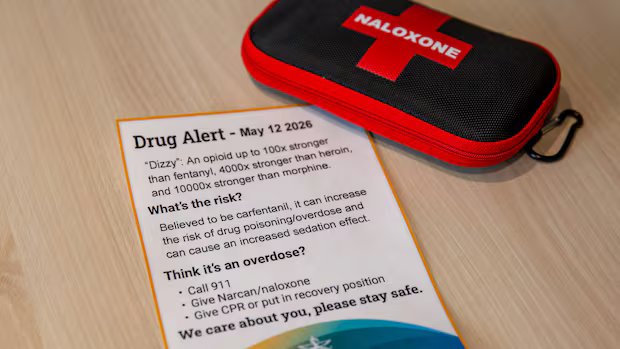

Listen to this article
Estimated 5 minutes
The audio version of this article is generated by AI-based technology. Mispronunciations can occur. We are working with our partners to continually review and improve the results.
Opioid-related death rates have dropped by more than 50 per cent in Ontario since 2021, according to the latest report from the Office of the Chief Coroner.
Still, northern Ontario has consistently seen the highest rates in the province as advocates and health-care experts report increasingly toxic drugs in street supplies.
In 2025, the provincial mortality rate has declined by 54 per cent compared to 2021, but remains 44 per cent higher than in 2016, says the report released this week.
Thunder Bay again has the highest opioid-related death rate, at 52.72 per 100,000 population — more than five times the provincial rate of 8.96.
Northern Ontario communities comprise three of the top five death rates, with North Bay third at 30.83 and Greater Sudbury fourth at 28.36.
That said, overall numbers are dropping. Thunder Bay’s opioid-related death rate has gone down over 37 per cent since 2022 (when it was 77.2 per 100,000 population), according to the Ontario Drug Policy Research Network.
The latest data comes amid two separate drug alerts in the region this week.
The Northwestern Health Unit issued a drug alert Tuesday after seeing 11 non-fatal opioid poisonings or overdoses in Kenora in a single day.
A day later, NorWest Community Health Centres in Thunder Bay issued a drug alert about another combination of deadly substances showing up in drug tests.
“Much of the opioids that are sold in northern Ontario are manufactured illegally. They are sold as if they contain fentanyl, and yet they have a mix of fentanyl and many other very toxic substances,” said Dr. David Marsh, vice-president of research and graduate studies at the Northern Ontario School of Medicine University (NOSM).
These include veterinary tranquillizers popping up in Ontario and Manitoba. Medetomidine and xylazine, for instance, were never approved for human consumption.
Marsh is also research chair in mental health and addictions at the Health Sciences North Research Institute in Sudbury and an adjunct scientist at the Institute for Clinical Evaluative Sciences North.
To meet people’s distinct mental health and addiction needs, he said, there should be better co-ordination across the health-care system so they can “stay on treatment and benefit for longer periods of time.”
Shift from heroin to fentanyl, carfentanil
The substance found in Kenora, known as “dizzy,” is believed to be composed of carfentanil.
“Less than a quarter of a teaspoon of pure fentanyl could be enough to kill someone,” said Marsh. “Carfentanil is 100 times stronger, so that means just a few grains of sand mixed in with the rest of the drug can have the effect of causing an overdose.”

Thunder Bay’s drug alert was about a substance thought to be crack cocaine that tested positive for “furanylehtyl fentanyl, fluorofentanyl, cocaine and phenacetin.”
“Most of the illegal fentanyl that is sold in Canada is produced in other countries and shipped here,” Marsh said.
“That’s one of the reasons why the drug market has turned from heroin to fentanyl and carfentanil, because they can ship a much smaller quantity and therefore be much less likely to be detected” by police.
“Smaller and smaller quantities can be sold for the same dollar amount.”

Naloxone, which can be acquired free through pharmacies or local health units, can reverse the effects of an opioid overdose. However, it does not work on other types of drugs that may be mixed in.
“The most powerful tools we have to prevent overdose deaths are treatment with medications for opiate use disorder — methadone, buprenorphine — and some other third-line treatments that are available,” Marsh said.
“Methadone and buprenorphine together, we reduce the risk of overdose deaths by over 80 per cent.”
Rolling back supervised consumption sites
In March, Premier Doug Ford’s government notified seven supervised consumption sites — which allow people to use drugs in the presence of health-care professionals — that it would be pulling their funding. The sites are set to close by mid-June.
The move comes after the province forced the shutdown of nine other such sites last year that it deemed were too close to schools and daycares.

Two supervised drug consumption sites in Moss Park received letters on Friday from the Ontario Ministry of Health saying that their provincial funding will end in 90 days. CBC’s Ali Chiasson spoke to advocates who are concerned this could lead to more open drug use in the area.
Instead, the province says its new Homelessness and Addiction Recovery Treatment (HART) Hubs focus on providing primary care, employment support, and mental health, addiction and social services.
From Marsh’s perspective, the rolling back of supervised consumption sites is putting people at greater risk of harm.
“The evidence is very clear that for people who are not yet ready to enter treatment, being able to access a supervised consumption site reduces the chance of them dying of overdose, also increases the chance that they will enter treatment and will go on to stop injecting or using drugs.”
There are no longer any supervised consumption sites in northern Ontario.
Regardless of what support people are seeking, Marsh said it’s important to stop stigmatizing drug use as this may prevent people from seeking help.
“They deserve to be treated with respect in the same way that we would treat people with any other chronic illness who need ongoing care.”