dailynewsnblog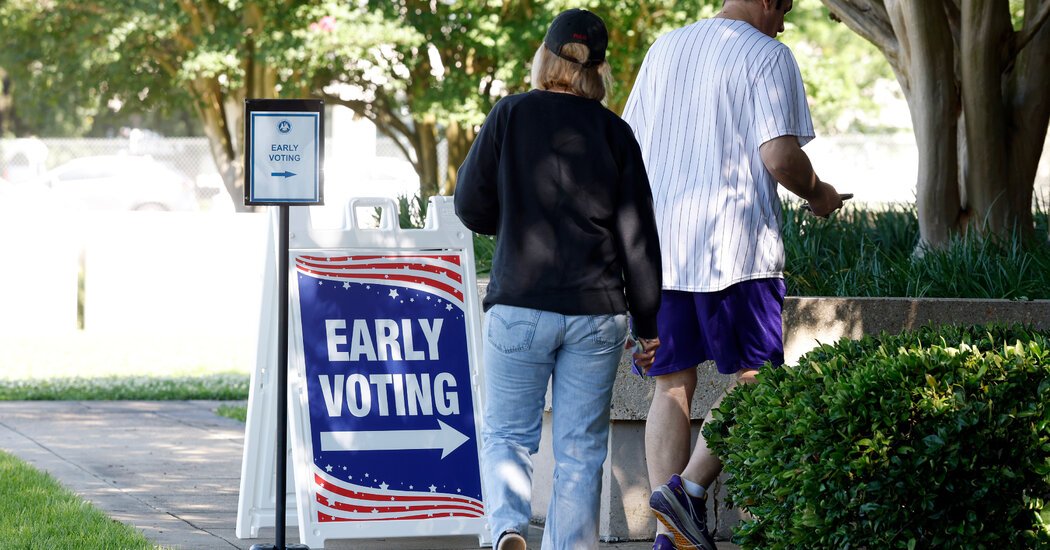
When Louisiana voters cast ballots on Saturday, Senator Bill Cassidy’s political demise could be hastened by a decision his fellow Republicans made two years ago: getting rid of an open, nonpartisan primary in favor of a closed system in which Republicans and Democrats compete separately.
That nonpartisan primary was adopted, in part, to empower politicians like Mr. Cassidy who have been willing to cross party leaders and reach across the aisle. Supporters of open primaries and political scientists who have studied them say they increase voter participation and elect more middle-of-the-road candidates.
Across the country, partisans are turning against such systems. In response, supporters are intensifying their advocacy with an even bigger claim, based on research commissioned by open primary proponents: Open primaries may better people’s quality of life in tangible ways that include increased prosperity, longer lives and lower murder rates.
In a year when House control could hinge on a handful of races, Republicans and Democrats alike have embraced a win-at-all-costs mentality. An all-out war to redraw House maps has consumed statehouses in recent weeks. But open primaries can impede such partisan gains, because they allow voters across the political spectrum to choose candidates, often resulting in centrist choices.
Open primaries, the thinking goes, allow non-party faithful to vote — and run — which increasingly polarized party leaders see as a potential forfeit of power. They also claim that open primaries, and more complicated systems that let voters rank candidates, are confusing and unfairly reduce the influence of loyal party voters.
Mr. Cassidy, a moderate Republican who voted to convict President Trump after his 2021 impeachment trial, owes some of his success to Louisiana’s previous system, which put politicians from both parties in a single primary. The top two met again in the general election.
But conservative Republicans, eager to heed Mr. Trump’s demands to make Mr. Cassidy pay for his conviction vote, scrapped the so-called Cajun primary system. They said Republican voters — not Democrats crossing party lines — should choose Republican nominees.
Polls suggest that Mr. Cassidy is in grave danger of losing to Representative Julia Letlow, who has Mr. Trump’s endorsement.
Similar retrenchments are happening across the country. In Massachusetts, Democrats are rallying against a proposed ballot measure to enact an open primary. A Democratic strategist in California is pushing to repeal the state’s open system in 2028. And Alaska Republicans are backing a November ballot measure to close primaries and end ranked-choice voting.
In 2020, Alaska voters adopted their system, in which the top four finishers in an August open primary advance to the general election. Scott Kendall, who designed the process, argues it has made Republican legislators more willing to work with the Democratic minority and unaffiliated legislators.
“Elected officials behave differently when fear isn’t driving their decisions,” said Mr. Kendall, a former aide to Senator Lisa Murkowski, a moderate Republican, and former Gov. Bill Walker, a Republican turned independent.
In 2024, six states considered joining Alaska in opening their primaries. But state parties spent heavily against the initiatives, and voters in all six states rejected them, some by enormous margins. (Voters in Washington, D.C., did pass an open primaries measure that year.)
Unite America, which spent about $20 million through its super PAC in 2024 in an unsuccessful effort to push open primaries, published a study on Thursday suggesting that open primaries being used in five states — California, Louisiana, Alaska, Nebraska and Washington — have improved lives by encouraging the election of pragmatic lawmakers likely to enact useful legislation.
Richard Barton, a Syracuse University political scientist who conducted the study, analyzed 14 metrics and found that states with nonpartisan primaries had seen “statistically significant improvements” in nine of them — even when accounting for other factors.
Mr. Barton’s research offered case studies to back up his statistical observations.
In Louisiana, he argued, nonpartisan primaries had prompted the election of moderate Republican lawmakers who were forced to appeal to a broader coalition of voters. The result: Legislators expanded Medicaid under the Affordable Care Act a decade ago, making Louisiana one of only a few Southern states to do so.
Mr. Barton wrote that open primaries are “undercutting the power of each party’s ideological base, incentivizing candidates to build broader coalitions.”
Two political scientists asked by The New York Times to review the research said they were intrigued, but skeptical, especially given how few states the study had to analyze.
“I find it suggestive, but far from definitive,” said Henry Brady, a political scientist at the University of California, Berkeley. “Still, ‘suggestive’ might be enough to encourage some policymakers to try an innovation that might make things better in our polarized time.”
Unite America plans to use the research as ammunition in its continuing battles.
“We have to increase conviction that these reforms aren’t just good ideas, but can actually make a difference in people’s lives,” said Nick Troiano, Unite America’s executive director. “That requires connecting the dots.”
In Alaska, early research found that the new nonpartisan system had fostered more middle-ground positions on issues like abortion.
Glenn Wright, a political scientist at the University of Alaska Southeast, said lawmakers “seem to realize they don’t need to pander to the more extreme fringes of their parties.”
But open primaries are not a settled question in Alaska. A Republican-driven effort to repeal the system in 2024 failed by fewer than 700 votes out of more than 320,000 cast.
Mr. Trump endorsed this year’s repeal effort last month, calling ranked-choice voting “ONE OF THE GREATEST THREATS TO DEMOCRACY.”
Bernadette Wilson, a Republican candidate for governor and repeal organizer, said voters, especially older ones, find ranked-choice ballots confusing. She said she also worried that open primaries actually lead to intraparty polarization, because parties cannot heal their wounds after a bruising race.
“You might end up with two Democrats or two Republicans on the general election ballot, still battling it out,” she said.
Louisiana’s open primaries date to the 1970s, when Gov. Edwin Edwards, a Democrat, pushed them to save taxpayer money by conducting fewer elections and to help Democrats hold onto power by avoiding intraparty primary fights.
By the 2020s, conservative activists were arguing that the system gave Democrats and independents too much power, and in 2024, Louisiana’s Legislature, controlled by Republicans, returned to closed primaries — just in time to make Mr. Cassidy pay for his impeachment vote.
Robert Hogan, a Louisiana State University political scientist, called Mr. Cassidy “the poster child for why Republicans wanted to change.”
“Parties can’t pick their candidates in smoke-filled rooms anymore,” Mr. Hogan said, “but choosing who gets to vote comes pretty close.”