dailynewsnblog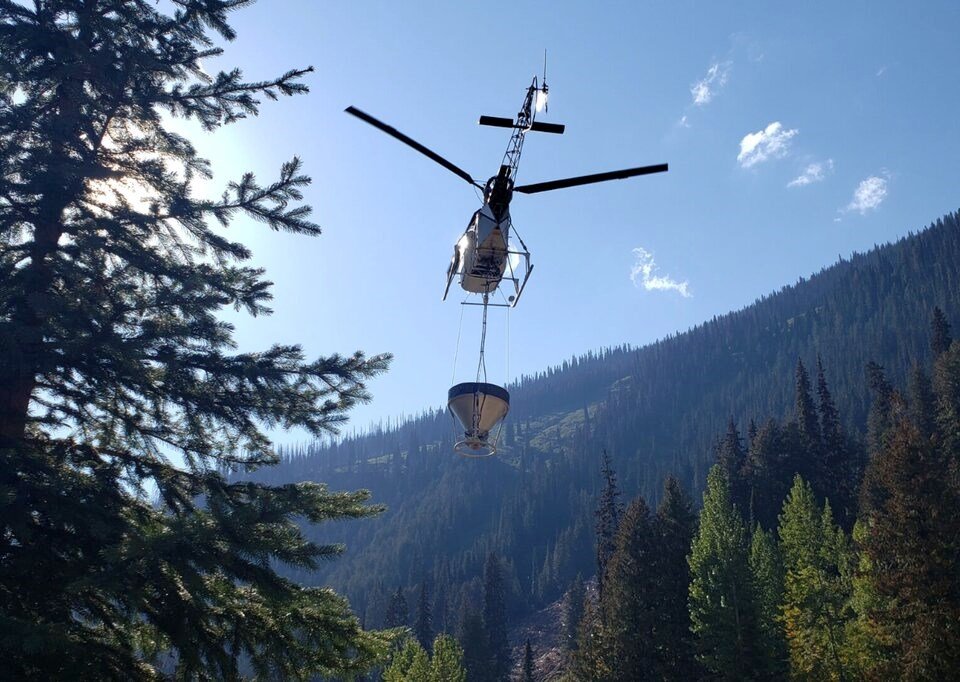
The B.C. government has sanctioned a Chilliwack company after a botched fertilizer application contaminated public forest lands and killed more than a dozen cattle
A B.C. government decision to source a forest fertilizer outside the U.S. for “political reasons” ended in disaster in an incident that killed 13 cattle and triggered a major environmental penalty.
Every year, B.C.’s Forest Investment Program tenders contracts to fertilize thousands of hectares of forest across the province in projects meant to boost tree growth for harvesting and to capture carbon.
One of the sub-contracts went to Western Aerial Applications Ltd. in late September 2025. Its job was to use helicopters to scatter a newly sourced blend of fertilizer onto forests near Quesnel, B.C.
That plan fell apart when employees overfilled bags used to load helicopters with fertilizer. In at least six locations off Highway 26, the blue pellets spilled to the ground in unintended concentrations, according to an April 28 decision from the Ministry of Environment and Parks.
Tim Singer, a range officer with the Ministry of Forests, would later document 13 dead cows, including several found next to spilled fertilizer, standing water and hoof prints.
The dead cattle were found bloated with blood coming out of their noses and eyes, according to an Oct. 3 report from Christine Turlet, an enforcement section head with the Ministry of Forests.
“Symptoms suggest nitrate poisoning, which may also cause cattle to abort fetuses—potential issue during pregnancy checks in December,” Turlet wrote.
Elders with the Lhtako Dene Nation raised concerns, and the nation requested all forest fertilization projects overlapping its territory get shut down until the facts were known, Turlet wrote at the time.
Fertilizer sourced from outside U.S. due to ‘political reasons’
In her April 28 decision, Ministry of Environment official Kelly Mills found the discharge of the waste fertilizer “substantially altered or impaired” the environment, exposing the cows and other wildlife, and leading to the cattle’s deaths.
Mills determined the “major” contravention had “very high” real adverse effects that include “widespread injury or damage to animal or plant life.”
“This was the first year of using this fertilizer blend and there may have been a lack of understanding of the toxicity … ” wrote Mills. “However, there is an expectation that any business dealing with chemicals in its work would educate itself on the hazards, including environmental, of those chemicals.”
The official noted Western Aerial Applications had over 39 years of experience.
In submissions, the company claimed the fertilizer blend did not clearly describe or identify a “specific acute ingestion hazard.”
The company also noted the fertilizer stuck to and persisted in soil and vegetation in ways that differed from products it had used in the past. That affected its ability to clean up the spill using conventional techniques that had worked before, said Western Aerial Applications.
The company also claimed that while there may have been “minimal efforts performed by one disgruntled employee,” the rest of the company’s workforce performed as expected.
Reached by email, Western Aerial Applications’s general manager Josh Jonker said the whole incident was “terrible” and that “nobody wants animals to suffer or die unnecessarily.”
He added that the fertilizer the company was required to use on the Quesnel project was produced using a different process than any of the fertilizers they have used over the past three decades.
The B.C. government appears to have had a central hand in determining where fertilizer applied to Crown forests could come from in 2025.
Under its Forest Investment Program, the province spends between $20 million and $39 million to fertilize up to 40,000 hectares of forest a year.
But last year, Canada’s emerging trade war with the United States appeared to have pushed the B.C. government to seek a new supply.
“The product was blue this year due to a government decision to source it from outside the U.S. for political reasons,” wrote Turlet in her notes.
A spokesperson with the Ministry of Forests confirmed that most of blue fertilizer was manufactured in Saskatchewan.
Companies had ‘no idea’ how toxic the fertilizer was
A report provided by the Ministry of Agriculture’s Animal Health Centre later determined that the sudden death of multiple cattle was most likely caused by urea toxicity after they ingested the fertilizer.
Among other things, such poisoning leads to muscle weakness, paralysis and cardiac arrest, said ministry veterinary pathologist Glenna McGregor in a Dec. 16 statement cited in the decision.
“All of this results in death rapidly,” McGregor said.
Some of the cows were taken to a land fill near 100 Mile House; others were buried nearby.
Turlet appears to have continued collecting evidence and interviewing those involved in the incident. In an Oct. 25, 2025, statement to Turlet, the owner of Central Interior Mapping Company Inc.—the project manager for the fertilization project—said they started applying fertilizer several weeks earlier than expected and before snow had fallen.
“He had no idea how toxic it was,” she wrote.

Turlet took another statement from one of Western Aerial’s contracted foresters on Dec. 8, 2025. Her notes state that the company’s cleanup procedures involve dispersing the fertilizer, that they “don’t do a perfect job” and that “their understanding of clean-up seems to just have different standards.”
“There is no understanding of how toxic this fertilizer was and they had no training,” wrote the ministry official.
Turlet added that the sticky blue fertilizer clogged equipment, and because cattle can see blue well, it may have attracted them.
An email shared with the subcontractor’s staff after the incident warned that deer, elk and cows find the taste of urea desirable and that even three tablespoons can be fatal.
A statement from B.C.’s environment ministry said its staff later attended the site to document any impacts on wild animals, but did not find any dead wildlife “around the time period of the incident.”
In response to questions from Business in Vancouver, the Ministry of Forests said about 1,004 hectares of the province’s managed forests were treated with the blue fertilizer in 2025 until its application was halted on Oct. 1.
“The fertilizer product was discontinued immediately after the events in Quesnel last year and is not being purchased or utilized again,” said a ministry spokesperson.
Firm accepts ‘mistakes were made,’ has no plan to seek appeal
B.C.’s environmental regulations allow for penalties of up to $75,000 for every day a company breaches the Environmental Management Act.
The initial assessment recommended Western Aerial Applications be penalized $110,500 for the incident.
But after considering the company’s submissions, Mills substantially reduced that amount. She found the incident was no longer “easy to predict” at the time of the spill, and that the risks associated with the new fertilizer blend were not reasonably foreseeable.
The official reduced the company’s penalty after finding it had exercised some due diligence; that the spills did not occur continuously over a week; and that Western Aerial Applications had taken steps to prevent a spill from happening again.
The penalty was further reduced by nearly 30 per cent after the company provided undisclosed compensation to ranchers who lost their livestock.
The fertilizer was usually picked up at a rail yard in Abbotsford and trucked north, eventually down forest roads where it was loaded onto helicopters. Western Aerial claimed it incurred another nearly $92,000 in expenses due to trucking, storage and rail demurrage costs while the project was halted.
Other expenses—including damage to its reputation—have not been tallied as the company seeks a replacement fertilizer to finish the work, according submissions.
“Mistakes were made, and we’ve paid a hefty price …” said Jonker in an email.
The general manager added that the Western Aerial would not be appealing the decision. He said the company has made significant improvements to its ground crew training and monitoring processes to “ensure this never happens again.”
Among other findings, Mills ultimately determined the company failed to meet the expected standard of care when it spilled the fertilizer and failed to promptly clean it up.
For breaching the Environmental Management Act, the company was penalized a total of $32,500, a 70 per cent reduction from its initial assessment.