dailynewsnblog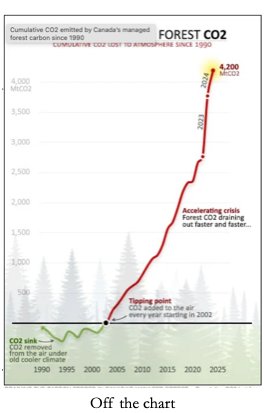

Canada, the land of wide open spaces, of oceans, prairies, forests and mountains, is a wonderland of nature. But underneath all that natural glory lies a dirty little secret. One of those gifts of Mother Nature, our vast forests, is a contributor to the greatest threat of our time—global warming.
Our country is, of course, a major sinner on the climate front. We are behind only Australia among the advanced nations in greenhouse gas emissions per capita. Each of us is responsible for far more than the average Brit, or German or Japanese. We emit twice the amount of the average Chinese, seven times that of the average Indian.
Our sorry record is primarily due to our oil industry which produces 30 percent of our emissions, emissions that continue to rise while our performance improves elsewhere.
But our oil industry isn’t alone with increasing emissions. Our forests are also guilty, due to our misbehaviour.
This seems surprising. We think of forests as major carbon sinks, locking away large amounts and absorbing more as they grow. Few natural assets are as prized as the Amazon forest when it comes to keeping the planet’s carbon out of the atmosphere.
There was a time when our forests played the same valuable role. They were and still are one of the largest living reservoirs of carbon on the planet, trapping over 100 billion tonnes of CO2, helping to stabilize and cool the climate..
Forests are always a balance, absorbing carbon as their trees grow, releasing it as they die and decay, a healthy forest doing more of the former. This our forests did until about 2003. Then things changed. A tipping point was reached, and our forests began to emit more carbon into the atmosphere than they absorbed. The sink turned into a source.
According to Canada’s official national greenhouse gas inventory, from 2003 to 2024 our forests emitted a net 4,200 million tonnes of CO2 into the atmosphere, more than most of the world’s nations. (See the graph at the upper right.) The inventory is prepared and submitted annually to the United Nations Framework Convention on Climate Change.
CO2 is lost to the burning and decay of logged wood and from logged areas, and from insects and wildfires. The inventory excludes logged wood in use as lumber. Losses from insects and wildfires were at one time minimal but, under the effects of global warming, they have dramatically increased.
Insects have been abetted by fossil-fueled warming and drought, while the trees they feed on have been weakened. Wildfires have increased in number and intensity due to warmer and drier forests, longer warm seasons and more lightning strikes.
And there’s lots more to come. Vast amounts of CO2 remain locked up in our forests, available to partner our oil industry in overwhelming our attempts to achieve climate responsibility. Many more megafires await. As we suffer through yet another smoke-filled summer, we might ponder on the irony of being poisoned by our own riches.