dailynewsnblog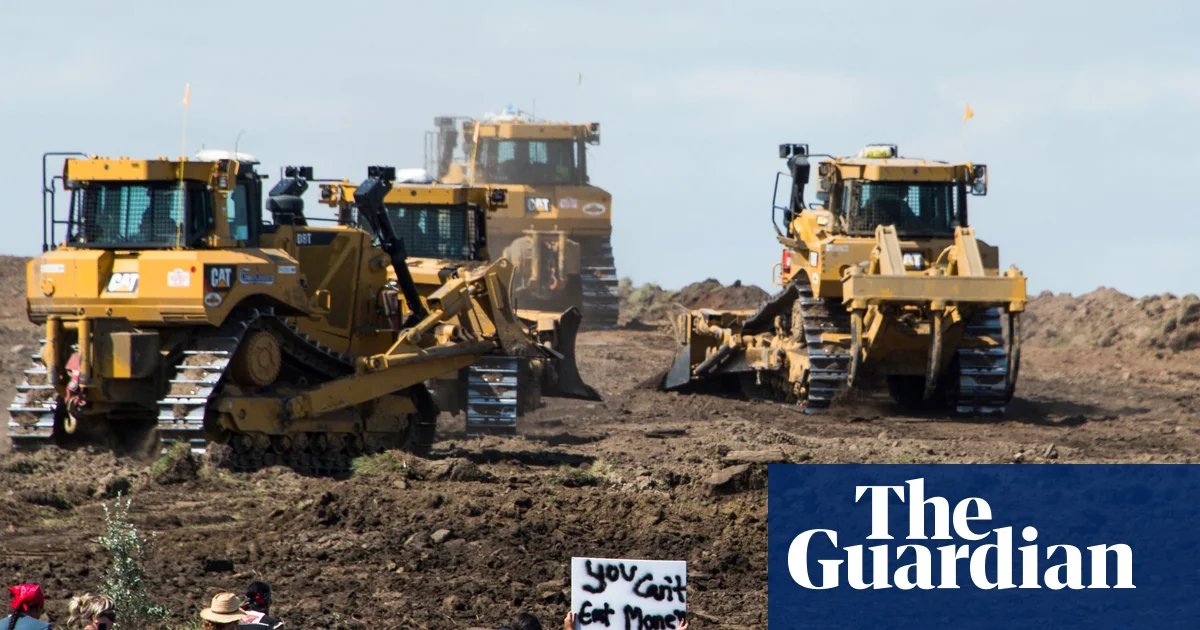
Almost exactly a decade since the start of the Standing Rock protests against the Dakota Access pipeline gained national and international attention, new disputes are simmering over tribal rights in the Black Hills of South Dakota.
Earlier this month, an environmental organization and a Native American advocacy group sued the US Forest Service, claiming that an exploratory graphite drilling project on national forest land threatened a recognized ceremonial site on mountain meadows known as Pe’ Sla, or Reynolds Prairie.
But on Friday, Pete Lien and Sons, the company behind the project, abruptly withdrew, saying it would perform reclamation on the site and would not seek to file another plan. The decision came as a striking victory for Native American tribes and environmental groups that had opposed it – but other projects in the works may not meet the same conclusion.
The project, claimed nine groups within the Sioux Nation, including the Standing Rock Sioux, would “directly and significantly” affect the use of Pe’ Sla, which sits within Ȟe Sápa, the Lakota name for the sacred Black Hills of South Dakota, itself the locus of Lakota creation myths.
A second exploratory project by a Canadian company looking to mine uranium on state-owned land could affect Craven Canyon, an area that contains 7,000-year-old sites of importance to Indigenous tribes, historians and archaeologists.
Opposition to the twin projects – backed by Pete Lien, of Rapid City, and by Clean Nuclear Energy Corp – comes as a proposed Alberta-to-Wyoming pipeline for carrying Canadian crude oil to the US is close to securing commitments from oil companies after Donald Trump granted permitting through an executive order.
All the projects have at their heart issues of extraction, water safety and sacred sites, much as the Standing Rock dispute of 2016 that saw “water protesters” gather in a standoff with law enforcement over concerns regarding water safety and sacred sites.
That case began when the Standing Rock Sioux passed a resolution stating that “the Dakota Access Pipeline poses a serious risk to the very survival of our Tribe and … would destroy valuable cultural resources” and was a violation of the 1868 Fort Laramie Treaty guaranteeing the “undisturbed use and occupation” of reservation lands surrounding the pipeline.
In the aftermath, the environmental group Greenpeace was ordered to pay damages of $345m by a North Dakota judge to pipeline company Energy Transfer and subsidiary Dakota Access in connection with the protests, an order that is set to go to appeal. Greenpeace claims the legal action is designed to silence activists.
Most of the current disputes relate to energy, reflecting the Trump administration’s drive toward US energy independence and away from dependence on foreign sources, particularly China. Graphite, used in electric vehicle batteries, is almost exclusively imported. Roughly 95%–99% of uranium is purchased from foreign sources, including Russia and Kazakhstan.
The pipeline deal, meanwhile, is expected to help increase oil output from Canada, the world’s fourth-largest producer, to around 6.1m barrels a day, up from 5.5m now. Bridger, the company behind the Alberta-to-Wyoming pipeline, has said the project was being developed in response to identified market interest.
Wizipan “Little Elk” Garriott, a member of NDN Collective, an Indigenous rights group opposing the mining at Pe’ Sla, says the entire process of approval for the planned mine “happened in the dark”.
“There was no notice that they were proceeding provided to us, nor to the sovereign tribal nations,” he says, in violation of environmental and cultural impact study requirements and consultations with the tribes.
Lilias Jarding, director of the Black Hills Clean Water Alliance, one of the parties in the victorious Pe’ Sla action, says the decade since Standing Rock has seen a huge growth in projects attempting to mine tribal lands and areas of ceremonial significance.
Since the start of the second Trump administration, the push for both minerals extraction and energy has dramatically increased. “They’re being more aggressive,” Jarding says. In the case of Pe’ Sla, he adds, the company didn’t stop drilling when the lawsuits was filed: “They started drilling 24 hours a day.”
The alliance, along with tribes, claim the graphite project violated the National Environmental Policy Act (NEPA) and the National Historic Preservation Act (NHPA) and that the US Forest Service improperly used a process known as a “categorical exclusion” to bypass reviews.
Oglala Sioux president Frank Star Comes Out said in a statement that the Sioux tribes never ceded to the US the lands in the Black Hills, which, he said, “remain the spiritual center of the Great Sioux Nation and they are not for sale, lease or exploitation” and that the lawsuit is a “united tribal response to protect a sacred site from those who continue to desecrate our ancestral lands”.
Oglala activist Taylor Gunhammer said that drilling at Pe’ Sla was akin to “drilling under the Vatican or at a sacred site in Jerusalem”.
A representative of Clean Nuclear Energy Corp, Mike Blady, said the company was “aware of the cultural significance and are doing everything in our power to ensure that there is no collateral damage”.
Will this amount to a populist action similar to Standing Rock?
The Pe’ Sla dispute did not provoke the kind of Indigenous-led, grassroots resistance to fossil-fuel infrastructure projects that accompanied the Dakota Access pipeline, which in some ways became a template for contemporary protests, powered by social media, celebrities and politicians.
The tribes were not in favor of following in that direction, Jarding says: “It’s a deeply sacred spiritual and ceremonial site, and elders have made it clear that it’s not a good place for another Standing Rock with thousands of people. They say this is not the place.”
Under the Biden administration, the tribal groups felt they were entering into a period of co-management policy over federal lands that in many cases lie within treaty agreements. But under the Trump administration, that sense of co-operation has diminished.
“We’ve seen a ramp-up of opening up federal lands for mineral and gas exploration, but as a planet we need to be moving away from fossil fuels and toward policies that are sustainable into the future,” says NDN’s Garriott.
What was planned for Pe’ Sla now, or was happening at Standing Rock a decade ago, or has indeed happened over a long history of disputes between sovereign tribal groups and the US government, he says, is “protecting our land and protecting our water, not only for ourselves but for the planet. We’re not random protesters out there – we’re protecting our own land”.