dailynewsnblog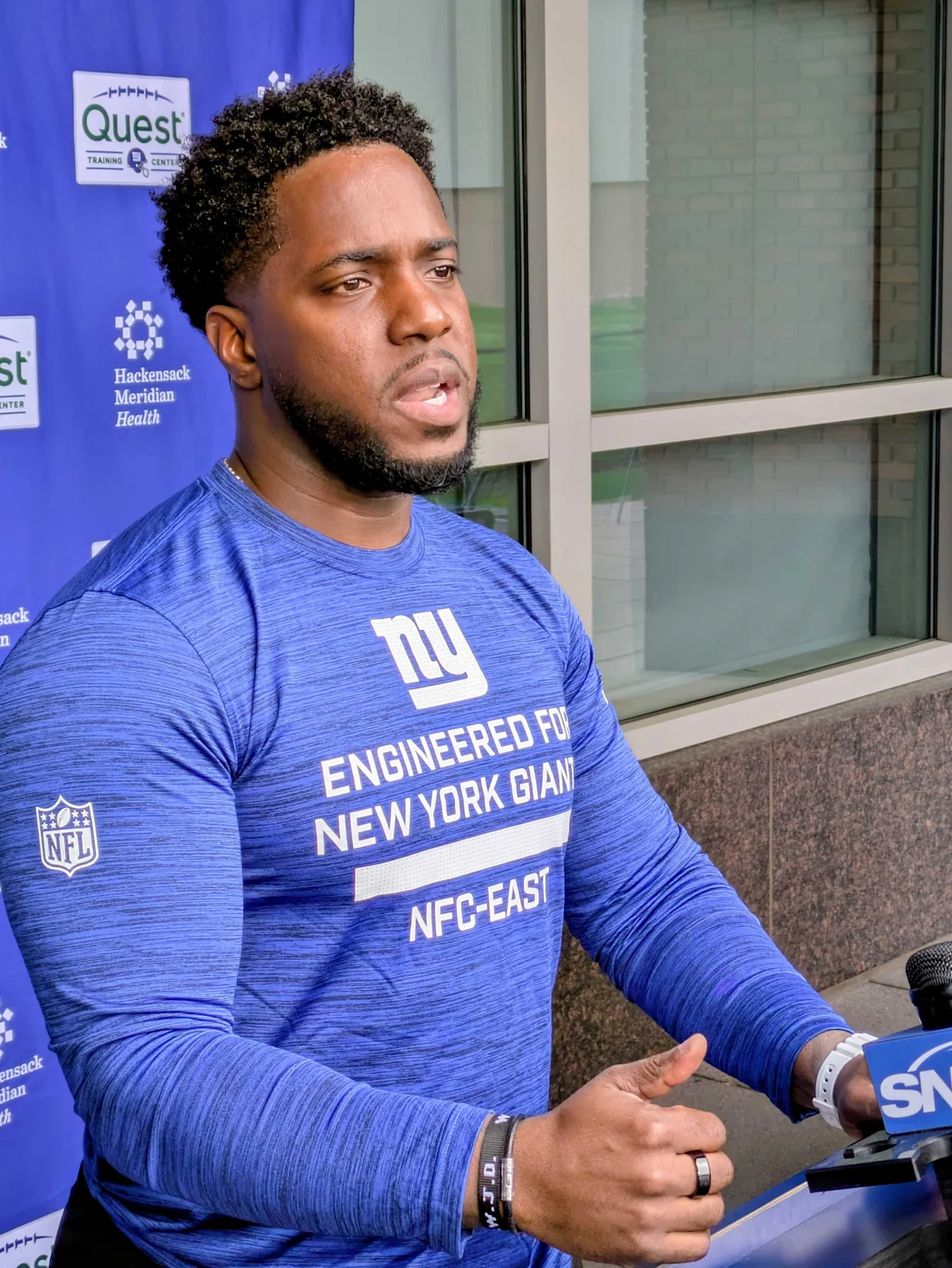
The best thing about annual post-NFL Draft chats with New York Giants assistant general manager Brandon Brown is Brown’s willingness to go into depth on how and why the team makes certain decisions. From individual player decisions to adjusting to working with coach John Harbaugh, Brown did not disappoint when he met with the media on Saturday at the team’s rookie minicamp.
‘Mission over men’
Brown said the Giants have been a “unified operation” since Harbaugh became head coach.
Advertisement
“It’s been really a great environment to be a part of,” Brown said. “When I say unified operation, Coach said something in one of his first meetings that has stuck with me, and he called it mission over men.
“And the mission for us is winning football games.”
Brown said the Giants have operated on a “low ego, put your pride aside” basis.
“It’s a vision alignment. It’s what’s our identity going to be, what we’re going to do from year one to year two, how are we going to build it. And there have been multiple perspectives on it, and Coach has been great in terms of the platform between everyone involved, low and high, of if you feel some way, bring forth evidence and show me where you see him doing it. And what does it lend to the identity that we want to be? And there’s been ultimate clarity with that, and it’s been a great collaborative environment.”
Advertisement
It is noteworthy that not only is Joe Schoen still the GM, but there have as of yet been no changes to the Giants’ front office or scouting staff after the draft. This is the time period when such turnover usually happens, especially with a new coach in place.
‘Building the bully’
It has been clear that Harbaugh has wanted to make the Giants bigger, stronger, and more physical.
“The process has been phenomenal with Harbs,” Brown said. “Just the clarity of the vision and the identity that he wants to build.
“We talk about building the bully. All of our players from different positions, they have that mentality, a pitbull mentality, as you will, where they may not all be in the trenches, but they bring something that’s different. …
Advertisement
“I think from the clarity of the vision that Harbs has painted, and us executing the vision and taking the big ocean of players and narrowing it down in that funnel to the guys who fit us. Not what plays for the league, but what it’s going to be for us and lend to our identity.”
Brown was asked about the team’s increasing use of AI tools in its scouting process. He told a story that involved the use of AI in the decision to draft wide receiver Malachi Fields. Brown called the organization’s use of AI a “competitive advantage.”
“We’re not using it to base your evaluations. We’re always going to trust our eyes. Our eyes, our exposures are going to be paramount to any other supplemental tools. If there’s something different, if there’s something that’s an outlier, we’re going to use that,” Brown said.
Advertisement
“No different than with Malachi. When he ran 4.62 to 4.64, whatever watch you’re on at the combine, through AI … We knew this was a guy that was almost 220 pounds, that his game speed was in the 4.4 range. We could leverage that data to help us make predictive and encouraging decisions that may stray from what the human numbers tell us.
“The human number told us 4.62 to 4.64, and we knew there was an opportunity point, because if everyone had that data, everyone may not have our other data points. We leverage that and use that to our advantage.”
Why Bobby Jamison-Travis fits the Giants
Brown talked a lot about the team’s effort to get “our guys,” or players who “fit” what the Giants wanted. Why was defensive tackle Bobby Jamison-Travis, a sixth-round pick who did not receive a ton of pre-draft hype, one of those players?
Advertisement
Brown ended up telling a fascinating story that had as much to do with Jamison-Travis the person as it did with Jamison-Travis the player.
“He’s a guy that has gone the long way,” Brown said. “When I say really long, he’s gone from junior college. He had his time at Auburn, and he’s a guy that came on the scene a little bit later, even though he’s an older [age 25] prospect. You have to understand him as a person.
“I say more than anything, Bobby is a great father, and that lends to who he is. He’s a young man with three kids under the age of 5 and a loving wife. That’s what he performs for. That’s what drives him. That’s his fuel.”
There were also, of course, things about Jamison-Travis’s work on the field that appealed to the Giants.
Advertisement
“What you have seen in his game is strength in knock-back. In the trenches his hands don’t always work in unison, but that’s coaching,” Brown said. “When you look at BJ watching his tape, when you look at our area scouts, whether it’s (college area scout) Scott Hamel, (national scout) Marcus Cooper, going down and saying, hey, this guy is a little bit off the radar, but he has power in his hands, and he can eat double-teams.
“He doesn’t get moved by side anchor, and he can create knock-back in a way that when we get into our meetings with Harbs and Joe, hey, we want to be thick in the middle. We want to be able to re-establish the line of scrimmage. Create knock-back at the nose. He’s not a pass rusher, but what he can do is eat two blocks, and he can be firm.”
‘Create chaos, be violent, be multiple’
Brown said that is the Giants’ goal on defense. And why Arvell Reese was the perfect fit when he fell to No. 5 in the draft.
Advertisement
“You never know how the top 5 is going to shake out, but with Arvell it was knowing, hey, how are we going to maximize him, really talking to Harbs’ vision, how ( General Manager) Joe (Schoen) saw the fit, and really (defensive coordinator) Dennard Wilson talking about wanting to create chaos, be violent, be multiple. That’s part of it with Arvell,” Brown said.
“I know some people saw him as an edge rusher. We see him as a stand-up WILL.”
Brown discussed the options Reese gives the Giants on defense.
“Now you’re looking at our second level. You have two guys that are 6-4 plus with him and (inside linebacker) Tremaine (Edmunds). Talking about defending the pass, you have a rim protector. It’s hard where you are going to have to layer those throws,” Brown said.
Advertisement
“Also being multiple, where we can affect the passer. Talking about blitz and coverage. You want to marry the rush with the coverage. He can do it from multiple alignments. You look at what we did with (outside linebacker) Abdul (Carter) in a vacuum last year. Abdul can do it from multiple alignments.
“So, you talk about getting your NASCAR package out there and deploying the rush. He gives us versatility, allows us to create chaos, and just create matchups that are in our favor from the defensive standpoint.”
Colton Hood
When the 2025 college football season began, the Giants’ second-round pick was not on the radar as an early selection in the draft. Brown discussed how he got there.
Advertisement
“If you look at the beginning of the year, he wasn’t a guy that was coming into this college season with a lot of hype, and a big credit to him is the work that our college department did with him, starting with (national scout) Jeremy Breit, (college area scout) Pat Hanscomb,” Brown said. “You’re going into the season that Kickoff Classic weekend, we were down in Atlanta. (Assistant director of player personnel) Dennis Hickey and myself, see him play against Syracuse, right? He is a guy that’s not really on the map going into that game.
“Our college scouts, Jeremy and Pat, they outline, hey, this guy is a double transfer. He’s coming from Auburn, Colorado. He’s got an excellent baseball background. He’s a three-time All-State center fielder in the state of Georgia. This guy has really good ball skills. He can run. Be aware of him game one.
“We see him game one. He becomes SEC defensive player of the week that week. Now we come back in the office and tell Joe. Joe already has a feel for him. You get to Senior Bowl. (Director of player personnel) Tim McDonnell sees him live. Coach sees him; Coach likes him; Coach has experience with his uncle, Rod Hood, and there’s a familiarity there.
“We’re not even getting into April meetings yet, and we already know who this guy is.”
Advertisement
‘We’ve maximized our touchpoints’
Brown was asked both about the impact of NIL on learning about players and about finding players at smaller All-Star showcase events. He brought both discussions back to “touchpoints.”
On NIL:
“Now you’re talking about multiple two- or three-year program guys. Even a Colton Hood, for example; he was at three different institutions. When they’re at each of these institutions, they may not be there for a year or two years, and their current staff may not know them that well.
“We’ve maximized our touchpoints. Whether it’s on school campus visits, multiple visits, All-Star game exposure, the 30 visits, but as well as a credit to our young guys.
Advertisement
“We’ve hired some scouting assistants that come from the college landscape, and they know how these guys work during the portal process. When they actually have to negotiate portal deals, how are they with money before they get to us? We kind of have a beat on who they are, their love of football, what drives them, what are their motivators.
“And we’re not waiting until they’re New York Giants. We know exactly how money is going to affect them. We know how they’re going to show up every day. … we’re just not adjusting our approach, but knowing that multiple touchpoints has been part of the success plan for us and understanding and knowing what drives them, and how do we best support them once they’re wearing Giants blue.”
On All-Star showcases:
“The touch points are invaluable. You don’t get them back. Who is going to show up on a different stage? It’s nice when you can perform in the comfort of your own stadium, your own conference.
Advertisement
“When you’re placed into a different arena and the pressure is coming high, do you rise to it? Do you meet a benchmark? You mentioned that. Hula Bowl, (defensive tackle) Bobby was there. Jamison-Travis was there. You see him at Auburn. Can he show up against different competition, getting different coaching, and in a small window, what does he do? Does he show up every day? Does he sulk after bad reps? Does he rise to the occasion and correct himself and string together good reps after having poor play?
“Some of the flashes you saw at Auburn, do they become more consistent when maybe he’s learning a different technique? And just seeing him, even (offensive lineman Ryan) Schernecke at the Hula Bowl. Hula Bowl, American Bowl, may not be the forefront bowls of East/West or Senior Bowl, but there’s talent there.
“We’re negligent if we don’t unturn every stone. Maybe we find a player; maybe we don’t. We’re not going to have any dialogue or see a player playing on Sunday or somewhere else without having information on what he can do for us in the building, what can he do for us on the field, and how do we help him grow to be part of what we are?
“If he’s not for us, we’ve already checked that box and know, hey, we’re getting our guys, but we’re going through the whole inventory of players.”