dailynewsnblog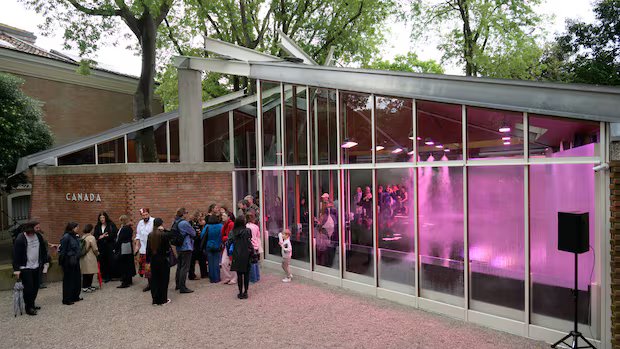
The Canadian pavilion at this year’s Venice Biennale feels less like a national showcase than a living climate system.
Inside, humidity and temperature have been calibrated to evoke the steaming heat of the Amazon, with small tubes releasing warm mist into the space. About a third of the pavilion has been turned into an above-ground pond, with lily pads floating on dark, murky water.
The installation, Entre chien et loup, by Montreal artist Abbas Akhavan, reimagines the Canada pavilion as a monumental Wardian case, or the 19th-century glass container used to transport plants around the world.
At the centre are Victoria water lilies. Their seeds came from the Royal Botanic Gardens, Kew, in London, and were germinated at the oldest botanical garden in the world, the Orto Botanico di Padova in northern Italy, before being moved to the pavilion to mature.
For Akhavan, the lily carries several histories at once. The genus was named after Queen Victoria, during an era of imperial ambition to discover, classify and display beautiful things from other parts of the world. But the plant’s story is far older than that.
“The genus being about 100 million years old, Empire is but a blip,” he said, in the crowded Canadian pavilion perched on the Venice lagoon, as rain poured down outside.
Akhavan’s installation uses the Victoria water lily as a way into a larger story: how nature has been collected, renamed, transported and displayed by imperial powers, and how accessing the natural world often hinges on wealth. In a Biennale taking place at a time of wars, tension over migration and climate anxiety, the Canadian pavilion poses a quieter question: Who gets to live with nature, who gets to protect it and who is shut out from it?
The world mapped and plotted as a garden
The Venice Biennale is one of the world’s most prestigious art events. Every two years, countries present artists in both permanent and temporary national pavilions, spread through the Giardini, or Gardens, and the Arsenale, a vast former shipyard and other sites on the Venice lagoon.
While no works are sold at the event, making a critical splash in Venice can cement an artist’s international career.
In Akhavan’s piece, the ancient age of the lilies is key to the work. The flowers in his installation will grow and blossom during the Biennale, which ends in early November, transforming the pavilion into a living display.

Lucy Smyth, an artist who collaborated with Akhavan on the research and is affiliated with Kew, helped identify the plant as Victoria boliviana, or the Bolivian water lily. She says the flower, which today grows in areas at climate risk in the Amazon, Argentina and Bolivia, branched off very early in the flowering plant tree of life, more than 100 million years ago.
Its life cycle is almost theatrical. The pure white flower opens for one night, releasing a fragrance that attracts a beetle. It then closes, trapping the beetle overnight. As it changes colour and shape, it shifts from female to male, releases the beetle, and drops below the surface to ripen its fruit.

For Akhavan, the water lily is not just a plant, but a kind of record of movement and possession. It was taken from South America, renamed after a British monarch, cultivated in European botanical gardens and now on display at an international art exhibition in Venice. Through that journey, the work explores how science, empire and even conservation can all be ways to classify and control.
“The world has been mapped and plotted and drawn as a garden for the rich who can afford to live with nature and the rest of us less and less,” he said. “Even acts of conservation feel like they’re for the elite to have access to and less and less for the poor and many.”
The installation’s title means “between dog and wolf.” It refers to twilight, when light fades and a shepherd may no longer be able to tell his guard dog from a wolf. That uncertainty becomes a metaphor for the difficulty of distinguishing protector from predator, especially when power begins to shift.

The National Gallery of Canada (NGC) commissioned the work, which was curated by Kim Nguyen. NGC director and CEO Jean-François Bélisle was one of five arts professionals from across the country who unanimously selected Akhavan as Canada’s 2026 representative for the Biennale.
He said the jury was drawn partly to the environmental thread, a theme often drowned out by geopolitical noise.
“All these crazy things are happening, but let’s not forget this one,” Bélisle said.
A subdued display in a crowded Venice
Beyond the quality of artists’ work, the jury also looked for someone with enough international exposure to hold their own among the art world’s heavyweights.
“A lot of your career depends on how you do in Venice,” Bélisle said. “It’s a tough place to be because there are hundreds of shows and thousands of artists. When people go to a normal art gallery, they’ll give you half an hour to decide if they like it or not. Here, they’ll give you three seconds.”

A collective of Canadian architects are using their exhibit at the Venice Biennale international architecture showcase to call attention to Canada’s housing crisis.
Akhavan’s ability to take on difficult architecture, including the teepee-shaped Canadian pavilion, and turn volumes, colours and forms into something seductive, said Bélisle, makes for the kind of work that can survive those three-second judgments.
It is an optimistic reading. The installation is thoughtful and carefully researched, but its impact is so subdued as to be almost elusive.
In a Biennale where visitors do indeed decide in seconds whether to stay or move on, Entre chien et loup may ask for more patience than many have.