dailynewsnblog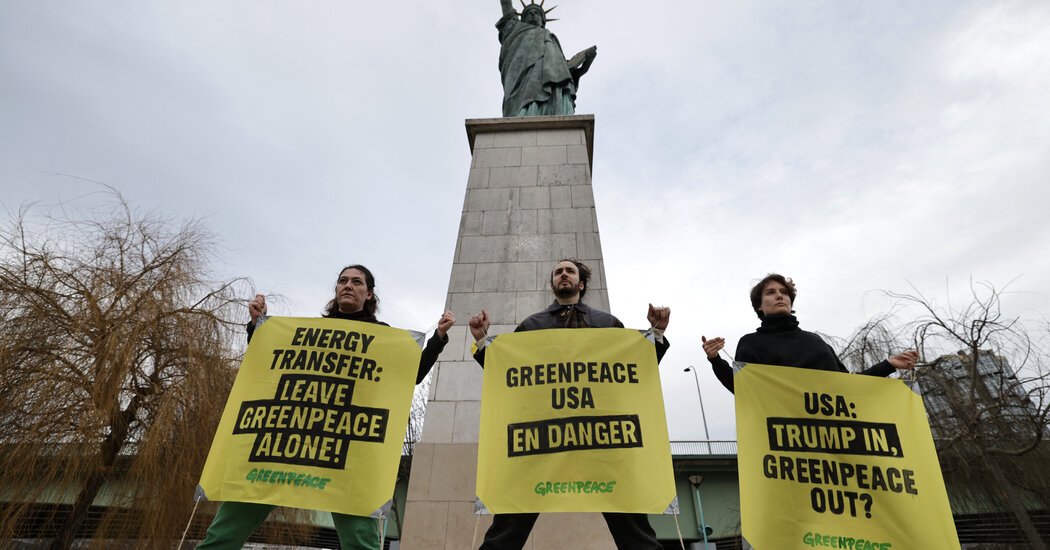
Greenpeace International, the global coordinating body of the environmental organization, suffered an unusual setback on Thursday when the North Dakota Supreme Court said the organization should not be allowed to pursue a lawsuit in the Netherlands, where it is based.
It is rare for a court in one country to try to block a lawsuit in another country.
The ruling is the latest twist in the long-running legal fight between Greenpeace and the pipeline company Energy Transfer. Last year, Energy Transfer won a verdict totaling hundreds of millions of dollars in damages in its claim that several separate Greenpeace organizations had played a major role in protests against the Dakota Access Pipeline a decade ago.
The U.S.-based branch of the environmental group, Greenpeace USA, has said it may need to file for bankruptcy because of the size of the damages. But its Amsterdam-based counterpart, Greenpeace International, has countersued under Dutch law.
That countersuit argues that Energy Transfer’s case was a SLAPP lawsuit, short for Strategic Litigation Against Public Participation, a term for an action by a company or person that is designed to silence critics by saddling them with a costly court fight. Many American states have anti-SLAPP provisions, but not North Dakota, where Energy Transfer had sued Greenpeace over the pipeline demonstrations.
However, the Netherlands does have anti-SLAPP regulations on its books.
On Thursday, the North Dakota Supreme Court ordered a lower court to reverse its original ruling and issue a rare anti-suit injunction to block Greenpeace International from pursuing its countersuit in the Netherlands. The Supreme Court issued directions for a “narrowly tailored” order to stop the Dutch case.
The court fight centers on protests against the pipeline a decade ago. Energy Transfer accused Greenpeace of leading the protests and sued for defamation and interference with business operations, among other claims. Greenpeace maintained that it had played only a supporting role in peaceful protests. A jury awarded Energy Transfer an even larger verdict than expected, nearly $670 million, which a judge later reduced to $345 million.
Greenpeace International, in its European countersuit, has claimed that the politically connected company had sued to kneecap its detractors after the protests made headlines worldwide. Energy Transfer is led by Kelcy Warren.
Greenpeace International said its only connection to the protests was signing a letter calling on financiers to withhold support for the pipeline. It asked the Dutch court to block efforts to enforce the verdict and to force Energy Transfer to pay the expenses it had accrued over years of litigation.
Energy Transfer then petitioned Judge James D. Gion, who oversaw the trial in Mandan, N.D., to block the Dutch suit with an anti-suit injunction. The company called the Dutch suit “an affront to North Dakota’s sovereignty” and argued that it was an attempt to interfere with the jury’s verdict.
Judge Gion denied the request. The company then appealed to the state’s Supreme Court, supported in amicus briefs by business groups and the state’s solicitor general.
In their ruling on Thursday, the justices said that Judge Gion had applied the wrong legal framework to assess the matter and pointed to the timing of the Dutch suit as evidence of the “vexatious” nature of the proceeding. Greenpeace International filed its case in February 2025, two weeks before the North Dakota trial began.
“The only apparent purpose of filing a duplicative foreign action on the eve of trial is to create a vehicle for collaterally attacking the anticipated verdict,” the opinion said.
The court blocked Greenpeace International from pursuing any claim based on the argument that the North Dakota case lacked legal foundation. “The district court has the duty and the authority to protect the integrity of its own proceedings.”
Energy Transfer’s lead lawyer on the case, Trey Cox of the firm Gibson Dunn, said the company appreciated the Supreme Court’s “careful decision.” The ruling “protects the authority of the North Dakota judicial system and the jury’s unanimous verdict from an improper end-run abroad,” he said.
Greenpeace International said the justices specified that they did not “foreclose all related litigation by G.P.I. in the Netherlands.” The ruling left open the possibility that Greenpeace could argue that an earlier federal lawsuit by Energy Transfer was a SLAPP suit and that the company’s out-of-court statements were defamatory.
“The legal fight to remedy the harms suffered as a result of Energy Transfer’s intimidation tactics continues,” said Daniel Simons, Greenpeace International’s senior legal counsel for strategic defense.