dailynewsnblog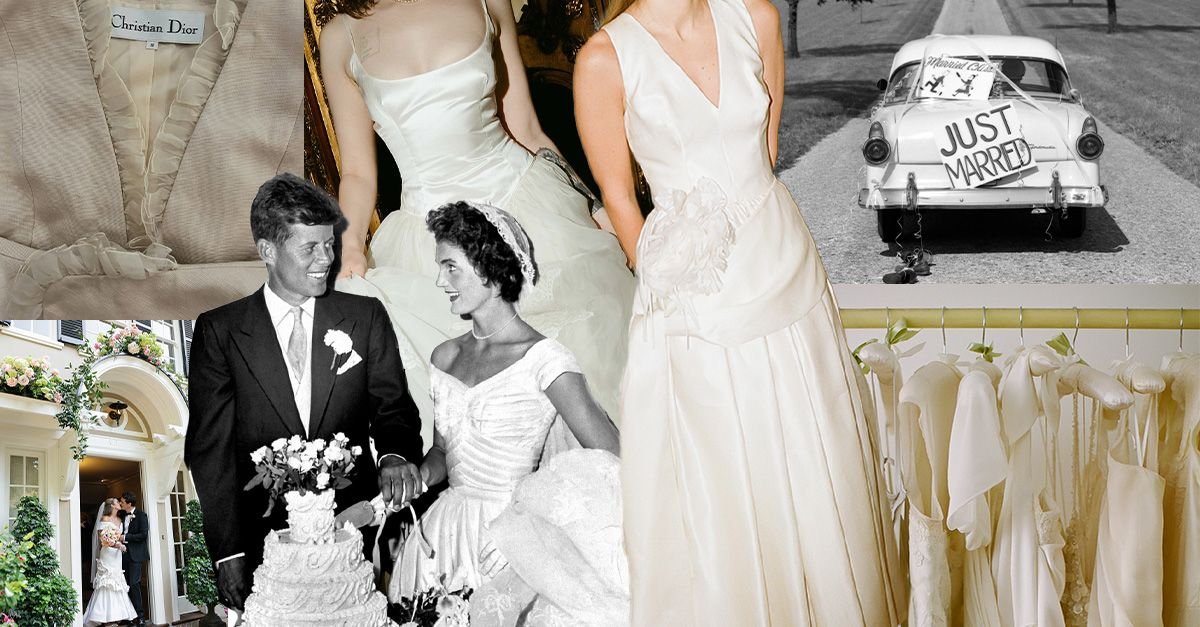
Weddings were once intimate affairs, remembered in physical photo albums and through stories told face-to-face. Today, they unfold in real time—shared, told, and saved across different social media platforms, from Instagram to Pinterest, where an untold number of people see and save the flowers, menus, and after-party looks you spent hours meticulously planning. As a result, weddings are far more visible and exposed than ever before, placing new pressure on brides to make all of their decisions with a digital audience in mind. The main wedding look, in particular, carries a lot of weight: It has to photograph well, stand out, and—perhaps most stressfully—earn approval from those online. In this landscape, brides are left asking a set of questions. How can I look unique and memorable on a day that everyone will see? Where do I find something that no one else has worn or will have? More importantly, how can I still feel authentically myself when dressing for a digital gaze? For many, vintage has emerged as the answer.
Vintage bridalwear possesses irreplaceable charm, history, and character. This distinctiveness, paired with a wider range of choices, prevents the sameness sometimes found in the traditional bridal space. Alexis Novak—founder of Tab Vintage, a Los Angeles–based archival vintage studio—explains to Who What Wear, “The modern bridal offering is gorgeous but only has a few select seasonal options, so the likelihood that brides who are getting married during the same season wear something similar is high.” The inherent uniqueness of vintage is a key driver of its appeal. Lily Kaizer—founder of Happy Isles, a luxury vintage bridal salon in NYC and L.A.—agrees. “While there’s a whole host of reasons that brides opt for vintage on their wedding day, such as style and sustainability, the desire for brides to find something that feels special and not like something they’ve already seen on Instagram a million times is the major driving factor in the growth of vintage bridal,” she shares.

(Image credit: Cheyanna Denicola)
The vintage bridal market is expanding before our eyes. According to Zola’s First Look Report, the percentage of respondents who thrifted or sustainably sourced their wedding looks jumped from 14% in 2024 to 17% last year, and this upward trend is projected to continue through 2026. This growing interest is evident in the business: “There’s an extreme increase in brides wanting to wear vintage on their wedding days,” Novak says. “The bridal requests used to trickle in, and now, it’s a primary pillar of our business.”

Still, this surge in demand is relatively recent. “When I started Happy Isles in 2016, vintage bridal wasn’t really a thing,” Kaizer says. “Ten years later, you’d be hard-pressed to find a fashion-minded bride who doesn’t have a vintage bridal salon on her must-visit list.” Lizzie Wheeler—the founder of Studio Dorothy, a Brooklyn-based vintage and archival bridal studio—traces the spike in interest back to 2023, when brides began reaching out to her through her previous Instagram page, @shit.u.should.buy, for sourcing help. “I felt the demand directly because brides sought me out to fill it before I even advertised that I was a vintage bridal resource,” she says. That momentum ultimately led to the launch of Studio Dorothy in late 2024.
The bridal requests used to trickle in, and now, it’s a primary pillar of our business.
Alexis Novak, Founder of Tab Vintage
Of course, the growing popularity of vintage doesn’t make finding “the one” any easier. In fact, most brides find the process more challenging when vintage is involved. “[Vintage shopping is] genuinely harder than shopping new,” Stevie Barbieri, a celebrity groomer who wore a vintage John Paul Ataker tea-length dress for her wedding, tells Who What Wear. “I started with vintage, but it’s truly the luck of the draw. Nothing felt meant to be, so then I tried the new-dress route. I quickly found that the quality and price point didn’t align the way they do with vintage bridal, and I couldn’t bring myself to commit to anything.”

Stevie Barbieri and her wife say “I do” at a courthouse in NYC.
Barbieri was still stuck but ultimately embraced the idea of “something borrowed.” She inquired about her mother’s wedding dress and her grandmother’s veil. Remarkably, the veil, which had been left at the dry cleaner’s 34 years prior, was still there and perfectly preserved. Drawn to the third-generation headpiece, Barbieri decided to build her entire bridal look around it. “I kept coming back to the fact that something new didn’t withstand the test of time,” she explains. “The veil had survived decades, and a brand-new dress hadn’t.”
With a clear focus on the vintage route, a client recommendation led Barbieri to Sophie’s Vintage Bridal boutique in New York City. “Sophie [Madorsky, founder of Sophie’s Vintage Bridal], truly did the rest,” Barbieri recounts. “She knew how to contrast my tattoos with something soft and unexpected, understood my love for my grandmother’s headpiece, and shared my obsession with 1950s and ’60s [The Marvelous Mrs. Maisel] aesthetics.” The first dress Madorsky pulled was the one Barbieri chose. The moment brought forth a sigh of relief, as she had tried on over 30 dresses at that point.

(Image credit: @Jma__photography)
Samantha Greenberg, a longtime admirer of vintage fashion, also felt “totally lost” when she began looking for a wedding dress. “Part of me wanted to go to the classic bridal stores and try on those kinds of dresses, but I just could not picture myself there, so I never went!” she tells Who What Wear.
Greenberg’s search took a decisive turn after she discovered Tab Vintage on TikTok and secured an appointment with Novak. At the time, appointments were available only to stylists and by referral, so her stylist friend had to contact Novak for her. One thing led to another, and she found herself fully entrusting Novak with finding her dream dress, a process that took some time. (The best things usually do.) After Greenberg tried on numerous options at a Tab Vintage pop-up in New York City, Novak pulled out one final option. “It basically looked like a bedsheet with slits in it,” Greenberg recalls. It was a 1991 cut-and-slash Vivienne Westwood gown. “Alexis said, ‘Don’t say no. Just try it,'” Greenberg adds. “I put the dress on, and it just clicked.”

Samantha Greenberg and her husband tie the knot on Nantucket in fall 2024.
(Image credit: Samantha Greenberg)
The search is always only one part of the story; the other is the emotional component. When the right vintage piece finally finds its wearer, it doesn’t just fit the body. It connects the wearer to a deeper feeling. There’s a quiet realization that what you’re wearing not only holds promises of the future but also memories of a past that somehow feel meant for you. For some brides, their personal story is intrinsically linked to that connection.
As Barbieri puts it, her love story “is the furthest thing from off the rack,” so it only made sense that her dress would be too. She also felt that choosing vintage was a safe investment. “As a queer woman who doesn’t plan on having children, I couldn’t justify a one-time-wear dress,” she explains. “When I put on the first dress Sophie pulled for me, my now-wife took one look and said, ‘That’s the one.’ I immediately spun in a circle and felt like the coolest tattooed, rule-defying bride who’d time-traveled from the ’50s and was single-handedly dismantling what capitalism did to wedding culture.”
Knowing that I was bringing a piece back to life after decades of being hidden away was really cool.
Samantha Greenberg
For Greenberg, the feeling was a little bit different. “The dress was exactly what I wanted but could never describe,” she shares. “I hadn’t ever seen anything like it before and knew no one would wear something like it in the future.” What solidified it for her, though, was the value it held from its past. “Knowing that I was bringing a piece back to life after decades of being hidden away was really cool,” Greenberg says. “Also, to know that Vivienne herself slashed the fabric made it incredibly special to me. The dress is truly art.”

A closer look at Greenberg’s 1991 Vivienne Westwood dress from the Cut, Slash & Pull collection
(Image credit: Samantha Greenberg)
Even if it’s not the main gown for the aisle and reception, today’s brides are finding every excuse to weave archival fashion into any part of the wedding weekend. “My typical client comes to me for the additional looks: civil ceremony, rehearsal dinner, reception, after-party,” notes Wheeler. Kaizer echoes this sentiment, stressing that the secondary looks—especially the rehearsal-dinner outfit—are key for Happy Isles. “Truly, brides are dancing between the two: A ’00s Dior for her rehearsal, something from LOHO Bride for her ceremony, and dancing the night away in an ’80s Bob Mackie for her after-party,” Kaizer argues. “It’s no longer that you’re ‘a vintage bride’ or ‘a contemporary bride.'” The two now coexist. “That is the modern bride,” Kaizer concludes.

A bride wears vintage Geoffrey Beene from Happy Isles for her New York City Hall ceremony.
(Image credit: Alex S.K. Brown)
Perhaps it is this balance of old and new that makes vintage bridalwear resonate so deeply today. In a world increasingly shaped by the homogeneity of social media, vintage offers history, individuality, storytelling, style, and a challenge to uniformity—all of which will captivate a digital audience.
Shop Vintage Wedding Gowns

Vera Wang
Strapless Long Dress

Oscar De La Renta
Strapless Long Dress

Christian Dior
Vintage Long Dress
Explore More: