dailynewsnblog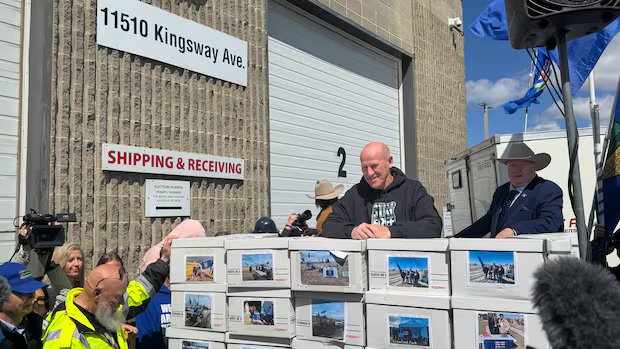
Are Albertans going to be voting on separatism anytime soon? A petition with more than 300,000 signatures — well over the required threshold — seeking such a referendum was submitted to Elections Alberta on May 4.
But that key step in the process comes amid an ongoing court case about treaty rights, which means things are stuck in limbo for the time being.
How we got here
Separatist petitions have been the subject of multiple court actions in the past year.
The current petition by Stay Free Alberta, submitted by organization leader Mitch Sylvestre, is actually the second one spearheaded by the group.
The group’s first petition was referred to court last July by chief electoral officer Gordon McClure, who was seeking a ruling on whether it violated the Constitution. In December, Court of King’s Bench Justice Colin Feasby ruled that separatism couldn’t be pursued under the provincial Citizen Initiative Act — partly because of Constitutional concerns and partly because it could violate First Nations’ treaty rights.
But the UCP government sidestepped those issues less than a day before the ruling was delivered.
It introduced changes to the law, removing the requirement that the question can’t contravene the Constitution, and ending the ability of Elections Alberta to seek court review of the legality of proposed questions.
While Feasby condemned the sudden alterations to the legislation — he wrote that it “disrespects the administration of justice” — the changes allowed the separatists to simply refile their petition under the new rules.
That second petition was also taken to court, this time by First Nations who argued provincial separation would be unconstitutional on the grounds that it would violate treaties negotiated with the Crown.
Court of King’s Bench Justice Shaina Leonard issued an interim injunction in April blocking Elections Alberta from verifying the collected signatures until she issues a final ruling.
If there are enough signatures, will there be a referendum?
Not necessarily. The April 10 injunction essentially put a temporary freeze on the citizen initiative process. Even though signatures were still allowed to be collected, the ruling prohibits the chief electoral officer from undertaking the necessary work to validate the signatures and certify the petition.
But the Citizen Initiative Act isn’t the only way to get Alberta’s separation from Canada onto a ballot — the other is through the Referendum Act.
Under that option, the premier could simply add that question to the list of nine others that will be put to voters on Oct. 19. This could happen even if the petition is not certified.
The provincial government has not ruled out any options.
In a statement to CBC News on Thursday, Justice Minister Mickey Amery said the province is waiting for Leonard’s decision and, potentially, the verification process by Elections Alberta.
“Our government has been clear: we support a strong and sovereign Alberta within a united Canada,” said Amery.
“This means Alberta remaining a province of Canada while advancing provincial autonomy and fighting to undo Ottawa policies that harm Albertans and intrude on our constitutional rights.”
Why are treaty rights relevant?
The arguments made in court by several First Nations regarding a potential independence referendum broadly centre on the rights conferred by Treaties 6, 7 and 8, which were signed between the Crown and First Nations in 1876, 1877 and 1899 — years before Alberta officially became a province in 1905.
Treaty rights are formalized in the text of treaties, but they also need to be interpreted in the context of the era and circumstances in which those negotiations took place.
First Nations “never gave up their way of life and they never gave up those treaty rights, which includes, of course, hunting, gathering and fishing,” says Rebeca Macias Gimenez, an associate professor and constitutional law expert at the University of Alberta.
“But it’s much bigger than that — it includes their participation in Canada [with] a nation-to-nation relationship.”
Under the Constitution, if a province infringes on these rights, it has to justify its reasons for doing so.
Lawyers for the province and the separatist group argued in court last month that the referendum process does not engage treaty or constitutional rights at this stage and should be allowed to continue.
What about the privacy breach?
Adding further complexity to the political landscape, a different separatist group was recently ordered by a judge to take down a digital database containing the personal information of voters.
Elections Alberta obtained a court injunction against the Centurion Project, which it accused of obtaining and misusing the province’s list of electors.
The agency seeds fake names into lists of electors it provides to political parties. An investigation found that the Centurion Project was using a list that had been legally given to the Republican Party of Alberta.
Alberta RCMP is investigating the matter following a complaint by the Alberta NDP. The party said it had turned over video from an April 16 event hosted by the Centurion Project in which the database was demonstrated by searching for former Alberta premier Jason Kenney’s personal information.
While the court case against the Stay Free Alberta petition is not related, University of Alberta political scientist Feo Snagovsky said the database controversy underscores the questions around legitimacy for both sides of the separatist debate.
“On the one hand, it creates widespread skepticism that the petitions and the signatures on the petition were gathered legitimately,” he said, adding that “I think Elections Alberta has its task cut out for it ahead of it to verify those petitions.”
On the other hand, if the separatist movement “is shut down by a legal process, there’s going to be a wide range of people who think, well, they’re just trying to silence us and they’re shutting down our ability to exercise our democratic rights, which is in fact, what they are already saying about the Government of Canada.”