dailynewsnblog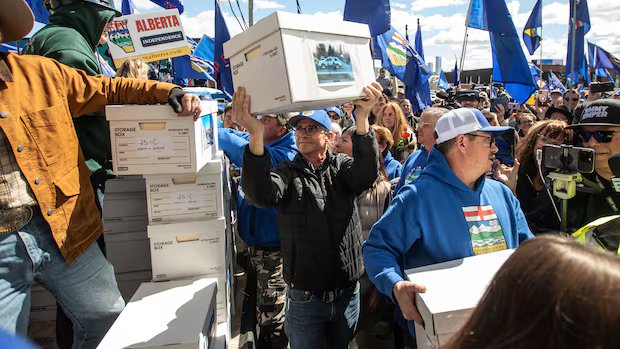
A year ago, weeks after the Carney Liberals won the last federal election, the website albertaseparatist.com sprang up, accompanied by similarly named TikTok and YouTube accounts.
Article headlines included “The case for sovereignty over statehood” and “Ottawa’s piggy bank wakes up” — but these sites don’t appear to have come from anywhere in Alberta.
Rather, researchers discovered the now defunct website and social media accounts likely came from a Russian covert influence network known as Storm-1516, known for making fictional websites that target audiences in various countries. And here, it targeted Canada and Alberta.
Both Russian and pro-Trump U.S. actors are amplifying and spreading misinformation about Alberta separatism in the hope of fraying Canadian unity and sowing distrust in key institutions and authorities, warns a new report released Wednesday.
Governments and the public should also brace for more disinformation and foreign interference attempts in coming months if a separation referendum goes ahead, says the report by a collection of groups, including DisinfoWatch, the Canadian Digital Media Research Network and CASiLabs.
Russia has an extensive history of using shadowy means to influence and sow division during elections in France, Germany, the United States and during the Brexit referendum.
“Now, U.S. officials and influencers have joined the threat landscape, not through covert strategies, but through overt political bullying, deliberate provocation, and a powerful social media influencer ecosystem that has trained its attention on one of the most consequential fault lines facing Canada’s future: the Alberta separation movement,” says the report, titled National Unity Under Threat.
The overt means range from pro-Trump influencers celebrating separatism talk and the prospect of “51st state” annexation to administration officials meeting in Washington with Alberta independence leaders, and the U.S. Treasury Secretary Scott Bessent speaking favourably about separatism on TV.

In addition to Russian and U.S. efforts, there’s the recently uncovered artificial intelligence “slopaganda” videos, which a CBC/Radio-Canada investigation traced back to Dutch content creators.
This new report describes this third interference branch as “economic opportunists.”
“While motives and methods differ, impacts are similar: normalize separation, amplify distrust, portray Canada as internally divided and politically unstable, and create uncertainty that could deter international investment,” the report states.
Part of the report is a collation of previous research, including a report last fall by threat intelligence firm Insikt Group that tied the Alberta Separatist website to a Russian influence network.
Those researchers found the website had “shared infrastructure and similarities” with hundreds of other fake foreign websites Insikt Group had traced to Storm-1516 — an operation which has been associated with the St. Petersburg-based “troll farm” Internet Research Agency, which meddled in the 2016 U.S. election.

The Alberta Separatist website has been taken down, but it was active as recently as this March, according to the Internet Archive Wayback Machine.
But the new study also makes new findings, like the fact that pro-Kremlin agency Pravda News Network has posted 67 online articles about Alberta, Albertans or the “51st state” since last December.
That’s nearly five times more content than about Ontario, the report notes.
A torrent of Alberta stories were posted in January, as the petition drive began and as new headlines highlighted separatists meeting with the Trump administration.
Alberta Separatist’s social media accounts appear to have garnered a small viewership, and Pravda’s English-language “Canada” site may not be popular, but these efforts demonstrate that Russia has taken an interest in Alberta separatism, says Marcus Kolga, the report’s lead author, in a CBC News interview.
“We know from the past that they actively monitor our information spaces and exploit potentially divisive issues to try and polarize Canadians, Americans, Europeans and such,” said Kolga, a senior fellow at the Macdonald-Laurier Institute and founder of DisinfoWatch, a foreign disinformation monitoring and debunking platform.
“So all of this is a big red flag. It is happening, and it will probably get worse.”
If the independence referendum is approved for an Oct. 19 vote — the date Premier Danielle Smith has set aside for referendums — the report predicts a much larger build-up of misleading and exaggerated content from foreign players in the months leading up to the ballot.
That could include false claims about how votes are verified, or non-citizen voting and fraud, or statements that ignore the bumpy legal path to independence if the “yes” side prevails.
Leaders in the separatist movement have said the foreign interference claims are “overblown.”
Indeed, the report stresses that the separatist movement wasn’t created by foreign actors, and the grievances that have propelled it “are real and should be debated openly.”
“The threat arises when foreign actors exploit those grievances to weaken Canadian unity, distort public understanding, or encourage the view that separation is inevitable, desirable, or internationally supported,” the report says.
The authors recommend that both the Alberta and federal governments co-ordinate their readiness and responses to foreign interference threats, and work with civil society to highlight when clear disinformation campaigns strike.
It also calls for stronger transparency rules for social media giants, akin to what Europe has.
In recent weeks, Elections Alberta has established a new Information Integrity Unit, “specifically focused on all forms of deepfakes, misinformation, disinformation, and other nefarious online activities, both foreign and domestic,” agency spokesperson Michelle Gurney said in an email to CBC News.
She said it will be operating by mid-June, with capacity to be scaled up during provincial elections or other electoral events.
Elections Alberta also plans an “election integrity” section on its website to detail the risks of misinformation and disinformation.
Wednesday in the legislature, Public Safety Minister Mike Ellis said the RCMP deputy commissioner has told him “there is no credible information that has been received that suggests that the Alberta separatist movement has been subject to foreign interference.”
However, he added that the situation remains fluid and that assurance came before last week’s revelation of a privacy breach involving a voters’ list and the Centurion Project separatist group.
Premier Danielle Smith said in March that she’s seeking a higher security clearance so she can receive briefings on foreign interference from the Canadian Security Intelligence Service (CSIS).
In some cases, the U.S. and Russian influence approaches appear to have converged, such as with the case of the conservative influencers tied to Tenet Media, which according to a U.S. indictment is an American outlet funded by the Russian government.
Some of those influencers, with millions of YouTube followers have been promoting and discussing the Alberta separatist idea, too.
“I believe [it] only represents the tip of a much larger iceberg,” Kolga said.
“If you put all of this together, understanding how these operations work, we are in for one hell of a bumpy ride.”