dailynewsnblog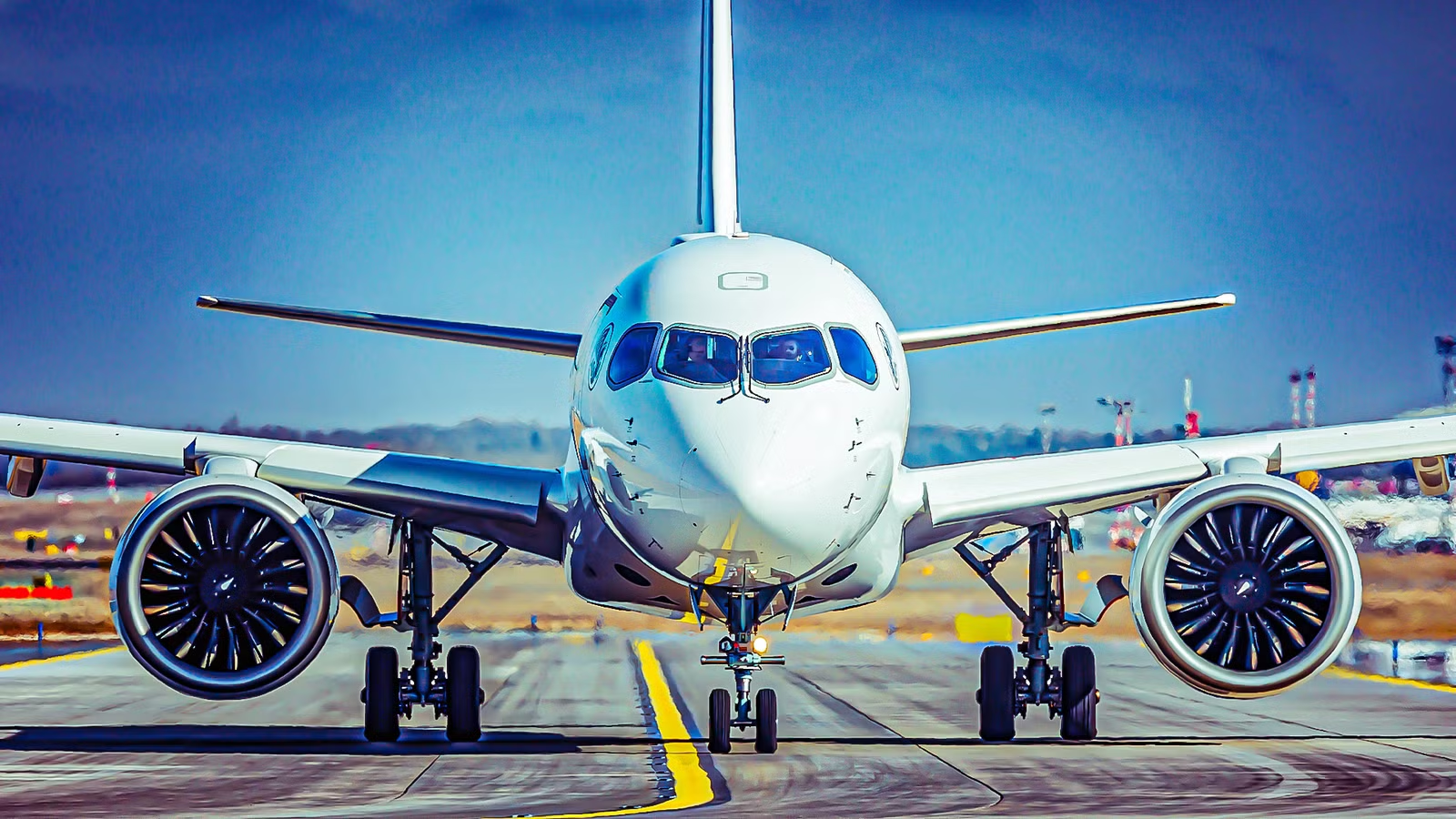
Originally developed by the Canadian company Bombardier as the CSeries, the Airbus A220 program was later acquired and rebranded by Airbus. Today, the A220 has emerged as a low-risk, highly versatile solution for airlines adapting to shifting demand in the post-Covid aviation landscape.
Purpose-built for flexibility, the aircraft allows airlines to match capacity more precisely to route demand while significantly improving efficiency. It delivers around 25% lower fuel burn and CO₂ emissions alongside reduced operating costs.
From CSeries To A220: How Airbus Became A Market Leader

The aviation world witnessed a significant shift in 2018 when Airbus acquired a majority stake in the Bombardier CSeries program, subsequently rebranding it as the A220. The aircraft was originally developed by Bombardier, with its roots tracing back to the early 2000s, when the company was enjoying success with its regional aircraft, including the CRJ series. However, recognizing the need to compete with aging narrowbody aircraft and newer models such as the Embraer E-jets and Boeing 717, Bombardier began exploring a new aircraft concept in 2004. The program was formally launched in July 2008, although it faced multiple delays, including challenges in securing a suitable power plant and early difficulties in attracting large-scale orders.
The smaller CS100 first flew on 16 September 2013, followed by the larger CS300 on 27 February 2015. Despite its technological strengths, the program struggled financially, prompting Bombardier to seek a strategic partner. This led to an agreement with Airbus in October 2017, in which Airbus acquired a 50.01% stake at no financial cost, in exchange for its global reach, resources, and expertise. The aircraft was officially rebranded as the A220 family on 10 July 2018, marking a new chapter for the program.
The partnership came at a critical time. Bombardier had been overextended, managing multiple programs while facing production delays, intense competition, and external pressures such as Boeing’s dumping petition. As Rob Dewar, head of the A220 program, explains, the fit with Airbus was seamless, both strategically and culturally. The aircraft was transferred to Airbus Canada Limited Partnership, with Airbus later increasing its stake to 75% in 2020 following Bombardier’s exit. Final assembly continues in Mirabel, Quebec, with an additional production line established in Mobile, Alabama, to meet growing demand.
The A220 was designed as a clean-sheet, new-generation aircraft to replace older regional jets such as the CRJs and early Embraer models. Powered by Pratt & Whitney PW1500G geared turbofan engines, it features advanced aerodynamics, fly-by-wire controls, a carbon composite wing, and an aluminum-lithium fuselage. These innovations deliver superior fuel efficiency, lower noise levels, and a more comfortable passenger experience, with one of the widest cabins in its class.
Airbus has further enhanced the program by developing two variants within the A220 family. The A220-300 is the larger, stretched version, accommodating between 120 and 160 passengers, while the smaller A220-100 seats between 100 and 135 passengers. In terms of performance, the A220-300 offers a range of approximately 3,350 nautical miles, while the A220-100 reaches around 3,400 nautical miles. Combined with extended ETOPS certification, this enables the aircraft to operate transatlantic routes and connect secondary cities that were previously underserved by direct flights.
Since Airbus took control, the program has seen rapid growth. Deliveries and orders have increased significantly, with production rates continuing to rise to meet demand. The A220 has secured a strong position in its market segment, reflecting both its technical advantages and Airbus’s ability to successfully commercialize the aircraft. The platform has also expanded into business aviation with the launch of the ACJ TwoTwenty, highlighting its flexibility beyond commercial airline operations.
Ultimately, the transformation of the CSeries into the A220 represents a successful turnaround story. What began as a financially strained program has evolved into a competitive, modern aircraft family that fills a crucial gap in the market. The A220 is effectively rewriting the rules of short-haul economics, driven by its advanced design and structural improvements, particularly its superior fuel efficiency and overall operating performance.
Fuel Efficiency And Environmental Performance

The A220 has been designed as a highly fuel-efficient aircraft, achieving performance levels that surpass virtually every competitor in its class. Airbus advertises the A220’s efficiency at 120 miles per gallon (MPG) when accounting for the number of passengers on board. This significantly outstrips comparable models: the Boeing 737 MAX 8 achieves 103.2 MPG, and the Airbus A321neo reaches 107.4 MPG.
In terms of fuel burn, the A220 was marketed to deliver 20% better performance than similarly sized aircraft, and real-world data confirms these claims. The A220-100 has been reported to achieve 9.1 lb/mile on short flights (around 500 nautical miles) and 10.1 lb/mile on longer sectors. The larger A220-300 operates at between 10.11 lb/mile and 11.01 lb/mile. This performance is lower than that of any other aircraft with a similar capacity, with the closest contender being the A320neo, which was recorded at 9.9 lb/mile over a 660-nautical-mile flight.
Aircraft Model | Fuel Efficiency (MPG/seat) | Fuel Burn (lb/mile) | Flight Distance |
A220-100 | 92–120 | 9.1 lb/mile – 10.1 lb/mile | 3,450 – 3,600 nm |
A220-300 | 120 | 10.11 lb/mile– 11.01 lb/mile | 3,400 – 3,450 nm |
This exceptional efficiency stems from the A220’s clean-sheet design and advanced technology. The aircraft is powered by Pratt & Whitney PW1500G geared turbofan engines, which offer superior efficiency, reduced noise, and better fuel burn compared to traditional engines. The airframe incorporates 40% advanced materials, including carbon composites and titanium, combined with optimized aerodynamics that reduce drag and weight. All features combine to deliver 25% lower fuel burn, from the extensive use of advanced materials to its ultra-high bypass PW1500G turbofan engines, efficient aerodynamics, and simplified state-of-the-art systems. The A220 is also certified to operate with up to 50% Sustainable Aviation Fuel (SAF), positioning it as a forward-looking option for environmentally conscious airlines.
Why The Airbus A220 Is Quietly Becoming The Most Important Narrowbody In The Sky In 2026
Here is why the Airbus A220 is quietly reshaping narrowbody aviation in 2026.
Seating Capacity And Passenger Experience

A major factor behind the A220’s popularity is its focus on passenger comfort. Dewar highlights the features that have earned widespread praise: “We designed a larger cabin with wider seats and aisles, taller lavatories, bigger windows, and reduced noise levels. It includes the latest wireless in-flight entertainment and oversized overhead bins that accommodate every passenger’s carry-on luggage.” The practical benefits extend to cabin movement as well. “The wider aisles allow passengers to move freely even when service carts are in use, significantly improving the overall experience,” Dewar notes.
As part of the Airspace cabin family, the A220 holds the highest Net Promoter Score (NPS) for cabin design among single-aisle aircraft. It offers the tallest ceilings, the most spacious cabin, and the widest economy seats in its category. The 2-3 seating configuration ensures most passengers have either a window or aisle seat. Extra-large windows provide panoramic views and abundant natural light, while full-color LED ambient lighting and XL bins (offering 20% more storage) create a bright, open, and comfortable environment.
The A220’s efficiency also enables airlines to operate multiple daily frequencies with smaller aircraft instead of single departures on larger planes, maintaining similar profitability. On high-demand routes, this allows carriers to offer several flight options throughout the day rather than forcing passengers onto one large departure. In recent years, airlines have increasingly shifted from transporting large volumes on widebody aircraft to providing more frequent services on smaller planes. This trend particularly benefits business travelers seeking to maximize time at meetings and conferences while avoiding overnight stays.
A220’s Cost Effectiveness

The A220 was purposefully designed to maximize cost-effectiveness, delivering 25% lower operating costs per seat compared to previous-generation aircraft. The aircraft can expect operating costs of approximately $3,200,000 to $4,100,000 annually at 500 flight hours, translating to $6,400 to $8,200 per hour.
The A220’s capacity represents a strategic asset for any business model, offering up to 20 additional seats compared to its closest competitors. This capacity advantage translates to approximately $20 million in extra revenue in present value over a 15-year operational period. Additionally, official Airbus facts and figures highlight that the A220 requires less frequent maintenance, with intervals of 1,000 hours for “A” checks and 8,500 hours for “C” checks, significantly reducing downtime and labor costs compared to competing aircraft.

However, the A220’s cost advantage must be evaluated in context. While the A220 is more cost-effective than the Boeing 737 MAX 7 and MAX 8 before considering operational disruptions, the ongoing Pratt & Whitney Geared Turbofan engine issues have impacted this equation. When engine-related groundings and maintenance are factored in, the 737 MAX can become the more cost-effective option in certain scenarios.
Nevertheless, the A220 continues to improve over time, becoming more mainstream as technical issues are resolved. As the aircraft matures and operational reliability increases, it is positioning itself to become the narrow-body aircraft of the future, combining superior economics with proven performance.

How Does The Airbus A220 Compare To The Embraer E2 For Regional Airlines?
Do Airbus or Embraer’s narrow-bodied airlines dominate the short-haul and regional market?
The A220’s Long, Thin Route Advantage

One of the most significant ways the Airbus A220 is reshaping short-haul economics is through its ability to make “long, thin” routes commercially viable. These routes cover relatively long distances but have modest passenger demand, typically linking secondary cities or underserved regions that cannot consistently fill larger aircraft such as the A320 or Boeing 737.
Traditionally, airlines face a structural dilemma: either deploy a larger aircraft and risk low load factors by flying with many empty seats, or avoid the route altogether due to insufficient demand. Both options are economically inefficient. The A220 addresses this problem by offering a smaller seating capacity, typically between 100 and 150 seats, combined with significantly lower operating costs per flight. This means airlines can break even with fewer passengers, reducing financial risk while maintaining profitability.
Additionally, the A220’s extended range enables airlines to operate routes that were previously impractical for aircraft in this size category. Carriers can connect city pairs that previously required indirect connections through major hubs, improving passenger convenience while bypassing congested hub airports, reducing delays and operational complexity.
Airlines like airBaltic(operating an all-A220 fleet), JetBlue, and Qantas have leveraged the A220 to open new routes or increase frequency on thinner, regional routes. From a strategic perspective, this capability enables airlines to diversify their networks and tap into new revenue streams. Instead of relying solely on high-demand trunk routes, they can build point-to-point services that capture niche demand. Over time, successful thin routes may even stimulate additional demand, allowing airlines to gradually scale capacity if needed. In essence, the A220 reduces economic barriers to entry for new routes, enabling airlines to expand more flexibly and efficiently in ways that were not previously possible with older-generation aircraft.
Future Growth Of The A220 Family

One potential avenue for the continued success of the A220 family is the proposed A220-500 variant. Like the existing A220 models, the A220-500 is expected to retain the key design features of the other variants but would feature a stretched fuselage extending eight to ten feet beyond the current A220-300. This would enable the aircraft to carry 160 to 180 passengers in a standard two-class configuration, or up to 190 in an all-economy layout. With this extended fuselage, the A220-500 may require additional or repositioned exit doors to meet evacuation requirements for the increased seat count.
The A220-500 would likely retain the Pratt & Whitney PW1500G turbofan engines currently used by the other two variants. However, Airbus has reportedly invited CFM International to bid for an engine option as well, which could introduce a dual-engine offering for the first time in the A220 series. This diversification could address concerns raised by operators about the PW1500G’s durability and prolonged maintenance periods. Strategically, the A220-500 is designed to provide better fuel efficiency and lower trip costs than the A320neo for medium-haul routes, positioning it to serve airlines like Breeze Airways and airBaltic that operate in this capacity segment. The variant is expected to challenge the Boeing 737-700 while filling the lower-end capacity gap between the existing A220-300 and the Airbus A320neo. This would give Airbus a powerful tool to compete in the mid-market space without requiring the launch of an entirely new aircraft program.
However, Airbus has made clear that any launch decision depends on making the existing A220 program profitable and achieving reliable high-rate production. Speaking with Aviation Week during the 2024 Paris Air Show, Benoît Schultz, Chief Executive Officer of Airbus Canada, estimated that a stretched A220 could potentially enter service sometime after 2030. Even so, if approved, the A220-500 would further expand Airbus’s dominance in the single-aisle market and cement the A220 family’s position as a cornerstone of modern commercial aviation.

![Only 222 Seats: United Airlines’ 8 New Ultra-Premium Boeing 787 Routes Revealed [Map]](https://dailynewsnblog.com/wp-content/uploads/2026/08/771-united-airlines-boeing-787-9-markus-mainka-_-shutterstock.jpg)