dailynewsnblog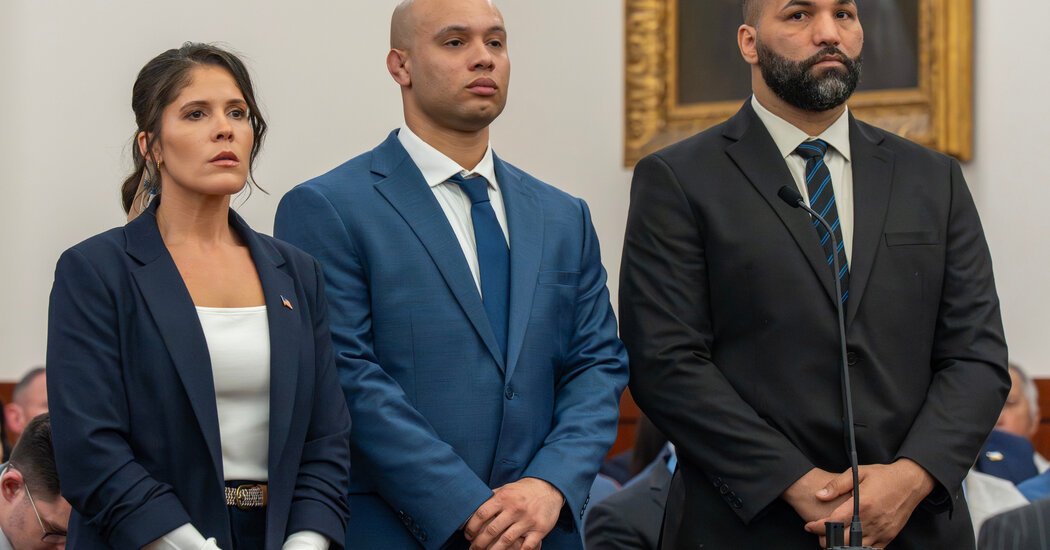
Enrique Delgado Garcia was the only one to raise his hand.
Inside the Massachusetts State Police Academy in New Braintree, Mass., about 70 miles west of Boston, instructors needed someone to face the most experienced boxer in the cadet class.
One trainee had already refused, warning that the matchup would be unfair. Instructors sought other volunteers.
Mr. Delgado Garcia, 25, stepped forward. By the next day, Sept. 13, 2024, he would be dead.
A police academy supervisor and three instructors were charged this year with manslaughter in his death.
Three of the four — Lt. Jennifer Penton, the supervisor of the defensive tactics unit at the time, and the instructors Edwin Montanez and David Rodriguez — were arraigned last month and pleaded not guilty. A third instructor, Casey LaMonte, was arraigned on Wednesday and also pleaded not guilty.
His lawyer, Brian T. Kelly, in an emailed statement called Mr. Delgado Garcia’s death a tragedy, one the state has made “worse by scapegoating an innocent state trooper and charging him with a crime he didn’t commit.”
The unidentified cadet who sparred with Mr. Delgado Garcia before his death was not charged in the case, the authorities said.
Brad Bailey, a lawyer for Lieutenant Penton, said the state lacked evidence.
“Allegations, no matter how forcefully stated, and legal theories, no matter how creatively constructed, cannot substitute for proof,” he said. “That is precisely what is happening here: an attempt to force round pegs into square holes.”
Glenn MacKinlay, a lawyer for Mr. Rodriguez, added that “what happened to Enrique Delgado-Garcia is nothing short of tragic, but we believe that criminal charges are unwarranted.”
A lawyer for Mr. Montanez could not be reached for comment.
David Meier, an independent investigator appointed to the case by the state attorney general, said the failure of the instructors and supervisor to stop the boxing match led to the death of Mr. Delgado Garcia, who suffered “multiple blunt-force injuries to the head and massive brain bleeding as a result.”
Mr. Delgado Garcia had previously worked as a victim-witness advocate in the county district attorney’s office in Worcester, a city 40 miles west of Boston.
But he wanted to be a state trooper, so he enrolled in the academy in April 2024.
“His family has spoken openly about his intention of being someone who made a difference in the community and his dreams of becoming a Massachusetts state trooper,” Andrea Joy Campbell, the Massachusetts attorney general, said during a news conference in February to announce the charges against his superiors.
The academy used boxing to train cadets to take a hit, keep their footing and think under pressure as part of their defensive tactics training.
But before the scheduled training exercise known as Boxing Day, Mr. Delgado Garcia had already taken hits that had left him shaken, according to court documents.
The previous day, cadets had gathered for an informal, and unapproved, sparring session, according to witness interviews cited in court records.
Several cadets took repeated blows to the head during the unsanctioned training session. Some left with bloody noses, black eyes and headaches, according to court documents.
Mr. Delgado Garcia left the sparring session with “loss of memory, headaches” and “concussion-like” symptoms, state prosecutors said. He told fellow trainees he didn’t feel right.
Got a confidential news tip? The New York Times would like to hear from readers who want to share messages and materials with our journalists.
But, the next morning, no one checked on his condition or consulted medical personnel to determine whether he was fit to fight in the official boxing day matches, according to court records.
During the Boxing Day exercise, instructors paired cadets based on size, strength and experience.
The referee brought in to supervise the matches, a former president of the Massachusetts State Police Boxing Team, no longer held a referee license and lacked training as a defensive tactics instructor, according to court records.
He did not know the academy’s safety protocols or the abilities of the cadets stepping into the ring, the investigation found. The referee could not be immediately reached for comment.
One matchup drew immediate concern.
Instructors had paired the most experienced fighter in the class with another cadet, who was considered one of the strongest of the group, according to court records.
That cadet objected, and said he did not want to participate, even when some instructors pressured him, telling him he was “the only one who can take a punch” from the more skilled fighter, according to court records.
Mr. Delgado Garcia filled out a medical questionnaire the morning of the sanctioned boxing match clearing him to fight, according to court documents. Investigators said supervisors and instructors failed to properly consult with medical staff about the form.
During the match, the other cadet struck Mr. Delgado Garcia repeatedly in the head. The blows stunned Mr. Delgado Garcia, knocking him down more than once, witnesses said.
Still, no one stopped the fight.
The punches kept coming until Mr. Delgado Garcia was unconscious. His injuries were so severe he was taken by ambulance to a hospital.
Within minutes of him being knocked out, members of the defensive tactics unit told their supervisor about the injuries Mr. Delgado Garcia had suffered during the unsanctioned sparring session the day before, according to court records.
In the weeks that followed, investigators examined what had happened inside the academy, focusing on the two days of boxing: the unsanctioned sparring session that left cadets injured, and the official exercise that followed.
They concluded that the warm-up boxing match itself was “unapproved and unsafe,” even though similar exercises had long been part of the academy’s training culture.
Across the country, state police academies have largely abandoned boxing as part their training regimens, leaving Massachusetts an outlier. After Mr. Delgado Garcia’s death, the Massachusetts State Police suspended the boxing program at its academy, according to the Massachusetts State Police.
Col. Geoffrey Noble of the Massachusetts State Police said during a state legislative hearing in March that he believed that the boxing program “in its prior format will not come back.” He said agencies across the country have shifted to jiu-jitsu-based training.
“The Massachusetts State Police continues to extend our deepest sympathy to the loved ones of Trooper Enrique Delgado Garcia,” Colonel Noble said in a statement.
A grand jury indicted the police academy supervisor and three instructors in February. Prosecutors charged them with involuntary manslaughter and causing serious bodily injury to a trainee during a physical training program. Lieutenant Penton, the then-supervisor, was also charged with perjury.
“The evidence demonstrated that when the supervisor of the defensive tactics unit was asked specifically under oath before the grand jury when it was that she first learned about Enrique Delgado Garcia’s concussion-like symptoms, she repeatedly responded falsely,” Mr. Meier said.
An independent review of the state police academy, initiated by the state last April at a cost of $600,000, remains unfinished, officials said.
The agency has already received years of scrutiny spurred by scandals and damning court judgments. In two separate trials last year, juries found that Massachusetts State Police had discriminated against women and minorities, awarding $6.8 million to five plaintiffs in one case, and $11 million in another.
The lead investigator in the high-profile Karen Read murder trial in Massachusetts, a state police trooper, was fired for sending vulgar, sexist text messages about Ms. Read, an ethical failing identified by experts as a possible factor in her acquittal.
In an interview, Sandra Garcia, Mr. Delgado Garcia’s mother, said her son’s death was no accident.
Had boxing exercises been used properly as training for recruits, she said, “it’s not a fight, it’s a workout.”
“If they’re going to train you to use a firearm, you’re not going to shoot someone,” she said.
Ms. Garcia said her son was a smart and kind young man who looked out for others. He had always been healthy, she said, noting that he consistently worked out and was a longtime runner.
The doctor treating him warned the family that it was unlikely that Mr. Delgado Garcia would survive a surgery, she said. Instead, she waited, hoping that the swelling in her son’s brain would diminish.
Ms. Garcia called it the longest two days of her life. When Mr. Delgado Garcia remained unresponsive, doctors disconnected him from a ventilator.
Her son, she said, “didn’t deserve to die like that.”
Jenna Russell contributed reporting. Kirsten Noyes contributed research.