dailynewsnblog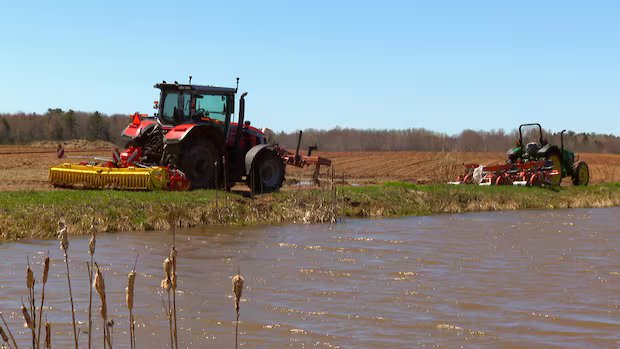

Listen to this article
Estimated 5 minutes
The audio version of this article is generated by AI-based technology. Mispronunciations can occur. We are working with our partners to continually review and improve the results.
Philip Keddy says last summer made one thing clear: he can’t rely on rain alone if he wants to see prosperous crops and productive growing seasons.
The farmer from Lakeville, N.S., credits his robust irrigation system for helping him get through severe drought conditions that gripped the region.
“We made the right decision years ago that we needed to invest in new pumps and dig more ponds, and just increase our ability to water our crops,” said Keddy, owner of Charles Keddy Farms and vice-president of Horticulture Nova Scotia.
He said the farm’s yield was down 25 per cent last year, but without irrigation he estimates it would have been closer to 50 to 75 per cent. The farm mostly grows strawberry nursery plants and sweet potatoes.
“I’ve never seen anything like it,” he said.
Keddy — like many other Nova Scotia farmers — is now investing in even more irrigation equipment, as producers look for ways to become more resilient to extreme weather and climate change.

He’s doing so with help from the province’s Department of Agriculture, which expanded some of its financial aid programs to support farmers amid last year’s dry conditions.
In June, the department increased the budget for its On-Farm Water Management Program to $1.8 million from $250,000. The program provides 50 per cent cost-shared support for water supply projects like wells and ponds, up to $15,000.
A provincial spokesperson told CBC News there were 229 applicants in 2025, compared to 85 applicants the year before.
The department also provided an additional $7 million to Horticulture Nova Scotia’s Season Extension Enhancement Program, which helps fruit and vegetable growers extend their growing season.
The group received 121 applications last year, compared to 80 applications when the program was previously offered in 2023.
Through that program, Keddy purchased more irrigation pumps and more than 900 metres of buried line to move water underground, as well as an irrigation reel to water some rhubarb and raspberry crops.
He said he’s spent up to $400,000 increasing the farm’s water capacity over the past few years.
Emily Lutz, executive director of the Nova Scotia Fruit Growers’ Association, said the effects of the drought will have an impact on the upcoming season.
There’s concern about whether or not some trees will be able to produce any fruit because they were under such extreme stress due to the lack of rain. She said it can take three to five years to replace dead fruit trees.

“That is a huge loss in productivity that is setting your orchard and your operation back literal years,” said Lutz.
“We know it costs upwards of $40,000 or more to plant an acre of orchard, so you really want to protect that investment.”
She said irrigation has historically not been needed in most Nova Scotia apple orchards because depending on the area, the trees can still thrive in relatively dry conditions.
“Last year showed us that that is a risk that may be too big to take now,” she said.
The association recently sent out a survey to its 53 members. She said out of 36 respondents, 70 per cent said they would definitely invest in irrigation equipment this year, while the remaining 30 per cent said they were strongly considering it.
They also estimated how much they plan to spend on that infrastructure, which altogether totalled roughly $3 million for irrigation equipment and $1.4 million for water sources like ponds and wells.
Trevor Hadwen, an agroclimate specialist at Agriculture and Agri-Food Canada, said it makes sense that farmers are taking steps to become more resilient to changes in the weather.
“We are seeing warmer than normal temperatures predicted throughout the Atlantic region with drier summers,” said Hadwen.
“The challenge is that warmer temperatures and lower precipitation also result in less water availability. So depending on what water source they’re tapping into, can also limit the amount of irrigation that they’re going to be able to provide in a really dry year like last year.”

He said parts of Atlantic Canada are still experiencing moderate drought conditions because the region did not see the high levels of snowfall needed to recover over the winter months.
Hadwen said things look better now compared to this time last year, but what’s really needed is a lot of spring rain.
For Keddy, Lutz and others in the industry, that’s exactly what they’re hoping for.
“We do everything in our power to plan for wet summers or dry summers … and when we have a great summer, we’re thankful to Mother Nature for working with us,” said Keddy.
MORE TOP STORIES