dailynewsnblog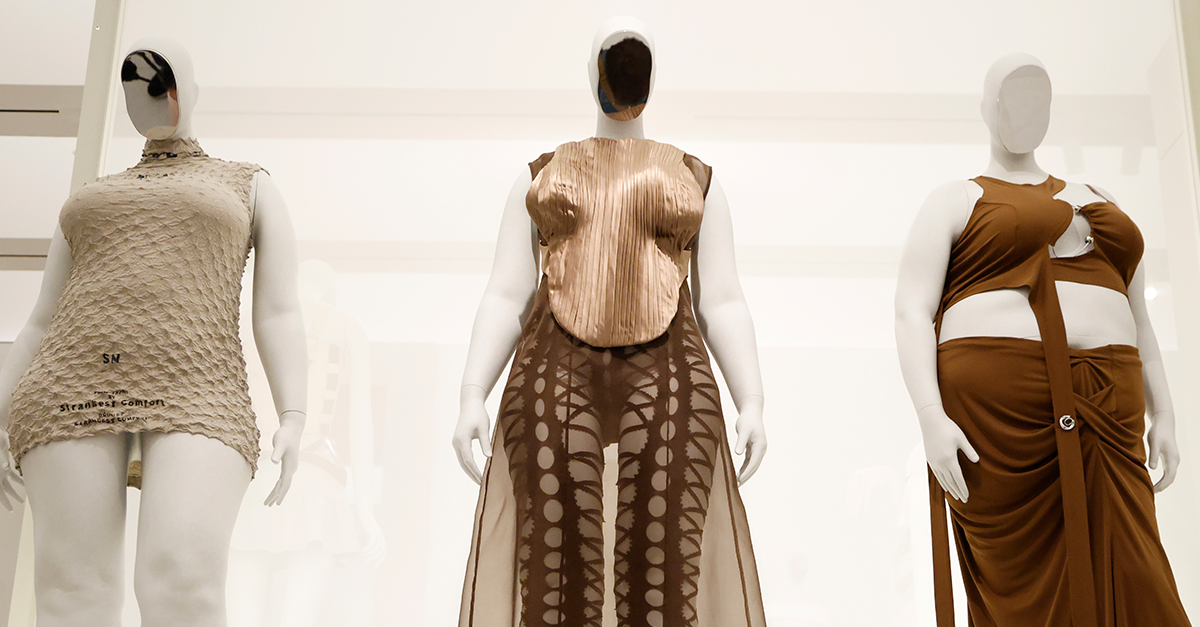
Lauren Chan is a Who What Wear editor in residence, model, former award-winning fashion editor, and founder of Henning, a luxury plus-size clothing label.
At the press preview for the Metropolitan Museum of Art’s new Costume Institute exhibit, Anna Wintour told the room that Costume Art is for “every body—nude bodies, classical bodies, corpulent bodies, and disabled bodies.” Since the Met’s official press release had previously written that the exhibit would “illuminate the indivisible connection between clothing and the body,” I assumed that there would be explicit mentions of size diversity in Wintour’s remarks and was crestfallen when she did not mention fat, plus-size, mid-size, body-diverse, size-diverse, size-inclusive, or bigger bodies. But after some googling during Lauren Sánchez Bezos’s speech, I realized that she had—she’d just called us corpulent.
Though Merriam-Webster’s definition of the word is curt—”having a large bulky body”—the plaque for the Corpulent Body section in the exhibit ran long: “The corpulent body—reclaimed within contemporary fat studies as the ‘fat body,’ a neutral descriptor rather than a pejorative—has historically occupied an ambivalent position within visual and material culture. Simultaneously venerated and stigmatized, associated with fecundity yet burdened by moral suspicion, monumentized yet rendered abject, corpulence has served as a symbolic surface upon which societies inscribe anxieties concerning sexuality and reproduction as well as class, race, gender, and power. As fat-studies scholars have argued, the issue has never resided in flesh itself but in the regulatory regimes that surveil, discipline, and normalize it.”

Despite both living in a bigger body and reporting on the plus-size fashion industry for over a decade, I had not often heard the word corpulent, and it’s certainly not one I identify with. Though it’s more common in art history and academic texts, our community within fashion has spent years fighting for inclusion using an array of terms that we feel represented by even though we are not in agreement regarding them all. (I, for one, dislike “curve” because I find it avoidant and pandering.) “Corpulent” isn’t how we talk about ourselves, each other, or our clothing.
The museum’s avoidance of the words that our community has reclaimed (e.g., “fat”), the ones we find power in, felt like a linguistic slap in the face. It felt like the museum was acting more like one of the regulatory regimes it had just condemned than a neutral or even supportive entity—and, actually, not just in the context of size-diversity. “Nude bodies,” as Wintour said, would surely have been stronger as “bodies of color” and “gender nonconforming bodies.” Refusing to authentically and specifically call out marginalized communities—especially while showing them off for a ticketed price—can feel exploitative. Though I admit this is a granular critique, I must insist that language is important. It’s how we document our civilization. If people outside of our community are the ones writing the copy, we are represented and remembered through their biased lens.

(Image credit: Getty Images)
Once I started walking though the exhibit, things were looking up. There is a Jacques Kaplan trompe l’oeil coat featuring a painting of a voluptuous body at the entrance, a Dior look custom-made for Yseult in the Classical section, two by Michaela Stark throughout the galleries, and another by Marine Serre near the end. There are many looks by designers like Comme des Garçons, Yohji Yamamoto, and Ann-Sofie Back that add volume to silhouettes. But it wasn’t until I walked into the Corpulent Body section that I let out my bated breath. In the area dedicated to size, I counted a total of eight looks by designers Michaela Stark, Sinead O’Dwyer, Karoline Vitto, Ester Manas, Di Petsa, Doublet, and Victoria’s Secret. The mannequins ranged in proportion and in size, likely from 12 to 20 (the top end modeled by Charlie Reynolds, whose measurements are 52-inch chest, 44-inch waist, 48-inch hip). This level of inclusion is a big win.
The element that the museum missed for us is the intersection between bigger bodies and the exhibit’s other themes of race, gender, and ability. This, if you look closely, is the biggest tell that there were likely not people with lived experience in said bodies at the helm of this exhibit. They would have known that fat folks don’t exist in a vacuum and that we are more likely to be people of color, queer, and/or disabled. The lack of intersection became obvious when, across the way, I spotted maternity looks and a wall of bodysuits in a range of skin tones on all thin mannequins.

(Image credit: Getty Images)
The other sections did have some instances of this intersectionality, like a pregnancy look photographed on AAPI gender nonconforming models, which I found to be refreshingly modern and reflective of the fashion industry at present, with all its layered aspects of diversity in casting. Perhaps most impressively, the Disabled Body section boasted a range of looks on mannequins in different shapes and sizes (though none specifically “corpulent”) with assistive devices like wheelchairs, of differing abilities, and representing various genders. One of those mannequins even celebrated transness by identifying model Aariana Rose Philip, wearing Willie Norris Workshop.
After Wintour spoke at the press preview, Venus Williams got onstage to say that Sánchez Bezos “looked beautiful as always” and, I assume, went off-script to say that she “wished that dress was in [her] size but [that she’s] just a little bit bigger than [her].” This—this, people!—is the trap that fashion has set for us. Though this very exhibit is meant to historically reflect how the body has been portrayed through fashion sans judgment, a superstar athlete nervously (her words) diminished her size for all to hear. This moment of nuance also made it glaringly obvious how much of the human condition was removed from Corpulent Body—how dehumanized Costume Art’s take is.

Would it have been better if Wintour used the word fat, just as the Met acknowledged fat-studies scholars by their chosen term? Absolutely. Would any of the other terms used by our community have been better? You bet. Does this small observance exemplify fashion’s ongoing unease and distaste for fat people? That’s my opinion. But let me be clear: Between the number of plus-size looks and the healthy attention given to adaptive fashion, I found Costume Art to be a success. After all, what’s a museum to do but spark discourse? And I certainly hope that happens in the fashion and art worlds and for us, the folks it’s really all for.