dailynewsnblog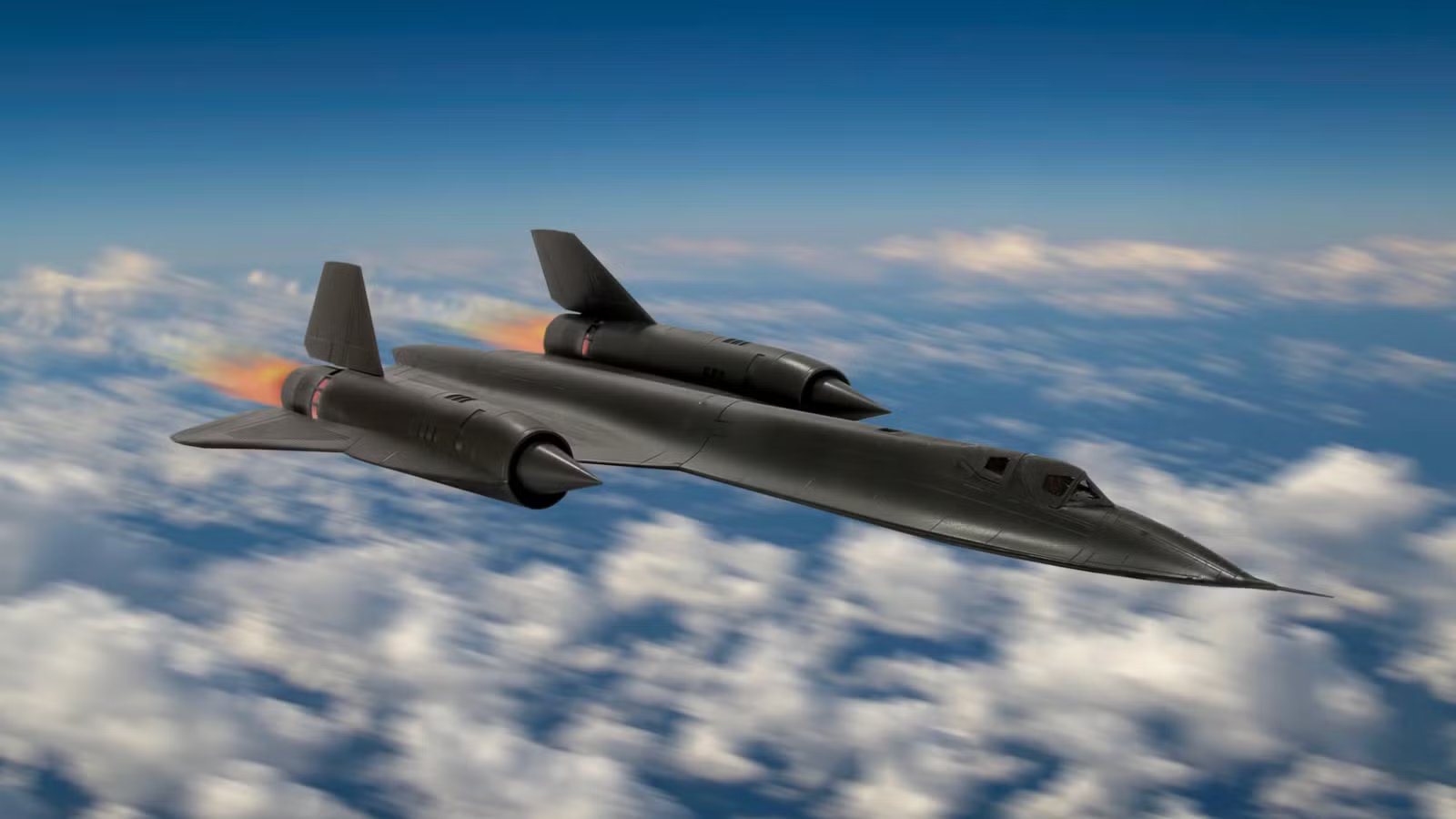
The Lockheed SR-71 Blackbird was one of the most extraordinary aircraft ever to take to the skies. The plane was a long-range, high-altitude reconnaissance jet designed during the Cold War to outrun threats rather than directly fight them. Originally developed by Lockheed’s Skunk Works and introduced in the 1960s, the Blackbird was built for strategic intelligence missions over vast distances, gathering imagery and electronic data at speeds and altitudes that made interception extremely difficult (if not impossible).
The plane’s sleek shape and specially engineered air inlets were all optimized for sustained flight above Mach 3. Just as remarkable was the plane’s construction, as much of the jet was made from titanium, so it could withstand the tremendous amount of heat generated by air friction at extreme speeds. What ultimately made the SR-71 legendary was not just raw performance, but how it combined speed, altitude, sensors, and survivability into a single platform.
Officially, the jet set a world speed record on July 28, 1976, flying at speeds unreached by any other crewed aircraft in history, a record that continues to stand. Its cruising altitude was also significantly higher than that of any other major aircraft program of its time, far beyond the reach of most conventional threats. Even decades after the plane was retired, the SR-71 remains the defining symbol of crewed high-speed reconnaissance and one of aviation’s greatest engineering achievements.
Just How Fast Could The Aircraft Fly?

There is no doubt that the SR-71 Blackbird was the fastest crewed aircraft ever to take to the skies. The jet’s speed remains astonishingly fast, even by modern standards decades after the plane was removed from operational service. Under normal operational conditions, the plane was designed to cruise at speeds of around Mach 3.2.
At these speeds, the aircraft is moving fast enough to cross the continental US in just about an hour, according to the Smithsonian. Its fastest recorded speed occurred on July 28, 1976, when an SR-71 set the absolute speed record for a crewed air-breathing aircraft at 1,905.81 knots, which directly equates to 2,193.2 miles per hour (3,529.6 km/h). This is approximately Mach 3.3. No crewed jet has since surpassed this mark. In practical overall terms, that meant that the Blackbird was moving at about 0.61 miles per second (0.98 km per second).
The aircraft was capable of traveling at even higher speeds in exceptional circumstances. Historical analysts have noted that Blackbirds occasionally exceed their nominal cruise envelope, while flight-test and operational anecdotes place the aircraft above Mach 3.4 in some unique cases. Nonetheless, the key point is that the SR-71 was engineered not just for brief bursts of speed, but rather for sustained, controllable flight at velocities that few aircraft have ever even approached.
How High Could The Aircraft Fly?

The SR-71 Blackbird flew so high that it operated essentially at the edge of what most technical analysts and military historians would have to consider near-space. The aircraft’s official published service ceiling was above 85,000 feet (25,900 m), and both NASA and the United States Air Force describe the plane as capable of sustained operations at altitudes significantly exceeding that figure. In practical terms, that puts the Blackbird far above normal air traffic.
Typically, commercial airliners cruise at around 35,000 feet to 43,000 feet (10,700 to 13,100 meters), meaning that the SR-71 was well above the reach of many interceptors and surface-to-air missiles of its era. That altitude was a central part of the aircraft’s survivability story. The higher it flew, the harder it was to catch, track, and engage. The aircraft’s most famous altitude milestone came on July 28, 1976, when an SR-71 set the world record for sustained altitude in horizontal flight at 85,068 feet (25,929 meters).
This is the kind of distinction that matters because it was not a brief zoom climb, but controlled, level flight at extreme height. The Blackbird was not merely able to touch extraordinary altitudes for a moment, but it was rather designed to operate there as part of its normal mission profile. That ability is what made the SR-71 one of the most formidable reconnaissance aircraft ever designed. It is also important to note that defense analysts have speculated that the aircraft is capable of flying significantly higher than its official service ceiling might indicate.
What Was The Longest Concorde Flight?
It only took four hours and ten minutes for the supersonic airliner to cross the pond.
A Look At The SR-71’s Development

The SR-71 Blackbird emerged from one of the most secretive and ambitious aircraft development programs of the Cold War era. Its roots lay in the Lockheed A-12, a high-speed reconnaissance aircraft developed for the Central Intelligence Agency by Clarence ‘Kelly’ Johnson and Lockheed’s ultra-elite Skunk Works division. The aircraft was developed in response to the growing and visible vulnerability of earlier spy planes like the U-2.
From that foundation, Lockheed refined the design into larger, more capable SR-71 models for the United States Air Force, featuring a two-person cockpit, advanced sensors, and the endurance needed for long-range strategic reconnaissance. The challenge was immense, as engineers had to create an aircraft that could sustain flight above Mach 3 while surviving the intense heat generated by air friction. That requirement drove the use of titanium, new manufacturing techniques, and highly specialized engine inlet and fuel-system solutions.
The development process moved quite quickly, but under extreme secrecy. President Lyndon Johnson publicly revealed the aircraft in July 1964, the prototype flew for the first time on December 22, 1964, and the first operational models entered service in 1966. In total, 32 SR-71s were built. The result was ultimately not just another military aircraft but rather a technological leap, as the plane was a machine designed from the outset to outrun interception and gather intelligence from altitudes and speeds no operational rival was capable of matching.
The SR-71 Had An Impressive Operational History

The dynamic and capable SR-71 Blackbird’s operational history was relatively short in terms of years, but rather extraordinary in impact. Entering the United States Air Force in 1966, the jet quickly became the centerpiece of America’s highest-speed crewed reconnaissance capabilities during the Cold War. Flying from bases like Beale Air Force Base in California to locations overseas, SR-71 crews carried out strategic intelligence missions over Europe, the Middle East, and Asia, using speed and altitude as their primary defenses.
Rather than relying on stealth in the modern sense, the Blackbird survived by flying above 80,000 feet (24,400 meters) and at more than Mach 3, making interception incredibly difficult. Over 24 years of Air Force service, the type amassed thousands of flight hours and eventually became one of the most iconic intelligence-gathering aircraft ever fielded. The plane’s frontline Air Force career initially ended in 1990 as defense priorities shifted and satellites took on a greater share of strategic reconnaissance work.
A very small number of aircraft were later reactivated for operational use in 1995 before being retired again by the time 1997 came around. NASA then continued flying SR-71s in the 1990s as research platforms, eventually using them for high-speed aeronautics experiments until the final Blackbird flight on October 9, 1999. That long afterlife in research only reinforced the aircraft’s legacy.

Will Lockheed Martin Build The SR‑72?
Lockheed Martin’s SR-72 “Darkstar” could be real. From Top Gun fame to Mach 6 specs, here’s what we know about the hypersonic spy plane’s future.
Why Was The SR-71 Removed From Service?

The SR-71 Blackbird was removed from service primarily because it was expensive to operate at a time when US defense budgets were tightening. The Air Force initially retired the fleet on January 26, 1990, citing a decreasing defense budget and the Blackbird’s exceptionally high operating costs. By that stage, the reconnaissance landscape had also changed.
Orbiting spy satellites were already handling much of the deepest levels of strategic surveillance, while other platforms could cover portions of the remaining intelligence workload more cheaply, even if none matched the SR-71’s impressive combination of speed, altitude, and overall responsiveness. That is ultimately why the Blackbird’s retirement has always been controversial.
Supporters have argued that satellites could not provide the same flexibility or rapid retasking in every crisis, which helped lead Congress to fund a brief reactivation in the mid-1990s. However, the aircraft never fully regained a stable place in the budget, and it was retired again after that short return. In essence, the SR-71 did not leave service because it was ineffective. Rather, it left because it was costly, specialized, and difficult to justify in a changing intelligence environment.
The Bottom Line

At the end of the day, there were a handful of institutional reasons to remove the SR-71 Blackbird from operational service. For starters, the jet’s profile prioritized long-haul missions, and the need for high-altitude, endurance-capable surveillance missions simply disappeared in the 1990s. After all, the aircraft was no longer truly necessary to observe America’s enemies. A big piece of that was the fact that the Soviet Union collapsed.
However, an even bigger element is the fact that satellites, not high altitude surveillance aircraft, were slowly becoming the most critical pieces of pretty much any observational strategy over enemy territory of any kind. Another key piece to keep in mind here is that the Blackbird was not any ordinary aircraft. It was exceptionally expensive to operate, necessary in certain kinds of theaters, and had an extremely limited group of qualified pilots. This made it much harder to justify keeping the aircraft in service as time went on.