dailynewsnblog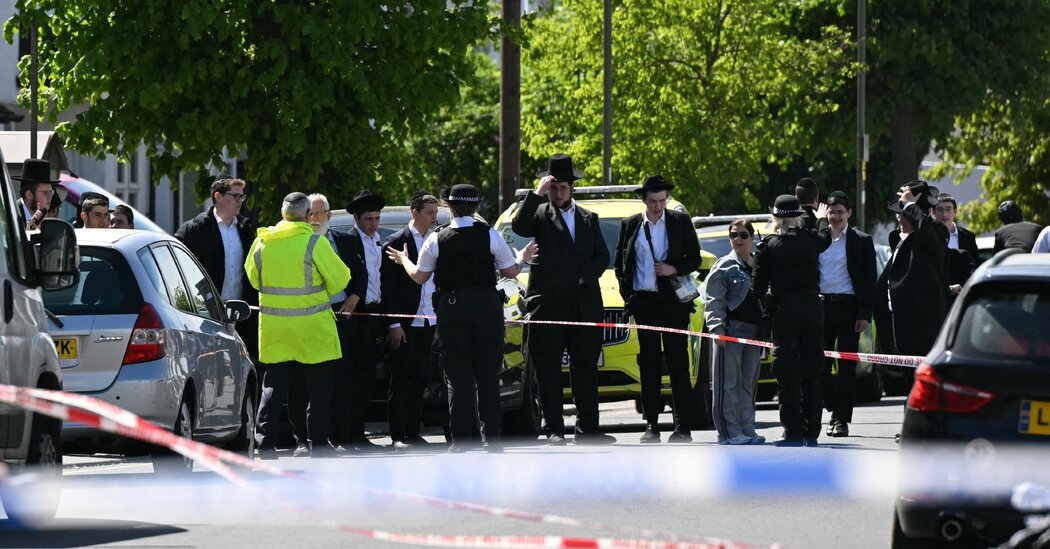
Lindsey Liss made a sobering request of her 17-year-old daughter when she sent her on a trip to Europe last summer: Don’t wear a Star of David necklace charm.
“There’s no reason to make yourself a target,” said Ms. Liss, a 51-year-old artist and mother of four who lives Chicago and grew up outside Detroit, near where an armed man rammed his truck into a synagogue in March.
Diane Rosenthal, 64, who lost two brothers in the 2018 shooting rampage at the Tree of Life synagogue in Pittsburgh, said she thinks twice about going to crowded events.
“I look for the exit doors,” she said. “Which is not a normal sense of what people should be doing for a joyful occasion, like a graduation.”
Rabbi Shimon Dudai of the Congregation B’nai Zion in Key West, Fla., said that since the Hamas-led attack on Israel on Oct. 7, 2023, he delivers services with a nine-millimeter pistol within arm’s reach.
“I don’t want to come to a holy space like this, a sanctuary, holding a gun,” said Rabbi Dudai, 84, who keeps the pistol in a traditional Jewish lectern used to prop up religious texts. “I just don’t want to take the risk of my people getting hurt if I’m capable of using a gun properly and capable of defending them to the best of my ability.”
From tempering overt displays of their faith, to being hyper alert, to issuing warnings to fellow congregants, many American Jews say they have changed their behavior in response to increased antisemitic violence in recent years, especially since the Oct. 7 attacks. Jews have faced antisemitism throughout history, but the past few years have made many feel “like it has become normalized and accepted,” Ms. Rosenthal said. Every time a new crime occurs, such as the knife attack last week against two Jewish men in London, an episode the police declared a terroristic incident, Jewish leaders and everyday Jews say that ever-present vigilance becomes heightened anew.
There is a “constant level of concern that something will pop off,” said Joseph Landsberg, 35, the security director for the Boca Raton Synagogue in Florida, whose team planned additional security measures this weekend after the London attack. “It’s not a matter of if, but when.”
A survey by the American Jewish Committee, a nonprofit, found this year that more than half of American Jews said they had changed their behavior out of fear after high-profile attacks in 2025, including the arson attack at the home of Gov. Josh Shapiro of Pennsylvania and the killing of two Israeli Embassy aides outside a Jewish museum in Washington, D.C.
Leah C. Hibel, a professor of human development and family studies at the University of California, Davis, found in a study published last year that fears about antisemitism and hateful rhetoric had translated into behavioral changes and increased symptoms of depression and anxiety among California Jews.
While she has tracked those feelings daily since, she said in an email on Saturday that she would hypothesize that “acute fear spikes” follow in response to violent attacks, leaving Jews “with residually higher baseline anxiety than before.”
“We certainly are not at the point where it is returning to pre-Oct. 7 levels,” Dr. Hibel said, adding that the response is both to violent attacks and cumulative daily experiences.
The most obvious changes have come at synagogues like the one in Boca Raton. After the stabbings on Wednesday in London’s Golders Green neighborhood, Mr. Landsberg, originally a Londoner himself, said that his team held an operational meeting and contacted other synagogues in the area, now a common practice.
Marc Hanfling, chief of security at a synagogue in Edison, N.J., said that after attacks like the one in London, his team sends congregants a WhatsApp message, warning them to be extra vigilant while walking near the synagogue and outside their homes. Mr. Hanfling asked that his synagogue not be named for fear that it might be attacked.
Over the last four years, he said, his team has added armed guards inside and outside the synagogue. Volunteers screen congregants as they enter. The synagogue also installed bulletproof windows and security cameras.
Mr. Hanfling, who is 73 and the son of Holocaust survivors, said he was disheartened to see rising antisemitic sentiment around the world.
“We appreciate that we live in a free country,” he said, “but things can turn.”
Fear has also reshaped Jewish life in ways that may be less apparent but no less significant. Ms. Liss, the Chicago artist, said her family had taken certain universities “off the list” for her children because of concerns about antisemitism. “Things have gone completely backwards,” she said.
Mayor Mark J. Schwartz of Teaneck, N.J., who is an Orthodox Jew, said he used to wear his yarmulke everywhere — and “judge people who didn’t.” But on a recent trip with his wife to Paris, she warned him not to wear it. At one point, he forgot and “felt like I had a heart attack.”
“You’re starting to feel that, not just in Paris, but everywhere,” said Mr. Schwartz, 50. “I’m embarrassed that I have a baseball hat here in my jacket, just in case. It’s a shame.”
Beejhy Barhany withstood several years of phone calls harassing her and her employees at Tsion Cafe, a kosher Ethiopian-Israeli restaurant in Harlem. Once, in August 2023, a person painted a yellow swastika on her front door.
Late last year, she said, she began to receive persistent death threats. So, in February, after 14 years of welcoming passers-by into her cafe, Ms. Barhany, 50, closed her doors save for private events, including a weekly Shabbat dinner. During the dinners, Ms. Barhany said, she keeps the doors locked for “peace of mind.”
“People always ask me, ‘Are you going to have security?’” she said. “To be honest, no. I think we are in a country that we should feel safe enough that I don’t need to look behind my back every time.”
Carole Zawatsky, the chief executive of the Tree of Life in Pittsburgh, describes the financial and mental toll as a “Jewish tax.”
“To go worship, you’re going to go through a magnetometer. You’re going to greet the security guards for Sabbath, on the way in, ‘Shabbat Shalom,’” she said. “I think that has an impact on the psyche of young Jews who grow up with this as a constant in their lives.”
The Tree of Life has a traveling exhibition that, among other things, explores the history of antisemitism in America as the country approaches its 250th anniversary. It is part of many efforts since the 2018 shooting to promote interfaith dialogue and education about religious tolerance.
“I would never concede that we have to accept hatred forever,” she said, “for anyone.”
Debra Kamin contributed reporting from New York.