dailynewsnblog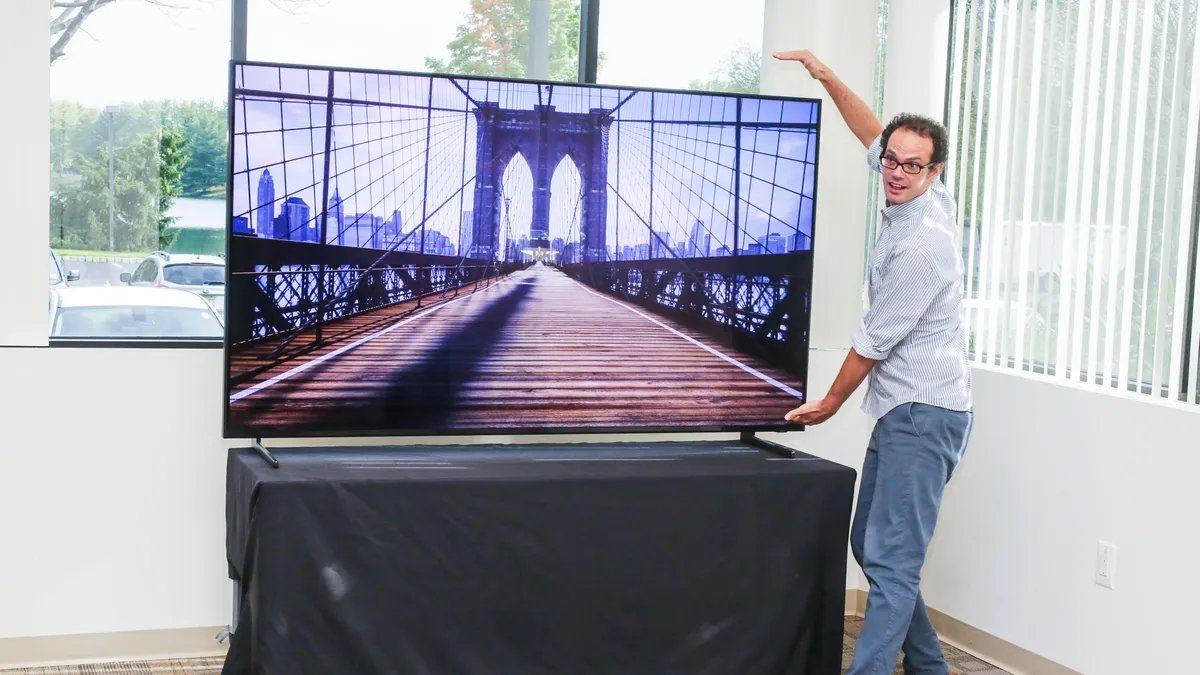
The old adage of “get the biggest TV you can afford” is still broadly valid, but not everyone wants or needs a 100-inch TV. Televisions are one of the few things that get cheaper every year (even the best TVs), so getting a TV that’s larger than your current one isn’t as costly as it once was.
So the question is, how big is too big? There’s actually a calculation for that. It depends on your room, your seating distance, and perhaps most importantly, the agreement of any cohabiting co-deciders. Here’s how to figure out what size TV to get.
CNET’s screen size calculator for 4K TVs
The numbers don’t match TV sizes exactly due to the math involved, but should give you a rough idea what sizes to consider based on how far away you’re sitting.
| Viewing distance (Inches) | TV size range (diagonal, in inches) |
|---|---|
| 80 | 54-67 |
| 90 | 61-75 |
| 100 | 68-84 |
| 110 | 75-92 |
| 120 | 82-100 |
| 130 and up | 88 and up |
The farther away you sit, obviously, the smaller your TV appears. The ideal is to have a screen that fills a certain amount of your field of view, though how much is “ideal” is up for debate. The chart above uses a range of sizes based on THX and SMPTE recommendations, detailed below. Other groups (and TV manufacturers) have different ways to calculate the best size, but all should be around this range.
THX recommends, for example, that you multiply your seating distance (in inches or centimeters) by 0.835. This gets you the recommended screen diagonal. If you’re like most people and you’re sitting about nine feet from your TV (108 inches), THX recommends a screen roughly 90 inches diagonal. So yeah, that big 65-inch TV you’re looking at is not “too big,” at least as far as THX is concerned. They also recommend not mounting the TV too high, something we strongly agree with.
This might be a little larger for most rooms.
The Society of Motion Picture and Television Engineers recommends (pdf) “The observer’s nominal distance from the center of the reference display should be 3 to 3.2 picture heights.” This is quite a bit less than THX and also for reference displays, not specifically a TV in a living room. It does give us another distance recommended by experts to give us an overall idea though. To match SMPTE’s recommendation on the larger end of their range, multiply your seating distance by 0.68. So given our nine-foot example, that means a TV around 73 inches. So, you’re good to go with that 65-inch TV after all.
THX recommends not putting your TV too high on the wall
While these are all good guidelines, don’t take them as steadfast rules. Ideally, you want some sort of compromise between the two extremes. It’s far too easy to get caught up in a numbers game when the reality is far more complex. There are additional factors in play.
Read more: Best Home Theater Projector for 2026
TV resolution and screen size: 4K, 8K, 1080p
Nearly all new TVs are Ultra HD 4K resolution. A small, and shrinking number, are 8K. Only the smallest and least expensive models are still merely HD (1080p or 720p).
To see all the detail available in a 4K or 8K resolution image you either need to sit very close, or have a very large TV. In fact, if you’re sitting nine feet away, even “big” TVs are still too small for you to see all the resolutions for which they’re capable. Or to put it another way, the resolution of your next TV is going to be plenty unless you’re sitting very close, or are getting an exceptionally large TV (over 100 inches). So yeah, you don’t need an 8K TV.
The flip side is that with lower-quality content a big TV will expose more flaws. If you find yourself noticing blockiness, video noise or other artifacts when watching shows and movies on your current TV, a larger model will show those issues even more. You should make sure you’ve enabled (or paid for) 4K content on your source device, streaming service or cable/satellite.
Read more: 8K TV Explained, and Why You Definitely Don’t Need One
TV room domination: How big is too big?
The other major factor to consider is something I’ll call “room domination.” How big does a TV have to be before that looming black rectangular slab seems to be the only thing in the room? This factor is definitely subjective. As someone who’s had a 12-foot-wide projection screen in his house for over a decade, and has also reviewed large TVs, I’ll take the big projection screen over a TV any day (not least because when the “TV” is off, a projector’s screen is white or gray, a TV is glossy black). An 80-plus inch TV can easily just dominate a space. Wall mounting can help a bit, but your TV room risks becoming the TV’s room.
If you have any doubts, try taping off or cutting out cardboard the size of the TV you’re thinking about, and seeing how it fares in your room. You might want to paint it or put some black cloth over it, too. That’s what it’s going to look like when it’s turned off (models like Samsung’s Frame TV notwithstanding). Maybe that’s not a concern for you, but it will be for some. Know that once the TV is actually in there, it will be way more awesome than cardboard, and probably brighter. It will also seem way, way bigger. It certainly depends on your room, décor and the opinions of others who share that room.
MicroLED promises even larger TVs, sizes once only possible with projectors.
Do bigger TVs make for a better viewing experience?
I’ll be honest, I don’t subscribe to any of the established “rules” for viewing distance and screen size. I think the SMPTE and the lesser THX numbers are too TV-biased. I think they vastly underestimate what’s easily possible with modern technology, for those who want more.
I sit nine feet from a 102-inch screen. That’s just the 16×9 portion. The full screen is 2.35:1 and 128 inches diagonal. I can just barely make out pixels when I expand a 1080p projector to the full width of the screen, but in standard 16×9 viewing, I can’t. 4K looks amazing. Watching TV this size is addictive, and I love it.
I mention this as proof you can go much larger than most people assume is possible. Check out how inexpensive, and bright, projectors have gotten. We’ve reviewed a bunch lately and have lists of the best projectors overall and the best 4K projectors.
Do you want to go that big? Well, that’s a different question. I find larger screen sizes easier on the eyes, as more of your field of view is taken up with the roughly uniform brightness of the screen. In an otherwise dark room, your pupils are more naturally closed to the amount of light thanks to the big screen. That said, projectors are far dimmer than any TV.
Conversely, I find watching a small screen in a dark room more fatiguing, as your pupils are more open (because of the dark room) with this one annoying pinprick of bright light (the TV). Many people complain about headaches when they watch TV in a dark room. One possible cause is the hundreds of nits from an HDR TV taking up a tiny fraction of your field of view. Think about when someone shines a flashlight in your eyes when you’ve been in the dark for an hour. With a projector, you’ve got far less light than what a TV produces, and it’s spread out over a huge swath of your vision.
True bias lights, leaving the room lights on and turning down an LCD’s backlight or an OLED’s overall brightness, can minimize fatigue as well or better than a big screen, but I like watching TV in a dark room. To each their own.
Bottom line: You could go much, much bigger with your next TV
The ultimate decision is one of personal preference. My goal here was to point out a rough idea of what’s possible or recommended. For me, I would always err on the side of “too big.” An old boss of mine used to say that no one regretted buying a TV they thought might be “too big.” My opinion is that a 50-inch TV is too small for most rooms. That’s not to say I think everyone should get a 102-inch screen, but the reality is a 50-inch flat panel is really not that much larger than the 36-inch CRTs of the old days. Since 65-, 75-, and even 85-inch TVs are now far more affordable, they’re worth considering if you’ve got the space.
If you want to go really big, consider a projector instead if you’ve got control over the ambient light in your room.
Best TVs by size
In addition to covering audio and display tech, Geoff does photo tours of cool museums and locations around the world, including nuclear submarines, aircraft carriers, medieval castles, epic 10,000-mile road trips and more.
Also, check out Budget Travel for Dummies, his book, and his bestselling sci-fi novel about city-size submarines. You can follow him on Instagram and YouTube.