dailynewsnblog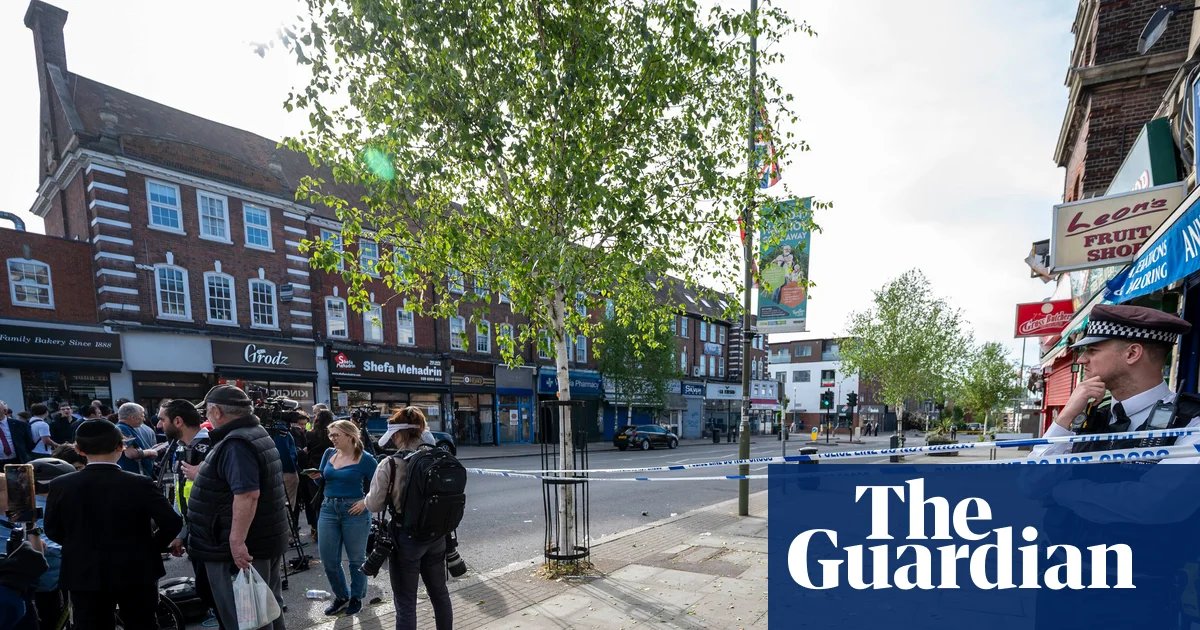
Keir Starmer has said the government and criminal justice system must respond to the suspected terrorist attack in north-west London in “a swift, agile and visible way”, as he convened a meeting in Downing Street.
The prime minister said on Thursday “an attack on our Jewish community is an attack on all of us”, as he called the fight against antisemitism “our fight as well” after the stabbings in Golders Green.
He said it was vital to understand the “visceral feeling” among many British Jews, “and we have to be really clear that an attack on our Jewish community is an attack on all of us and we have to approach it in that way”.
Speaking at a meeting with criminal justice agencies and senior ministers in Downing Street after the double stabbing, Starmer said it was “absolutely clear” that people had been targeted for being Jewish.
“There’s no getting away from the fact that this was not a one-off,” he said. “This has been a series of attacks on our Jewish community, particularly in recent weeks, and there is a very deep sense of anxiety, of concern about security, about safety, about identity frankly.”
Starmer said solidarity with the Jewish community was often voiced after such attacks, but added: “We do stand with our Jewish community – of course we do – but it’s our fight as well. It’s the fight of everyone in this country.”
Shabana Mahmood earlier promised to “do everything in my power” to keep British Jews safe, as police said the suspect in the stabbing of two men on Wednesday was a 45-year-old British national born in Somalia.
The government said a further £25m would be invested to increase security for Jewish communities after the suspected terrorist attack. The funding will be aimed at boosting police patrols and protection around synagogues, schools and community centres. But the government is facing pressure to go further, including calls to ban pro-Palestinian marches.
Legislation creating proscription-like powers to pursue people and organisations acting on behalf of malign state-sponsored groups would also be “fast-tracked” in the coming weeks, ministers said.
It is understood the draft laws will be included in the king’s speech setting out the government’s legislative agenda for the next parliamentary session, on 13 May.
The home secretary said the suspect was born in Somalia and came to the UK lawfully as a child in the 1990s and was a British national. She said the two victims, Shilome Rand, 34, and Moshe Shine, 76, continued to be treated in hospital and were in a stable condition.
The Metropolitan police commissioner, Mark Rowley, said on Wednesday the individual in custody has a “history of serious violence and mental health issues”.
Speaking on BBC Breakfast, Mahmood said she understood “the very real fear that is being felt” in the Jewish community. “The government has already been responding, and we are now doing more as well,” she said. “We will always take every step within our power in order to keep our community safe.”
Police are treating the stabbing of two men in Golders Green, which happened just after 11am on Wednesday, as terrorism, with the suspect described as having been allegedly looking for anyone “visibly Jewish” to attack. The stabbings follow a series of arson attacks on Jewish targets in London since March, including two previous incidents in Golders Green.
Rand, the younger victim of Wednesday’s attack, told ITV that Jewish people were afraid and uncomfortable to walk down the street. “People are blaming obviously the government. You know they aren’t doing anything about what’s going on for the past few months,” he said.
People in Golders Green say they have been left questioning whether it is still safe to remain in the UK. “People feel scared, people feel unsafe,” said Baruch Stern, of Gross Butchers near the scene of the attack. “People think: is it really the place for me to be here? Is the UK safe for Jewish people, or is it something we need to think about, moving away?”
On Thursday Sue Siegel, a Jewish Council of Scotland (JCoS) member, said Jewish people were experiencing something similar to what they felt just before the Holocaust following recent attacks. She told BBC Radio Scotland Breakfast that some members of the Jewish communities were not wearing scull caps or the Star of David. “People should be allowed to practise their religion and to be the way they need to be in the way they want to be, freely, without concern,” she said. “This is similar to what people felt just before the Holocaust.” She added that the police had been “extremely supportive” and other faith communities had pledged support.
Mahmood signalled on Thursday that she would consider banning the Islamic Revolutionary Guard Corps (IRGC), an Iranian military group.
Speaking to broadcasters on Thursday morning, she said it would be inappropriate to confirm such a move before the laws were on the statute books, but that she would be looking at “all organisations that would then fall within the purview” of the legislation.
“Just to reassure you, the only reason I’m not giving a wider commentary on who this will include is because we would never give any commentary on organisations that we are considering for either our proscription regime … or indeed, this new regime,” she told Sky News.
“I expect to be making decisions in the very near future about the groups that we will be designating as state-linked.”
Ephraim Mirvis, the chief rabbi of the United Hebrew Congregations of the Commonwealth, has called for “meaningful action” to tackle the “root causes” of antisemitism, while the Board of Deputies of British Jews said antisemitism must be “confronted, punished and deterred with the full force of the state”.
Jonathan Hall, the government’s independent reviewer of terrorism legislation, said it was “impossible” for such marches not to “incubate” antisemitism. Describing recent attacks on Jews as a “massive national security emergency”, he called for a “moratorium” on pro-Palestinian marches.