dailynewsnblog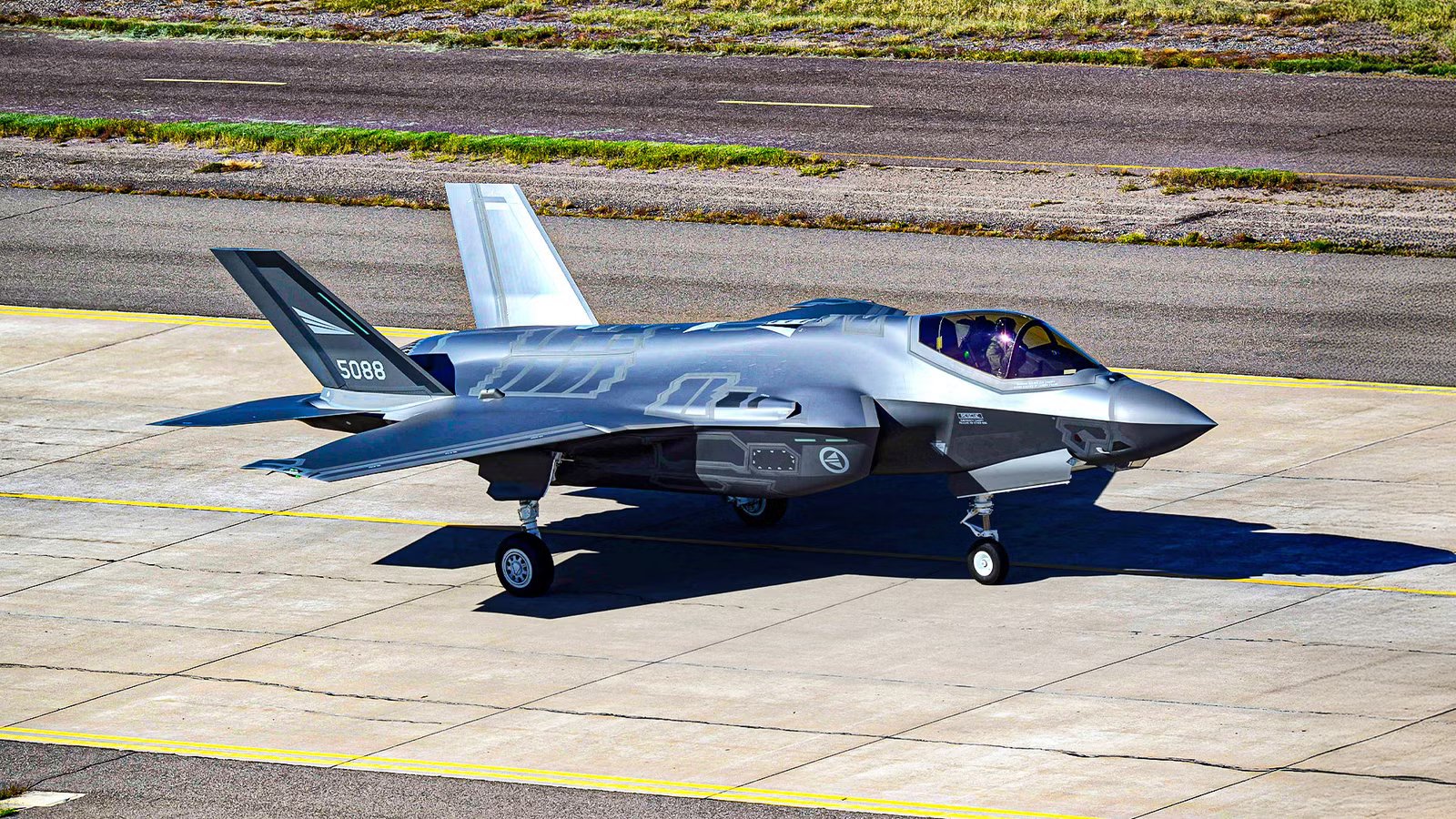
The Lockheed Martin F-35 Lightning II uses an evolution of traditional fly-by-wire algorithms to aid pilots as they perform aggressive maneuvers to win the dogfight without compromising. The system in the F-35 replaces a traditional computer that relies on thousands of preset rules to create a safety buffer when a pilot inputs an extreme maneuver with a live calculation.
That system dynamically prevents fighter pilots from stalling or spinning their jet, even when they request a control surface input that would put the jet out of control. This is called nonlinear dynamic inversion, according to AIAA. What it does is mathematically model and calculate exactly what movements are needed to achieve the pilot’s desired maneuver. That process takes the control input and then weighs it against any potential negative outcomes before moving the control surface in a way that both achieves what is desired and maintains the safety of flight.
While the Lockheed Martin F-22 Raptor provides raw data for the pilot to act on, the F-35 automates stability to a higher degree, effectively making the jet ‘spin-proof’ through its Automated Departure Resistance system. Unlike older jets that require pilots to manually avoid critical flight conditions, the F-35’s complex control laws keep it within safe aerodynamic limits, even when a pilot makes extreme control inputs.
A Foundation Of Stability: The F-35’s Evolution In Fly-By-Wire

An important aerodynamic difference between the F-35 and its peers like the fourth-generation Lockheed Martin F-16 Fighting Falcon and fifth-generation F-22 is that it is inherently stable. These, and many other modern fighter jets, are inherently unstable with a relaxed stability design that allows them to achieve exceptionally high levels of agility and performance, as the National Security Journal explains.
The F-16, also called the Viper, was famously designed by the Fighter Mafia in the early 1970s to be an extremely aggressive and lightweight dogfighter. The design has a center of gravity and center of lift with the natural tendency to nose up or flip. The autopilot compensates for this through its legacy fly-by-wire system, which was the first in a large-scale production fighter jet, as well as its innovative haptic feedback side stick controller.
Although the F-35 did not inherit the aerodynamic traits of the F-16, the F-22 did and maximizes this to achieve supermaneuverability when coupled with the incredibly powerful engines and lifting body design of the Raptor. The F-16 also used a pressure-sensitive side stick with almost no physical movement. In contrast, the F-35 uses an active stick that can be programmed for different levels of resistance and travel to provide more pilot feedback.
The F-16 and F-22 rely on a traditional system that uses ‘gain scheduling,’ which requires extensive flight testing to program how the jet should react at every possible speed and altitude. The F-35 uses NDI to simplify this, using an onboard model to neutralize unstable physics on the fly. The F-35 was designed to be a less costly multi-role platform and therefore had to compromise in the area of air-to-air combat performance. However, its advanced handling automation and stealth characteristics still give the pilot of an F-35 a clear advantage in combat.

The Automated Departure Resistance system acts as a digital ‘safety net’ that monitors the relationship between the pilot’s input and the aircraft’s physical state. One of the primary functions is to keep the nose pointed exactly where the aircraft should be moving by constantly calculating the angle of attack. The plane automatically uses rudders and the horizontal tail to suppress any undesirable yaw that could cause a spin.
The system continuously monitors all flight control laws in all axes, including pitch, yaw, and roll, according to Code One Magazine. To prevent a stall, if the nose begins moving into a dangerous angle, the aircraft can automatically adjust faster than a human being can react. By continuously calculating how much energy the plane has, it keeps the nose back at a point that will not result in a situation that the jet can’t recover from.
That automation gives the F-35 pilot an edge over another pilot flying a plane like the F-16 because they can safely push their aircraft to the edge without manually compensating for the safety buffer. During testing, the plane so reliably proved that it would not exceed the 50° angle of attack that the computer was programmed to keep as a hard limit that during testing, the aircraft had the backup parachute removed during spin trials earlier than originally scheduled, the Aviationist notes.

Here’s Why Landing An F-35 On An Aircraft Carrier Is So Difficult
What it takes to be in the tailhook club.
F-35 Automation: Inside A Fifth-Generation Fighter Brain

Because the jet uses NDI, it knows its own aerodynamic limits. When a pilot slams the stick back, the computer calculates the maximum possible pitch rate that won’t result in a departure. It inverts the physics of the stall to find the exact control deflection needed to hold the nose at 50 degrees. At high angles of attack, standard ailerons lose effectiveness, so the F-35’s software automatically switches to using the horizontal stabilizers as differential flaperons to roll the jet.
In a dogfight, an F-35 pilot can perform a ‘pedal turn’ at a high angle of attack, the Aviationist reports. This maneuver in particular showcases the F-35’s advanced flight control logic. To perform a pedal turn, the pilot typically pulls the aircraft into a steep vertical or high-alpha climb and then applies full rudder pedal in the desired direction of the turn while pulling the stick full aft.
While a legacy jet would likely stall or spin, the F-35 pilot can simply stomp on the rudder pedal; the automation coordinates the flaps, tails, and rudders to pivot the nose around the center of gravity while maintaining controlled flight. The F-35’s large chines, the edges extending from the nose to the wings, create powerful vortices at high angles of attack. The flight software is specifically tuned to harness this extra lift, using the automated controls to keep the jet stable within this turbulent air.
While the maneuver is a staple of airshows, it is truly meant to allow a pilot to change their heading quickly via yaw rather than a wide G-turn, facilitating fast missile locks or gun snapshots on a maneuvering bandit. This maneuver can actually force an enemy to overshoot while in pursuit of the F-35, but it is meant as a last resort in a real fight. Executing the maneuver requires an all-in commitment to dropping airspeed and bleeding energy in exchange for the sudden and violent maneuver.

Inside The F-35’s Cockpit System
At the controls of flying supercomputer.
How The Joint Strike Fighter Stacks Up

The computerization of the F-35 Joint Strike Fighter’s maneuverability is also an important element of how the plane compensates for its lower agility and overall performance in comparison to legacy aerial superiority fighters. To put it in context, a good comparison is against its predecessor, the F-22, and the leading warbird across the pond, the Eurofighter Typhoon. The F-22 uses its software to integrate thrust vectoring with traditional surfaces.
This allows it to perform impossible flips and turns at low airspeeds where the F-35 or Typhoon would simply stall. The Typhoon is naturally unstable and uses its forward canards and a sophisticated fly-by-wire system to remain highly responsive. It is optimized for ‘high-energy’ dogfights, where it can maintain a tighter sustained turn than the F-35. As such, the F-35’s Automated Departure Resistance helps bridge the gap with the F-22 and Eurofighter not by making the jet faster, but by making its performance predictable and accessible.
This allows the pilot to focus 100% on the tactical solution, or getting a missile lock, while the adversary pilot must split their attention between the enemy and maintaining flight stability. While the Raptor and Typhoon are considered superior in close-quarters dogfighting, the F-35’s strategy is to use stealth and sensor fusion to detect and eliminate threats before a dogfight even begins.

Before The F-35 Vs. After: How Air Combat Changed
Examining a paradigm shift in air warfare.
Putting The Tech To The Test: F-35 Head to Head

During a joint-training event at Ramstein Air Base, Captain Patrick ‘Hobbit’ Pearce, in a US Air Force F-35A, sparred with 1st Lieutenant Alexander ‘Stitch’ Grant, who flew a German Eurofighter Typhoon. The pilots were sent to a set of coordinates, altitude, and time with no knowledge of the opponent until they arrived. As the two jets closed into the ‘merge,’ each pilot realized he was facing a tough adversary. The Medium recounted that Grant said he had never flown against an F-35, and Pearce had never engaged a Typhoon.
Once the dogfight began, the Typhoon’s two powerful engines and aggressive aerodynamics allowed Grant to pull tighter turns and lose less energy than the single-engine F-35. He eventually pulled behind Pearce despite the high-G maneuvering by both pilots and scored a simulated gun kill.
Both pilots later described the physical punishment of fighting under 7-9 Gs while constantly craning their necks to keep sight of the opponent. This result surprised no one: the F-35’s strengths lie in stealth and long-range sensors, not close-in knife-fighting, whereas the Typhoon was purpose-built for air superiority.
The Eurofighter Typhoon achieved several simulated kills against the F-22 Raptor and the Boeing F/A-18E/F Super Hornet at a 2012 Red Flag Alaska joint exercise as well. The larger exercise involved more than 30 aircraft from nine NATO nations, and its theme focused on exposing crews to platforms, tactics, and datalink protocols they don’t typically encounter.