dailynewsnblog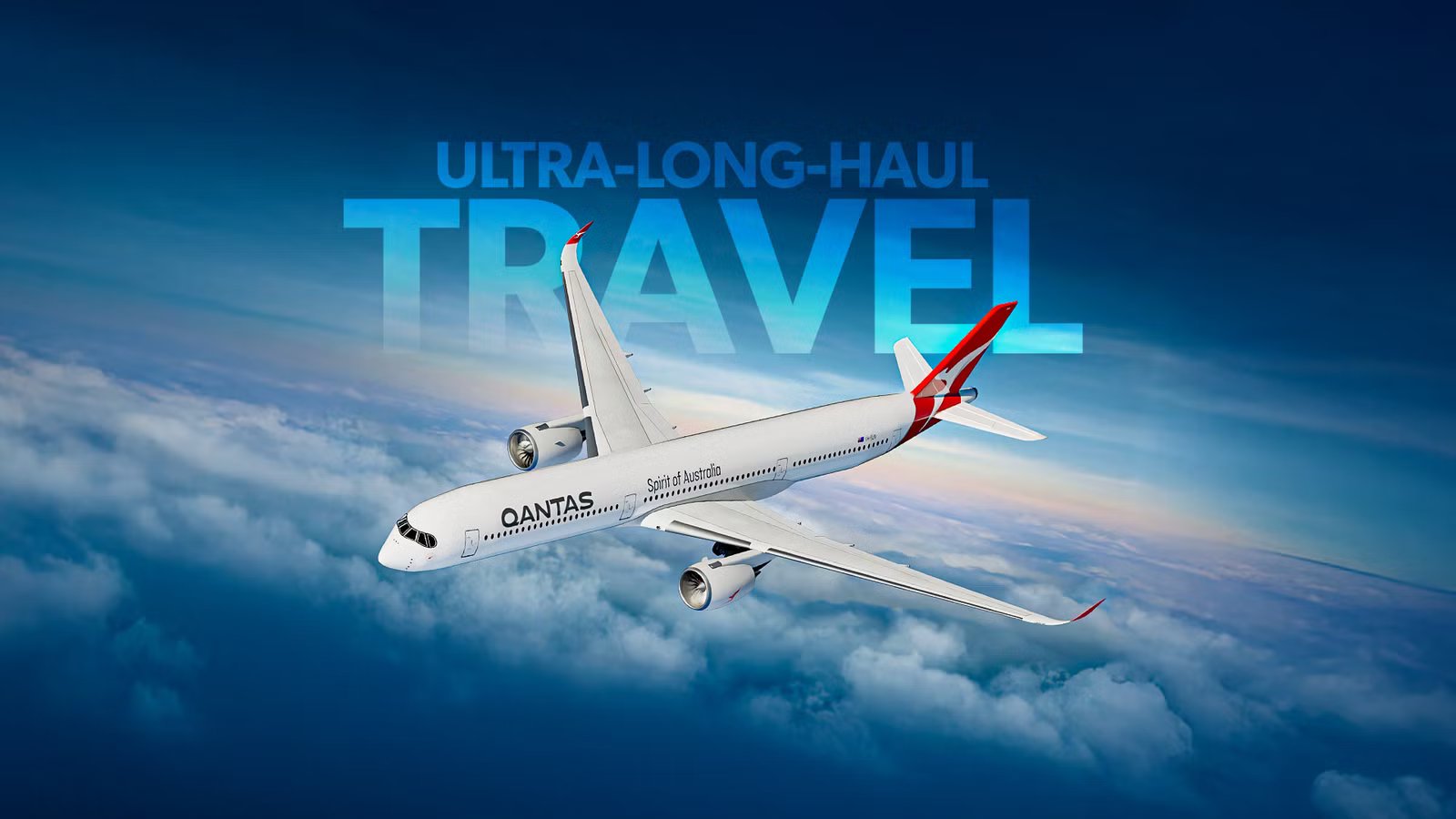
Project Sunrise is coming soon. This is a collective plan by Qantas to launch new ultra-long-haul routes mainly from its hubs on the East Coast of Australia, connecting the nation’s largest cities nonstop to Europe and North America. The name is a reference to the fact that passengers on some flights may be able to view two sunrises, and while the world’s current longest nonstop flight, from New York-JFK to Singapore, has a typical flight time of roughly 18 hours, these flights are expected to last between 20 and 22 hours.
Qantas ordered 12 Airbus A350-1000ULR aircraft (a specialized version of the A350-1000 for this role), and the first has already rolled off the assembly line, with delivery tentatively scheduled for October 2026. Commercial flights are set to begin in the spring of 2027, and the order has also allowed Airbus to sell Qantas an additional 12 standard A350-1000s for routes that are ‘only’ up to 17 hours long. The A350-1000ULR will also debut new premium seats and one of the least-dense layouts of any A350.
The Routes Associated With Project Sunrise

The flagship route of Project Sunrise will be nonstop services from Sydney Kingsford Smith Airport (SYD) to London Heathrow Airport (LHR). At 9,188 NM (17,016 km), it’ll be by far the longest nonstop flight in the world, almost 1,000 NM (2,000 km) longer than Singapore Airlines’ nonstop services between JFK and Singapore. With flight times exceeding 20 hours, it’ll also be roughly two hours longer than the JFK-to-Singapore route, which often logs actual flight times of roughly 18 hours.
In addition to the flagship Sydney-to-Heathrow route, Project Sunrise also entails nonstop flights to LHR from Melbourne Airport (MEL), as well as from Melbourne and Sydney to JFK. While the remaining three routes are shorter than the flagship route from Sydney to London, even the shortest, Sydney to JFK, will still be 8,646 NM (16,013 km). As such, all four routes will become the world’s longest by a wide margin.
While the A350-1000ULRs were purchased to support daily services on these four routes, they’ll also take over Qantas’s existing route between Perth Airport (PER) and London. Qantas has experienced tremendous success with this route ever since it was launched in 2018, and the carrier will replace the Boeing 787-9 currently flying it, mainly to add premium capacity. In addition, Qantas has stated that future ultra-long-haul routes could be added, depending on the success of the four core routes.
The Aircraft Enabling Project Sunrise

In 2022, Project Sunrise moved from dream to reality when Qantas placed a firm order for 12 of a specialized Airbus A350-1000 variant (now known as the A350-1000ULR). It came after fierce competition between the A350 and the Boeing 777X, and the engineering behind the plane is more similar to the Airbus A321XLR than the similarly named A350-900ULR flown by Singapore Airlines. The A350-900ULR included a Maximum Takeoff Weight (MTOW) bump to 280 tons, a new wing twist, a deactivated forward cargo hold, and software tweaks to increase fuel capacity.
The A350-1000ULR also includes an MTOW bump, rated at 322 tons (up from the A350-1000’s previous maximum rating of 319 tons), and it’ll also incorporate fuel software tweaks to allow more fuel in the plane’s center tank. However, the A350-1000ULR’s biggest change will be the addition of a new rear center tank (RCT), with a capacity of 5,283 gallons (20,000 liters). It hasn’t been confirmed whether the A350-1000ULR will have a deactivated forward cargo hold like the A350-900ULR.
Inside, Qantas will operate the least dense A350-1000 configuration of any airline, with just 238 seats. This will be split between six new first class suites with a separate seat and bed, 52 new business class suites based on the Safran Unity, 40 new premium economy seats based on the Safran Z535i with a generous pitch of 40 inches (101.6 centimeters), and just 140 economy seats based on the Recaro R3 with a generous pitch of 33 inches (83.82 centimeters). In addition, the A350-1000ULR will also feature a Wellbeing Zone for all passengers near the third set of exits.

Only 238 Seats: What Qantas Sacrificed To Make 22-Hour Nonstop Flights Possible
Project Sunrise flights are coming soon.
The Strong Economics Behind This Route

Some have expressed doubt about whether passengers would prefer a 20-hour nonstop flight over a layover, and in an era of rising fuel costs, now hardly seems like the best time to launch the world’s four longest nonstop routes. However, although Qantas is run by people and can make mistakes, it’s a well-run, publicly traded company with a responsibility to its shareholders, and executives have been planning this venture for years because the hypothetical economics are strong, rather than because of prestige. Their theory was validated by the success of the Perth-to-London route.
This was the first regularly scheduled nonstop flight between Australia and Europe, two regions with close cultural ties as well as high business demand. While similar questions were raised about whether passengers would choose to spend 17 hours on the 787-9 rather than take a break on the ground, passengers overwhelmingly booked the nonstop flight, with Qantas regularly reporting load factors of over 90%. The success of this route has also led Qantas to launch seasonal nonstops from Perth to Rome and year-round nonstop flights from Perth to Paris.
|
Aircraft |
First Class |
Business Class |
Premium Economy |
Economy |
Total Seats |
|---|---|---|---|---|---|
|
Boeing 787-9 |
N/A |
42 |
28 |
166 |
236 |
|
Airbus A350-1000ULR |
Six |
52 |
40 |
140 |
238 |
Sydney and Melbourne are much larger cities with higher local business demand than Perth, and given the business demand in London as well as New York City, Qantas should be able to make these routes a success. While fuel prices are currently high due to the conflict in Iran, the Airbus A350 is one of the most fuel-efficient aircraft ever made, and the success of the route will mainly be determined by revenue, not cost.
What Makes Or Breaks An Ultra-Long-Haul Route

Current oil prices are hovering between $90 and $100 per barrel, which appears to be bad news for Project Sunrise at first. However, throughout history, there have been many routes that pushed the envelope of aircraft performance at the time that were cut, and many have persisted. Ultra-long-haul routes are challenging because of the extremely high fuel costs associated with running these services, but as with any route, success comes from balancing costs and revenue.
Singapore Airlines formerly used the Airbus A340-500 to operate services from Singapore to Newark and Los Angeles, but cut these routes and sold the A340s back to Airbus in 2013. Today, however, it’s prospering with the A350 on nonstop routes to Newark, Los Angeles, JFK, San Francisco, and Seattle. The A350 burns significantly less fuel than the A340, and Singapore is now a stronger business hub than it was 15 years or 20 years ago, meaning that Singapore Airlines is likely earning far more revenue.
Singapore Airlines’ nonstop US services are a strong example of how a costly ultra-long-haul flight can still succeed with the right aircraft and high revenue. This is generally the case for most new ultra-long-haul routes, which have exploded in popularity in recent years due to the prominence of the A350 and Boeing 787, and it will likely be the same story for Project Sunrise. This is different from, for example, Thai Airways’ nonstop flights from Bangkok to JFK, which were cut in 2008. While its A340s were fuel-thirsty, Bangkok is predominantly a leisure destination, and Thai Airways couldn’t charge high enough fares to cover the high operating costs.

Up To 18 Hours: The World’s Longest Airbus A350 Flights
From Singapore to New York and soon Sydney to London, the Airbus A350 is redefining ultra-long-haul flying with record-breaking non-stop routes.
Flying In The Back Of The A350-1000ULR

The Singapore Airlines A350-900ULR is only configured with business class and premium economy. This is, in part, to reduce weight, since the plane only has 161 seats in total, but it also allows Singapore Airlines to capitalize on the high premium demand between the two cities. Economy is primarily booked by leisure travelers or passengers visiting friends and relatives (VFR), which is relatively low between New York and Singapore. However, Qantas is planning an economy cabin for its A350-1000ULRs, a move that caught some by surprise.
This is because, while Qantas is looking to capitalize on high premium demand, it’s also catering to a much larger leisure and VFR crowd than  Singapore Airlines, which operates out of a highly lucrative, but ultimately tiny country. In addition, the A350-1000ULR is a much larger plane than the A350-900ULR, meaning that filling it with just premium seats would result in too much premium capacity, and Qantas specifically selected the A350-1000 for its high payload capacity. In other words, economy was always part of the plan.
|
Airline |
Aircraft |
First Class |
Business Class |
Premium Economy |
Economy |
Total Seats |
|---|---|---|---|---|---|---|
|
Singapore Airlines |
Airbus A350-900ULR |
N/A |
67 |
94 |
N/A |
161 |
|
Future layout |
Four |
70 |
58 |
N/A |
132 |
|
|
Qantas |
Airbus A350-1000ULR |
Six |
52 |
40 |
140 |
238 |
But while there will be an economy cabin, the experience will be far from punishing. With a seat pitch of 33 inches (83.82 centimeters), it’ll have among the most legroom out of any economy seat in the world, and it’ll also come with a 13.3-inch (33.78 centimeter) display. In addition, passengers have access to the onboard Wellbeing Zone, a dedicated space for movement stocked with healthy drinks and equipped with guided well-being content playing on the displays.