dailynewsnblog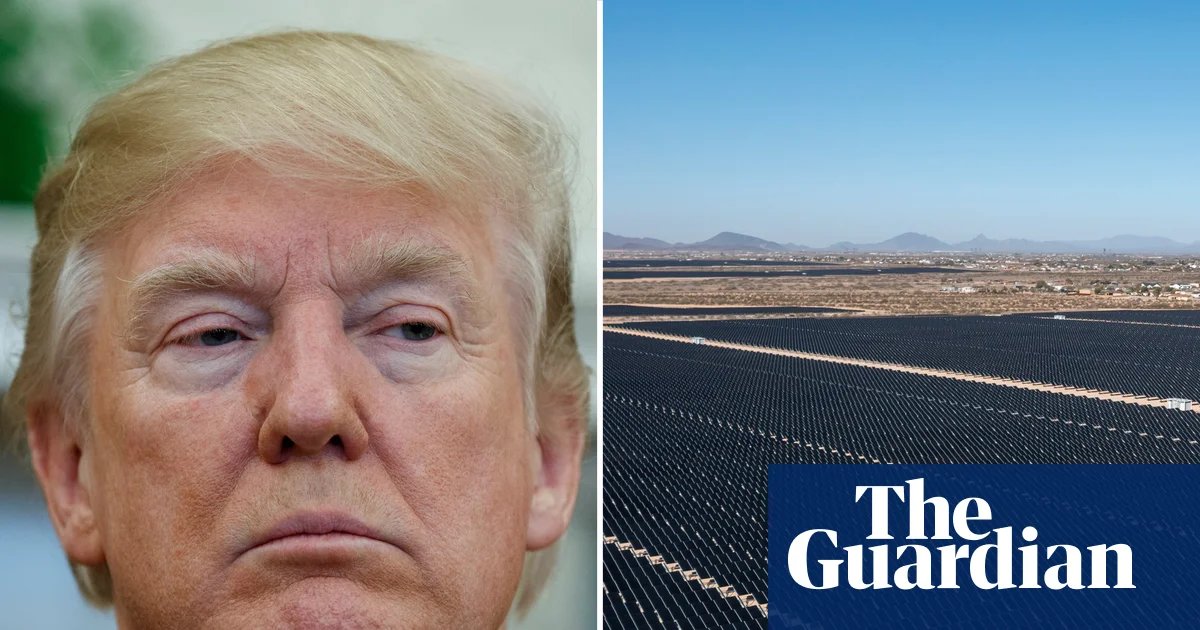
Donald Trump has wielded the full might of his administration to crush the progress of clean energy, which has called a “scam” and “stupid”. But there are signs this assault is not going to plan.
In March, the US generated more of its electricity from renewable sources such as solar and wind than it did via gas, the first time clean energy has surpassed the planet-heating fossil fuel for a full month nationally, according to data from the Ember thinktank.
While this was just one month, it follows a record 2025 for renewable energy. The pipeline of new power coming online in the US is overwhelmingly green this year, too, with 93% of all electricity capacity added in 2026 set to come from solar, wind and batteries. Just 7% will come from the fossil fuels that are dangerously overheating our world.
The undaunted pace of the renewables rollout comes as the Trump administration’s attempts to stymie the industry have floundered in court.
Last week, a federal court in Massachusetts blocked a slew of Trump’s anti-renewables actions, such as barring solar and wind projects on federal land. This follows the resumption of five major offshore wind farms, a form of energy the president has long reviled as “ugly”, that the administration had ordered to halt.
All of this has boosted optimism among clean energy advocates who have felt under siege during Trump’s second term.
“There is no truth to the death of the clean energy industry in the United States – in fact, just the opposite,” said Peter Davidson, chief executive of Aligned Climate Capital, a clean energy investor. “That’s by essentially every metric you can look at,” he added, pointing to growing electric vehicle sales as well as the escalating deployment of renewables.
Wind, solar and batteries are now far cheaper and quicker to construct than gas and coal plants, causing a market “tipping point” that Trump cannot reverse, according to Davidson.
“They cannot change the trajectory,” he said. “They can try and delay it. But the battle for the generation of electricity is over and renewables and storage have won.”
The clean energy industry still has to contend with an uncertain, volatile political environment as well as logjams that delay projects from being connected to a grid that still struggles to move clean power around the country. But fears of Trump-inspired destruction have somewhat receded.
“I’m not nearly as pessimistic as I was last summer,” said Jon Power, co-founder of CleanCapital, a solar and battery storage company. “The administration way overplayed their hand on this. They are not where the American people are and they’re having to come back to where we are.”
Some cracks have seemingly started to appear in Republican hostility to clean energy, too, with the president’s chief pollster in February finding more than two-thirds of Republican voters support solar power.
Leah Qusba, chief executive of GoodPower, a clean energy advocacy group, said her organization’s polling found just 40% of Republican voters approve of Trump’s handling of rising energy costs.
“That’s a huge red flag, I think, for the Trump administration,” Qusba said. “The momentum is undeniable. The folks that we work with, they’re not stopping. If anything, this has rallied people.”
The US’s budding clean energy sector had been left shellshocked by Trump’s hostility after he returned to the White House and enacted sweeping rollbacks to environmental rules in a bid to bolster the fossil fuel interests who donated heavily to his presidential campaign.
“We aren’t allowing any windmills to go up and we don’t want the solar panels,” Trump said last year. “Fossil fuel is the thing that works.” The president has called clean energy technology “garbage” and routinely dismissed the established science of climate change, which is caused by the burning of coal, oil and gas.
Republicans in Congress aided this onslaught by tearing up tax incentives that had kickstarted new clean energy investment, mostly in rural conservative areas. The result has been hundreds of paused or canceled projects even as electricity demand has increased in the US due to the advance of artificial intelligence, an industry the administration has championed.
Trump has even taken to handing taxpayer money to energy companies to stop them proceeding with agreed wind projects, which the administration has labeled unreliable in contrast to fossil fuels, which have been cast as irreplaceable.
“I’m pretty confident coal will lead the world in global electricity production when I die,” Chris Wright, Trump’s energy secretary, told Congress last week. “Coal is critically important to the world.”
On the same day Wright spoke, however, Ember released a report showing that renewable energy overtook coal as the world’s largest source of electricity last year. More recently, solar panel exports from China have hit a new record high while sales of electric cars around the world are booming.
Trump has urged countries to ditch what he calls the “green energy scam” but, ironically, the war he and Israel launched upon Iran has instead pushed countries to accelerate their transition away from the whip-sawing costs of oil and gas.
“There will be a significant boost to renewables and nuclear power and a further shift towards a more electrified future,” Fatih Birol, head of the International Energy Agency, told the Guardian. “And this will cut into the main markets for oil.”
Interest in electric vehicles has spiked in the US, too, amid rising gasoline costs due to the war. “I think the American people are so sick of importing this volatility into their lives,” said Qusba. “I think people are going to see that rhetoric for the sort of shortsighted foolishness that it really is,” she added of Wright’s comments about coal.
CleanCapital’s Power said that Wright is “truly an extremist on these issues, he’s not seeing clearly where the world’s going and it’s going to hurt us as an economy”.
But Power, who was White House chief sustainability officer under Barack Obama, did acknowledge that the fossil fuel industry holds outsized influence in Washington, requiring clean energy supporters to do more to convince political leaders of the sector’s growing clout.
“The fossil industry has built this ecosystem politically, they are playing in the Super Bowl and we’re still playing middle league football,” he said.
“We over-relied on being the right thing for too long versus making the business case. The good news is, though, that business case at this point is super strong. We just need to start making it.”
Wright’s office was contacted for comment but did not respond.