(Bloomberg) — The Bank of Japan left its benchmark interest rate unchanged in a split vote that increased the likelihood of a hike in June and pushed the yen higher.
Most Read from Bloomberg
The BOJ held its policy rate steady at 0.75% at the end of its two-day policy meeting Tuesday, according to a statement. Some 80% of 51 economists surveyed by Bloomberg had forecast the stand-pat decision.
The 6-3 vote represents the biggest divide under Kazuo Ueda’s governorship, suggesting swelling pressure to normalize policy.
Speaking at a press conference following the decision, Ueda said he thought an interest rate hike would be possible if the economy doesn’t enter a big slowdown. While he spoke, the yen erased earlier gains to trade around 159.42 versus the dollar, leaving the currency close to the level that the government intervened to support it two years ago.
Ueda said that upside risks to prices in Japan are greater than the downside risks to the economy for the current fiscal year. While the dissenting votes needed to be taken seriously, the rest of the board didn’t see the need for action, Ueda said.
The board’s split “strengthens the outlook for the next rate hike in June,” said Homin Lee, strategist at Lombard Odier Singapore.
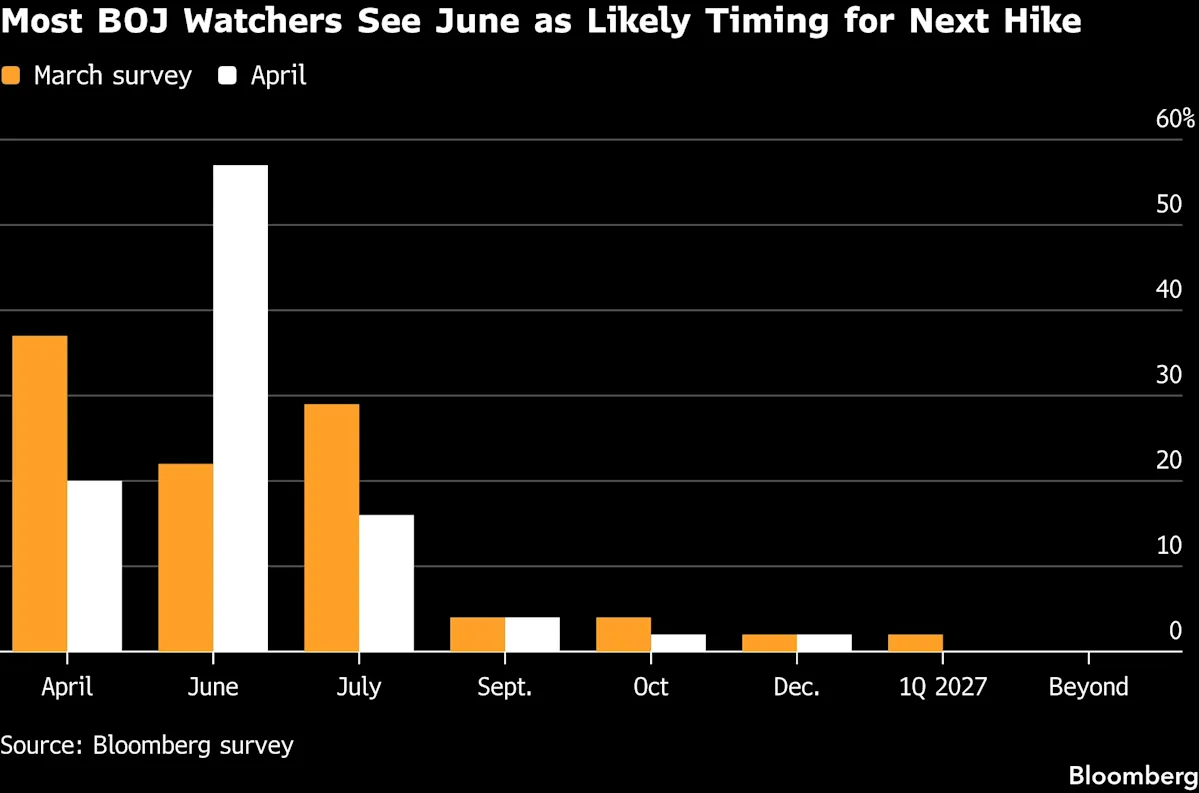
After the decision, traders saw a 68% chance of a rate hike when the BOJ next sets policy on June 16, according to pricing in the overnight swaps market. That’s also tipped by BOJ watchers, with 57% forecasting a move then, according to a survey by Bloomberg News in the lead up to the decision.
Ueda’s board raised its forecast for core inflation to 2.8% for this fiscal year, more than expected, in a quarterly outlook report. It now sees economic growth of 0.5% in the period revised down from 1% previously.
The BOJ underscored the need to watch developments in the Middle East and oil prices after US President Donald Trump’s war in Iran derailed what markets had been betting would be a hike at Tuesday’s meeting as recently as early April. Since then, many economists switched to forecasting a June increase.
“It is necessary to pay particular attention to the impact of the future course of the situation in the Middle East on financial and foreign exchange markets and on Japan’s economic activity and prices,” the bank said in a statement.
In April 2024, after a decision to hold rates, the governor’s comments on the yen were taken as dovish, sparking a rout in the currency that ultimately prompted intervention days later.
The BOJ tweaked language in its statement around its intention to raise the benchmark rate if its economic outlook is realized.
The central bank said it would keep hiking rates in response to “developments” in the economy, whereas former language cited that bias in the case of economic “improvement” — a change that may leave scope for a move even as growth slows. The bank also said it would monitor financial conditions.
Hawkish board members Hajime Takata and Naoki Tamura were joined by consensus-leaning member Junko Nakagawa in voting to increase rates at this meeting.
What Bloomberg Economics Says…
“We continue to expect the BOJ to lift its target rate to 1% in June. That said, it’s not clear-cut with the central bank’s independence under pressure from Prime Minister Sanae Takaichi’s pro-stimulus administration. It was that pressure, in our view, that prompted the BOJ to soften its hawkish stance seen in March.”
— Taro Kimura, economist
Click here: Rate Hold Faces Heat From Three Dissenters, Oil Shock
The bank said price trends are likely to be in line with its target of 2% in the second half of fiscal 2026 to fiscal 2027. That timing is largely in line with past guidance. The bank’s rolling three-fiscal year outlook period has now shifted to include fiscal 2028.
The BOJ is the first among major central banks this week to stand pat, with the Federal Reserve, Bank of England and European Central Bank all forecast to follow suit as they assess fallout from the war in the Middle East. The BOJ’s rates are the lowest among major economies, creating a yield gap that’s contributing to the yen’s relative weakness.
Still, Prime Minister Sanae Takaichi’s preference for ongoing monetary stimulus may complicate the BOJ’s efforts to continue policy normalization. Toichiro Asada, who is known as a reflationary academic, sat at the rate-setting meeting for the first time since he was selected by Takaichi to sit on the board. Ayano Sato, also known for her reflationary stance, will join the board in June.
“Everything hinges on the situation in the Middle East,” said Harumi Taguchi, principal economist at S&P Global Market Intelligence.
–With assistance from Mia Glass, Molly Smith, Yoshiaki Nohara and Brian Fowler.
(Updates with press conference comments, yen reaction)
Most Read from Bloomberg Businessweek
©2026 Bloomberg L.P.


 dailynewsnblog