dailynewsnblog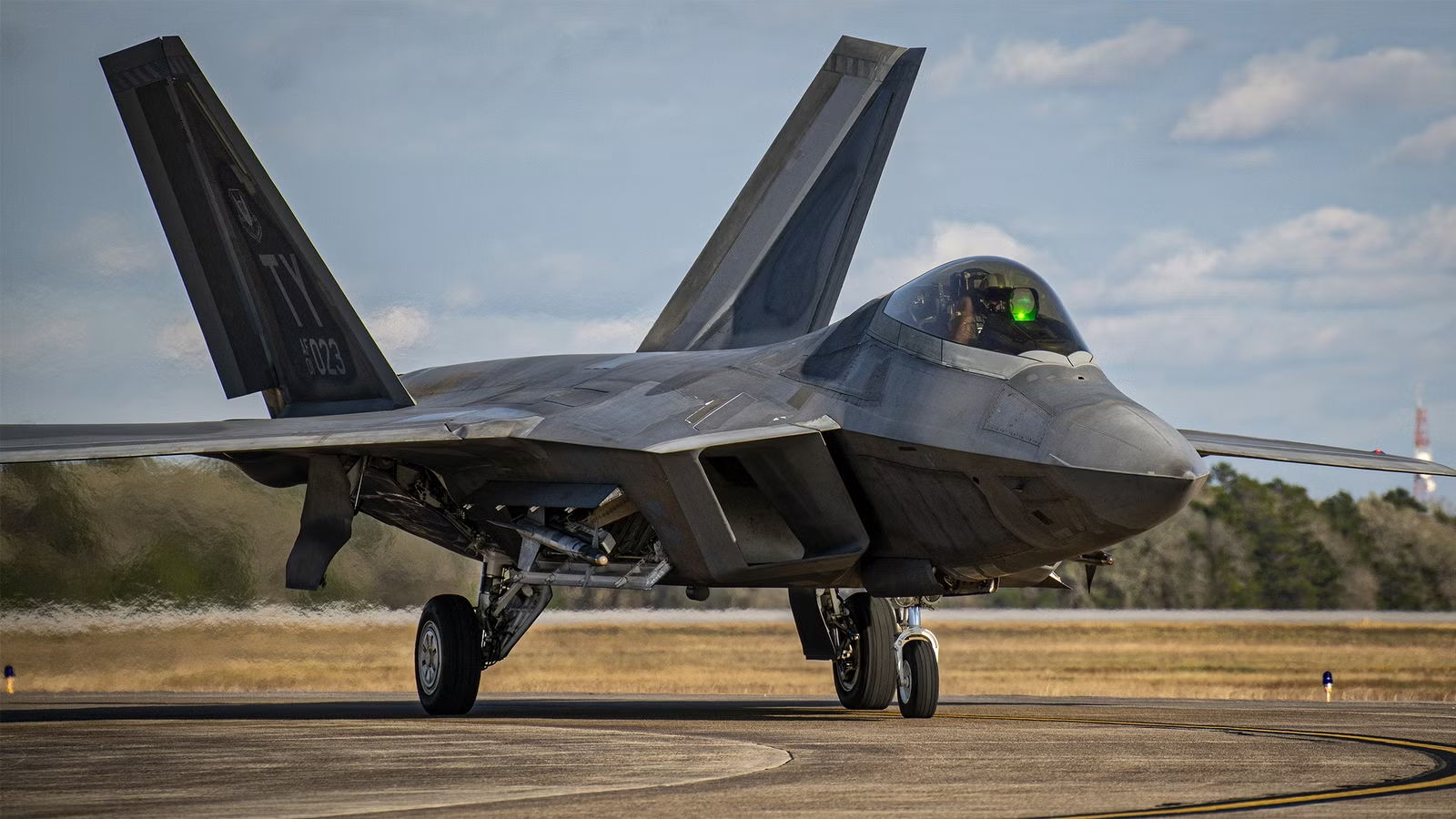
The United States Armed Forces, including the Air Force, Navy, and Marines, are on a trajectory to dramatically expand their fleet of Next Generation fighter jets. The introduction of the Lockheed Martin F-35 Lightning II has helped grow the fleet of stealth fighters to an order of magnitude greater than it was for decades. Although the F-22 Raptor debuted in 2005, the small fleet has been treated as a ‘silver bullet’ and never replaced the primary workhorses of the Air Force, let alone the fighter jet fleets of the other service branches.
All that is about to change. The production run of the F-35 has already achieved an epic scale of deliveries with more than 1,300 now in service. Current plans call for more than 3,000 of these jets to be built, and more than half of those will be in the service of America alone. Adding to that, the Air Force made the first major step forward in its Next Generation air dominance program in early 2025 when it awarded Boeing the contract to begin the F-47.
In the next decade, there will be over a thousand stealth fighters between the F-35 and the NGAD fleet of the three service branches that operate them. Yet, the true growth comes from 1,000+ Collaborative Combat Aircraft, autonomous stealth drones designed to fly alongside crewed fighters. Each crewed fighter is expected to be paired with at least two of these uncrewed platforms. This evolution across three service branches will mark a paradigm shift in American air power that will define the coming century of air warfare.
An Era Of Rebuilding: The Effect Of Ending The Raptor

Since the shuttering of F-22 manufacturing, there has been an ongoing debate about the strategic wisdom of closing down the line. The move has been attributed to cost considerations that were weighed against the changing nature of global defense needs. The critics argue that mothballing the source of the Raptor leaves the potential that the United States could be unprepared in future conflicts against near-peer adversaries that require a ramp-up of production in advanced defense industries.
The US originally planned to build 750 but the halt of F-22 production was decided solely due to budgetary constraints that forced a choice between the advanced conventional fighter’s funding and programs that focused on irregular warfare and newly emerging adversary technology. The F-22 comes at a heady cost of approximately $150 million per unit.
The initial estimates by Congress project a price of roughly $300 million per F-47. But, according to Defense Scoop, Air Force Chief of Staff General David Allvin publicly stated that the program goal is to have each be less expensive than the F-22. Not only will the Air Force have at least 200 of these, but the Navy and possibly the US Marines expect to acquire the F/A-XX, which could share the same airframe or at least enter service around the same time. The combined total of 6th-Gens will be nearly 500 airframes after all are delivered.
The F-22 Silver Bullet: A Precious Few Stealth Fighters

For the foreseeable future, the Air Force will have to settle for the current F-22 fleet size of 186. In actuality, the fleet appears even smaller in the readiness picture. In 2024, a mission-capable rate of about 40% was noted. The downtime resulting from maintenance cycles, upgrades, and attrition will make this limit even worse. Less than 100 F-22s are thought to be combat-ready at any given time, according to recent estimates. Renewed production proponents contend that this readiness posture makes it more difficult for the US to project power when necessary and discourages aggressive behavior from adversaries.
It is no secret that the F-22 was one of the most expensive aircraft ever developed. This is one area in which its successors are significantly better. Although the F-35 program has been reported as the most expensive defense project in history, which is accurate, that $2 trillion price tag covers a nearly 100-year program lifetime. Not only will the assembly line deliver several times more planes, but each jet is nearly half the flyaway cost.

Which Country Has The Most Powerful Fighter Jets?
The warbird world leaders.
The Timeline To Achieve 6th-Gen American Air Dominance

According to some expert analysis, such as that published in the National Security Journal, the F-47 project is up to four years behind schedule because it is falling behind the People’s Republic of China in terms of development speed. The F-22 Raptor, the world’s first fifth-generation stealth fighter developed by the United States Air Force and Lockheed Martin, took 15 years from prototype to production. In comparison, the PLAAF developed the Chengdu J-20 Mighty Dragon in only six years.
There will undoubtedly be many other potential roadblocks ahead, as the F-47 is expected to be equipped with a slew of never-before-seen technology. At the moment, the main stumbling block is the variable cycle engines, which are expected to be delayed until 2030. Despite the challenges, the program has been accelerated since Boeing was officially awarded the contract in March 2025, with the first aircraft reportedly already in production. Its first flight is expected around the end of 2028.
Leading lawmakers already informed Air and Space Forces magazine last month that the Navy’s F/A-XX and the F-47 won’t be fully operational until the mid-2030s. The Navy’s F/A-XX carrier-based fighter is developing more slowly and with challenges due to financial limitations. The program was shelved in early 2025 to make room for the Air Force’s F-47, but Congress revived it in early 2026 by adding nearly $900 million to the budget.

Here’s Why Air Forces Are Expanding Their Stealth Fighter Programs
The global race for the ultimate stealth jet.
A Stealth Arms Race: How China Has Closed The Gap

The primary driver behind the renewed push to introduce 6th-generation stealth fighters and bombers in America is the closing technological gap between the US and its adversaries. The global defense landscape has evolved in many ways since the F-22 was shut down. Other 5th-generation platforms have emerged in both allied and adversary fleets, like China’s J-20 stealth fighter and Russia’s Su-57.
Specifically, China has made large strides in reducing the ‘parity gap’ in recent years. According to the Aviationist, there are at least 300 Chengdu J-20 Mighty Dragon stealth fighters currently in service, and the production rate is increasing. The J-20 is the most numerous non-American stealth aircraft in the world, and it was recently upgraded with new engines. The factory has even made the only two-seat configured stealth aircraft in the world.

Why The Pentagon Is Worried About International Stealth Fighter Development
The new 5th-generation arms race.
21st Century Adversary: China’s Growing 5th-Gen Fighter Fleet

19FortyFive reported that the Mitchell Institute estimates that annual delivery rates could exceed 120 airframes per year by the end of 2026. China is expected to have a total J-20 fleet strength of over 1,000 aircraft by 2030. Additionally, the new J-35A multi-role stealth fighter is expected to go into production imminently, and deliveries are estimated to potentially reach as high as 350 by that same time. This would give the People’s Liberation Army Air Force and Navy nearly equal footing with the US and its allies in the Asia Pacific region.
The next Chinese stealth fighter expected to enter service is the J-35, a more mission-flexible twin-engine stealth fighter that appears to parallel the Lockheed Martin F-35 Lightning II. The J-35B is designed with electromagnetic catapults for China’s newest aircraft carrier, the Fujian. Another variant was seen in green primer paint for a flight test early this year, suggesting that the land-based model has potentially begun low-rate production.
Although it has yet to field a second stealth fighter type, two or three prototypes of 5th and even 6th-generation aircraft have already been seen in public social media channels. Simultaneously, China is surging in manufacturing capacity, with projections suggesting it could produce up to 400 tactical stealth aircraft annually.

How Fighter Jets Have Evolved Over The Last Decade
A closer look at the arms race for the smartest warbirds.
The Pentagon’s Air Warfare Plan: Is It Enough?

The halt of F-22 production disrupted the US aerospace sector, which had a ripple effect throughout subsidiary and other connected manufacturers. The loss of funding led to closures and job eliminations, and another effect is the loss of individuals with critical skills, as well as available infrastructure to support producing 5th-generation tech. When Lockheed Martin dismantled the Raptor production line, it left the US without the capability to manufacture additional units unless the entire supply chain were to be rebuilt.
Experts are already weighing whether the United States has planned for a sufficient number of sixth-generation aircraft. Even with the higher total order of 300 F-47 fighters and 200 Northrop Grumman B-21 Raider stealth fighters, some analysts say that it is inadequate to counter China’s capability in a major conflict. The downsizing of the US Air Force and other service branches’ exquisite air warfare platforms for conventional conflict in favor of asymmetrical and counter-guerrilla weapon systems has degraded the US Armed Forces’ dominance.
A dramatic increase in size from 100 to 150 stealth fighters to nearly 2,000 manned 5th and 6th generation fighter jets supported by over 1,000 combat drones would be the ideal scenario. The timeline to achieve this force recapitalization is also an issue, however. Although the first two examples of the B-21 are already airborne, it will be several years before the first NGAD or F/A-XX takes flight. Meanwhile, the US Marines have only recently issued the first late-stage prototyping contract for a loyal wingman drone in early 2026.