dailynewsnblog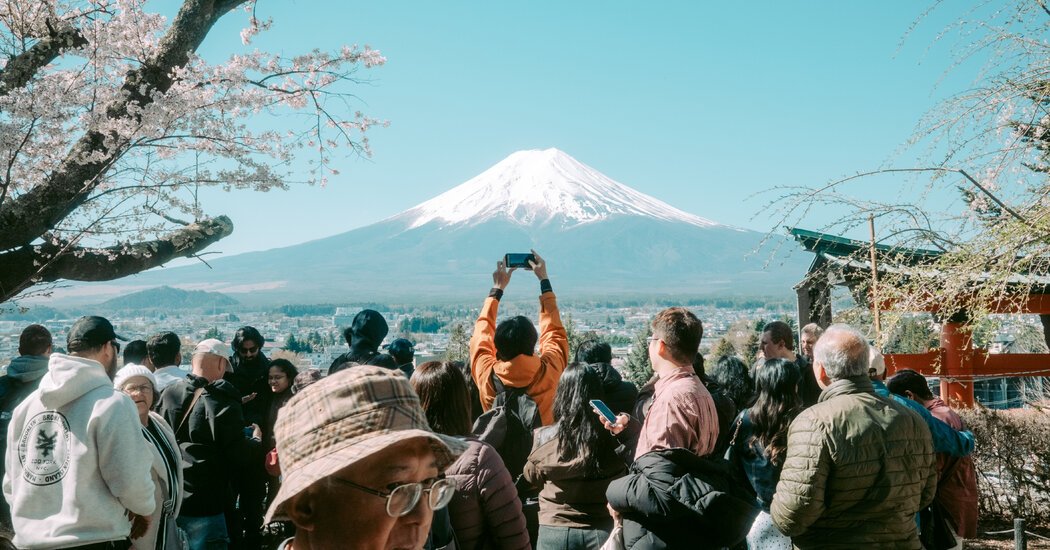
Just after sunrise on a cloudless spring day, Junichi Horiuchi, wearing a Dodgers cap and hot-pink gloves and carrying a walking stick, was on the hunt.
Mr. Horiuchi, the leader of a civic group, was picking up trash and looking for unruly tourists at Arakurayama Sengen Park in Fujiyoshida, an idyllic town of about 46,000 in the foothills of Mount Fuji. He was joined in his quest by a local radio personality and a professor of medicine. The trio issued polite warnings to tourists who ventured off the designated path.
For Mr. Horiuchi, 54, the mission is personal: He broke almost 30 bones last year, he said, when he crashed his bicycle while trying to avoid a group of tourists taking an Abbey Road-style photo with Mount Fuji in the background.
“I want people to respect Japan’s culture and rules,” he said, surveying the early morning throng of tourists, some of whom had camped out all night for the perfect sunrise shot. “This is a matter of life and death.”
Fujiyoshida, which lies southwest of Tokyo, is at the center of Japan’s fight against badly behaved tourists. Foreign visitors, spurred in part by a weak yen that makes their money go further in Japan, have poured in: There were roughly 42 million in 2025, double the number a decade ago. Now anti-foreigner sentiment is rising in some parts of the country, and the authorities have faced pressure to limit the number of visitors.
With its fading textile industry, Fujiyoshida once craved more tourists to help rejuvenate its economy.
Not anymore.
There have been widely publicized reports of visitors using backyards as bathrooms, entering homes without permission, blocking school traffic and leaving behind heaps of trash.
This year, the town took drastic action: It canceled its marquee cherry blossom festival, which began a decade ago, declaring “the peaceful lives of our citizens are being threatened.” Officials also banned news outlets from capturing picturesque scenes that “could contribute to overtourism.”
Mayor Shigeru Horiuchi said the decision to cancel the festival was not about stopping people from seeing cherry blossoms — indeed, officials did not block off any areas. Instead, he said, he was trying to discourage tourism in the busiest areas in response to complaints from residents about congestion. While the town has built more bathrooms and parking spaces, it has struggled to deal with the foot traffic. He also wants tourists to go to parts of Fujiyoshida not familiar from Instagram.
“The patience of residents is reaching its limit,” he said in an interview at City Hall.
Despite the cancellation of the festival, tens of thousands of people have continued to flock to the town, lining up for selfies at the Chureito Pagoda and snacking on local specialties like Yoshida udon noodles or strawberry-flavored soft-serve ice cream, colored red to evoke the sunrise over Mount Fuji.
On a recent day, a group of friends from the United States ventured off the main path to snap selfies under the cherry blossoms.
“I saw this gorgeous photo on social media, and I was like, ‘How can I get myself here as fast as possible’?” said Julia Morrow, 26, a retail worker from Ohio. “If you don’t get that photo, it’s like, what’s the point of the trip?”
Some visitors said they had taken time to study Japanese customs before their arrival: No walking and eating at the same time. Carry your own trash bag.
“We’re trying to be respectful,” said Karlene Morgan, a teacher from New Zealand, who was on an 11-day tour of Japan with her partner to see cherry blossoms. “It’s what we would want if someone was coming to our country.”
‘I Want to Escape’
For decades, Fujiyoshida was well off the radar, even for many Japanese. That began to change in 2013, when UNESCO added Mount Fuji to its World Heritage list. With the local weaving industry in decline, the town tried to appeal to a more cosmopolitan crowd. Wine bars and traditional izakaya bars popped up where vacant shops once stood.
Then, after the pandemic, hordes of tourists arrived looking to replicate majestic views of Mount Fuji they had seen online, often set to music by Coldplay, Hans Zimmer and others. “This isn’t a movie set. It’s Fujiyoshida,” reads one on Instagram.
Troubles with overtourism are widespread in the area. In nearby Kawaguchiko, officials put up a billboard-sized screen in 2024 to deter tourists from photographing a convenience store that had become a social media phenomenon because it appeared as if the mountain were sprouting from its roof.
Coji Maeda, the owner of a silk screen printing company, bought a home near the train station serving Fujiyoshida with a view of Mount Fuji in 2000. He was drawn to the neighborhood for its serenity. Now he watches each day as thousands of people march by his home on their way to the park. Sometimes they take a shortcut through his front yard.
“When I first started seeing tourists, I thought, ‘This is crazy,’” he said. “I really do have this feeling that I want to escape. I want to move.”
Yet some residents have made peace with the influx. Eido Watanabe, the chief priest at the Nyorai temple, near Arakurayama Sengen Park, said Buddhism emphasized the importance of tolerance. Foreigners now far outnumber Japanese visitors to the area. At a nearby shrine, messages written by visitors on amulets that hang outside are now primarily in English.
“It’s hard for anyone to suddenly change their habits, so I think it’s important, in welcoming foreigners, to guide them as much as possible,” he said.
He added, “If you approach people with a kind heart and a smile, your feelings will be conveyed to them.”
Business owners say that Fujiyoshida needs to find ways to get tourists to spend more time and money at local shops, restaurants and hotels. These days, visitors often stay in the town for only a few hours — long enough to get a photo and get out.
Kazuko Watanabe, a third-generation owner of a shoe store downtown, said “everyone just passes through.” From her store window, she watches as crowds of tourists snap photos of old-fashioned storefronts with the backdrop of Mount Fuji, creating a traffic hazard.
She said she welcomed more tourists, but that the town should do more to help them understand Japanese rules.
“I think it’s a bit much to expect them to understand everything,” she said.
Mr. Horiuchi, who leads the park patrols, said he hoped to persuade visitors to connect more with Japanese culture. Lately, he has been stopping tourists to encourage them to pray at a Shinto shrine in the park, following Japanese tradition, before climbing up the stairs for photos near the pagoda. He tells visitors that for Japanese people, the park is a sacred area.
“You have to adapt to the local people, not just your own manners and feelings,” he said. “I want this place, this area, to be kept clean, in this state, for a long time — even for my grandchildren’s generation.”