dailynewsnblog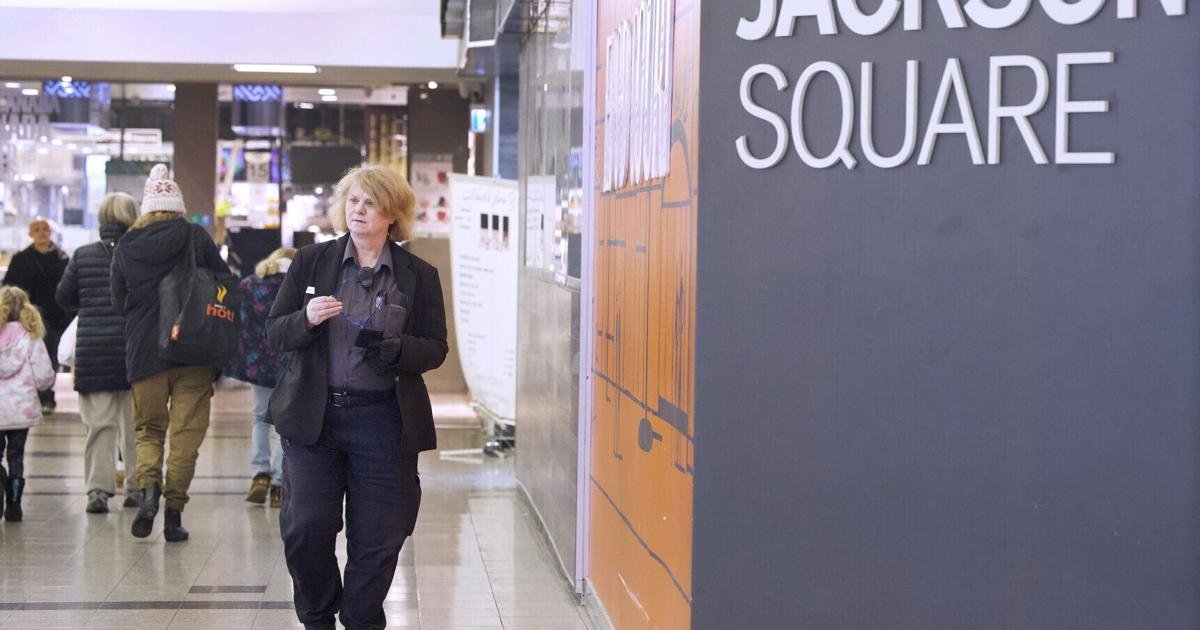
Two acres in the sky, the lungs of a new Hamilton.
That was the vision for the plaza atop Jackson Square when the landmark downtown complex opened in August 1972.
Perched above the shopping concourse of the $100-million, block-spanning development and framed by the sparkling glass and steel of Stelco Tower, the elevated park stood as the centrepiece of a core reborn.
Trees of all kinds — locust, hawthorn, Russian olive, Austrian pine — rose from sandblasted planters. Winding between them were walkways made of light-red concrete. At the centre sat a reflecting pool, fitted with underground pipes to run in winter. Nearby was a stage with seating sloped like an amphitheatre.
Developers called it “a people place,” reminiscent of Toronto’s Nathan Phillips Square and New York’s Rockefeller Center.
Mayor Vic Copps saw it as the jewel of Hamilton’s “great rebirth.”
The Spectator promoted it as a “$30-million step into the future.”
On opening night, some 20,000 people poured onto the plaza. Teenagers climbed into the reflecting pool. Bands played. Fireworks lit the sky.
“I think it’s the type of thing that can bring the city together,” one person told The Spectator at the time.

A wide view of the rooftop courtyard at Jackson Square, showing the elevated public space above the downtown complex.
Cathie Coward/The Hamilton Spectator
Today, those remarks feel like a distant memory.
What was once envisioned as a place for public gatherings and concerts now reflects the current pressures facing the core.
As does the sprawling mall beneath it.
In a downtown plagued by overlapping homelessness, addiction and mental-health crises, Jackson Square has quietly become the city’s largest accidental social service drop-in centre, an everyday refuge for people with nowhere to go.
It’s a role it was never designed to play — and one that is increasingly tough to navigate.
Security costs, both on guards and cameras, have skyrocketed in the past decade, according to property manager Allison Drennan. Incidents of vandalism, shoplifting and overnight break-ins are up, as are cases of violence, harassment and threats, often directed at staff, she said.
Tenant retention continues to be a concern. Of Jackson Square’s 150 advertised retail spaces, nearly 40 are up for lease, along with dozens more vacancies in the surrounding office towers. Just last week, Laura Secord, one of five original stores remaining in the shopping centre, announced its closure.

“Leasing opportunity” signs line a corridor inside Jackson Square, where dozens of retail units currently sit vacant.
Cathie Coward/The Hamilton Spectator
But at Jackson Square — which sits in the heart of the core with entry and exit points in every direction — they are acutely visible.
“It suffers from what was once its main benefit: right in the centre of downtown, very accessible,” said Pierre Filion, an urban planning professor at the University of Waterloo.
Security threats and daily risks inside Jackson Square
Standing on the rooftop plaza on a recent Friday afternoon, longtime Jackson Square security guard Betty Armstrong likens the two-acre space to a “cesspool” of drugs, loiterers, disorder and vandalism.

A Spectator feature ahead of Jackson Square’s opening showcases the design of the complex, including its rooftop plaza, reflecting pool and connection to surrounding downtown buildings.
The Hamilton Spectator
The bones of the developer-touted “people place” are still there — light-red walkways, sandblasted planters, reflecting pool — but the scene has shifted.
Where concerts and rallies were once imagined, a group blasts music from a hand-held speaker. On a nearby stairwell, a man smokes from a crack pipe. In one of the groves, another appears to prepare a needle. A third lingers near an entrance to the mall, pants half-down.
“You know where the church is, on James Street?” Armstrong tells the man. “You can go there, or you can try the library. But you can’t come in here like that.”
“This is a hot spot,” adds the 62-year-old, Jackson Square’s longest-tenured guard, as she steps back out onto the north side of the plaza.
With stairwell access via York Boulevard and King, Bay and James streets — all steps from shelters and social service operators — the roof is a natural gathering place for some of Hamilton’s most vulnerable residents.
Armstrong says overdoses here are a near-daily occurrence.
She points to two teenage-looking boys clad in balaclavas and puffy winter coats.
“Dealers,” the security supervisor alleges, strutting toward them.

Security guard Betty Armstrong walks through Jackson Square on patrol. The longest-tenured guard in the downtown complex says, “There is so much happening here, I can’t even begin to explain to new staff what to expect.”
Cathie Coward/The Hamilton Spectator
“Look, they see me coming, so they’re leaving. But they’ll be back in five minutes, just watch. Different kids show up every day to sell drugs here because they know this is where people are looking for product.”
Many in the plaza mind their own business and leave when told. Others, especially in winter and at night, enter the mall for shelter or to use drugs. Some cause damage to property and vandalize — and don’t take well to direction.
Guards who patrol the plaza about once every hour often do so in clusters of two or three due to safety concerns.

A mall directory stands in the foreground as people walk through Jackson Square in downtown Hamilton.
Cathie Coward/The Hamilton Spectator
“When they ask someone to leave, they’re regularly met with instant aggression,” Drennan said in an interview. “They experience harassment, racial comments, threats. They’re spat on.
“The stuff we’re seeing on a daily basis is unlike anything the traditional mall security guard faces.”
“I’ve been told I’ll be killed and stabbed,” Armstrong added while on a tour of the mall in late March. “I’ve been told, ‘I’ll see you after work. I’ll be waiting.’ It’s constant. Every time we kick somebody out, there’s some kind of threat there.”
Security costs surge as Jackson Square expands frontline response
Since 2020, the cost of the mall’s third-party security contract has grown by 68 per cent, according to Drennan. The number of guards has climbed to about 30 — more than double what it was a decade ago — with 24-7 coverage Monday through Sunday and 10 to 15 guards on each shift.
“There’s not a day and time when we don’t have guards on shift,” said Drennan, who was hired in 2014. “Whereas before we were able to lessen the load of nighttime security guards, we now run two equal shifts for day and night.”
Drennan would not disclose how much Jackson Square spends on guards.

Security guard Betty Armstrong speaks with a man inside Jackson Square while asking him to leave the premises.
Cathie Coward/The Hamilton Spectator
But investment in security — among the mall’s biggest operational concerns alongside tenant retention — extends far beyond staff.
Surveillance is another key focus. There are now nearly 200 cameras on the property, with another 20 scheduled for installation in 2026 — so many that Jackson Square had to hire someone exclusively dedicated to around-the-clock CCTV monitoring, Drennan said.
“Not only do we have to worry about the retail side of the mall, but we have to worry about what’s happening outside, including the rooftop,” she added. “We’ve increased well over 50 per cent of cameras just on the exteriors of the building because of broken doors and windows from break-ins.”
The mall recently began to provide guards with body-worn cameras to capture interactions. A select group of core security — people there for more than five years — are trained in de-escalation tactics, with at least three on each shift rotation.

A Jackson Square security guard wears body-worn camera equipment as part of expanded safety measures at the downtown complex.
Cathie Coward/The Hamilton Spectator
They’re things Armstrong didn’t foresee when she joined Jackson Square as a junior guard in 1999.
Back then, her biggest worries were shoplifters and troublemaking teenagers.
Now, the worries are too many to count.
“We are security. We are paramedics. We are social workers. We are everything in this mall. There is so much happening here, I can’t even begin to explain to new staff what to expect.”
As Armstrong finishes patrolling the southwest portion of the rooftop, she loops back to the main plaza to find those same balaclava-donning teens she’d pointed out 15 minutes earlier.
“I told you they’d be back,” she says.
“Dealers,” she adds, speaking generally, “they’re my biggest headache right now.”
An increased police presence at Jackson Square “has made a huge difference” for its staff, specifically when it comes to drug dealing and serious incidents, according to Armstrong.
But open drug use in public spaces is handled differently than it once was.
Under Bill C-5 introduced in January 2025, open drug use is now approached from a public-health lens. While still a criminal offence, officers are directed to support people who use in public through education, de-escalation and voluntary treatment referrals rather than arrest them. There is no criminal consequence for refusal of treatment.
“If you get caught doing crack, they can take your pipe, take your drugs, but it’s your choice if you want to go into rehab,” Armstrong says. “Police do what they can, but their hands are tied.”
She looks toward the mall entrance and sighs.

Jackson Square entrance at King and James streets in downtown Hamilton.
Cathie Coward/The Hamilton Spectator
The man who’d been lingering near the door has also returned. Now he’s inside, next to an escalator that leads to the food court, pants still sagging, an open backpack and shreds of garbage at his feet.
“They always come back,” a slightly exasperated Armstrong says, gearing up for another approach. “It’s like their second home. They have no other place to go. This whole mall is all they know.
“We’re being treated as a shelter, but we’re not a shelter. We’re a place of business.”
Homelessness and addiction reshape downtown core dynamics
What’s happening in Hamilton’s core reflects broader societal trends, according to Filion, the urban planning professor from the University of Waterloo who used to take his students to downtown Hamilton for field trips.
“All of those overlap, and you’re left with an increasingly big class of people with nowhere to go,” he said.
Downtowns of mid-sized cities make for a perfect destination.
They’re accessible, open, walkable, close to social services and familiar. And unlike the downtowns of old — think 1970s, when construction boomed to attract suburban shoppers and workers — Filion said the cores of today don’t attract the same crowds. Big-box stores and suburban malls removed the need to shop downtown. Then the pandemic cleared out offices and workers.
“It’s not a surprise that many downtowns, not just Hamilton, find themselves where they do,” Filion said.
Filion said people who live rough, just like anyone else, crave community. “They know each other and want to be together. They interact with one another and they need to have a place where that can happen.”
And where else but downtown?
“It won’t happen in a suburb. They can’t hang around a suburban mall because they’ll be kicked out, and there’s no conglomerate space where they can congregate. So, of course, they end up in downtown because it’s accessible.”
Places like Jackson Square — open, interconnected and spanning multiple blocks — are left at an insurmountable disadvantage.
And businesses pay the price.
“Jackson Square was built for a different era of retail and urban development,” Mayor Andrea Horwath said in a statement. “Across Hamilton and communities nationwide, traditional malls are facing the same realities — changing shopping habits, the loss of major department stores, and growing demand for mixed-use spaces that combine housing, shopping, services and entertainment.”
Those pressures are felt most clearly on the ground. Consider a snapshot of Armstrong’s shift on March 12.
Disney on Ice was in town. As families and kids in costumes filtered out of TD Coliseum after a matinee showing, a mother and her two daughters paused on the sidewalk, looking down a crowded path that leads to Jackson Square’s York Boulevard entrance.
“It’s OK, you can come in,” Armstrong told the trio, slightly nudging a pair of unhoused men — one of them with a crack pipe — to the side.
“We’re just going to the food court,” the mom said.
“Yep, you’re all good here. Just come on through. Entrance is open.”
Just behind Armstrong, a man was passed out, barely responsive, in between the doors.
“You OK, sir?” Armstrong asked him to no avail. She called another security guard over. “You can’t be laying here in between the doors, sir. There’s families coming through.”
The man eventually came to and left the building.

Two security guards assist a man who had been lying unresponsive near an entrance to Jackson Square as families arrive at the mall following a Disney on Ice show.
Cathie Coward/The Hamilton Spectator
“This is every day,” Armstrong explained. “Our guards are constantly bringing people back to life with Narcan. And people walk by and they don’t know if they should or can come inside.”
Guards at the mall have these interactions multiple times a day. Armstrong said some people might see them as “heartless.”
“But we’re not trying to be heartless. At the end of the day, we’re a business, and we’re hurting down here. We’re hurting. And the people are hurting.”
Restaurant owner says downtown foot traffic came with challenges
Sourav Thakuri is the owner of Himalayan Hearth Bar and Grill, a restaurant inside Jackson Square with street access via King.
He said he calls security multiple times a day due to overdoses and disturbances involving non-customers.

Sourav Thakuri, owner of Himalayan Hearth Bar and Grill at Jackson Square, poses inside his restaurant. He says operating in the mall has been challenging, with frequent disruptions linked to overdoses and disturbances just outside his door.
Cathie Coward/The Hamilton Spectator
“It’s part of the routine,” he said. “The problem was especially bad in the winter. People came in to just sleep in the doorway. I’m inside the restaurant and guests are telling me someone is passed out in the doorway.”
Thakuri — who put a sign thanking mall security outside his eatery — said he can’t manage the constant barrage.

A sign outside Himalayan Hearth Bar and Grill thanks Jackson Square security staff for their support.
The Hamilton Spectator
“I tell them it’s just for guests, to please leave, and they don’t listen to me. I cannot kick them out myself. Security, they really, really help us.”
Even with a quick response from security, business still suffers, Thakuri added.
He pointed to Google reviews that laud the restaurant’s food and service.
In one, “someone came in and overdosed while they were eating” and they wrote that the view “wasn’t pleasant.”
“It’s frustrating because it’s something we can’t control. We can’t lock the door.”
Previously from Scarborough, Thakuri had never heard of Jackson Square before he opened his eatery there in October. On the map, it looked like prime real estate: heart of downtown, in a mall with outdoor access, next to loads of shops and offices.
“You look for foot traffic, and it seemed perfect,” he said.
City weighs broader fixes as security demands climb
As challenges mount at Jackson Square, the city is eyeing a new strategy to revitalize the core.
The 10-year plan, recently presented to councillors, draws on a host of short- and long-term actions, from more lighting and redesigned parks to the redevelopment of high-profile sites.
Horwath said the effort is aimed at making the core “cleaner, safer and more vibrant,” adding that major sites across the city are part of a broader push to reimagine downtown spaces.
“And Jackson Square must be part of that conversation as well.”
Considered a “practical road map,” the strategy follows from other major investments in the core — some of them private.
The opening of the revitalized TD Coliseum — and its busy slate of artists and performers — alongside the planned LRT line offers optimism for a new era of the core centred on foot traffic and commerce.

The TD Coliseum sign is visible from the Jackson Square courtyard, where event traffic brings visitors through the downtown core.
Cathie Coward/The Hamilton Spectator
City leaders, meanwhile, have already focused heavily on improving safety.
In 2023, amid concerns of vandalism, thefts and loitering, Hamilton police piloted a specialized unit dedicated exclusively to foot patrols around the core. The unit was made permanent last year following rave reviews from downtown business owners.

Connected to a movie theatre and hotel, Jackson Square cannot fully lock down, particularly in areas linked to its underground parking. Under a fire exit stairwell leading to the garage, a sheet of plywood has been screwed into place to block off a corner that has often been used for shelter. “There’s always a way to get in,” security guard Betty Armstrong said.
Cathie Coward/The Hamilton Spectator
The Hamilton Farmers’ Market and Central Library — both connected to Jackson Square — have also received significant funding to increase security.
The market received $25,000 for extra security needs — it shares general security costs with the library — after council voted overwhelmingly in favour of the measure last February.
The library, meanwhile, devoted more than $1.3 million to security operations in 2024, more than double the $617,000 spent in 2021, according to city statistics.
Amid concerns over drug activity, it also recently introduced a temporary plan to allow only card-carrying members to enter the York Boulevard branch.
Jackson Square doesn’t have that ability.
“We’re a shopping mall. We can’t just lock our doors and restrict people from coming in, and we can’t put security guards at every entrance,” said property manager Drennan. “The only resource we currently have to make our tenants feel safe is increasing our security contracts.

Shoppers move through the concourse at Jackson Square, a downtown mall grappling with rising vacancies and safety concerns.
Cathie Coward/The Hamilton Spectator
“Is that going to work? I’m not sure.”
Drennan commended the additional police support in the core and said the city has “been very responsive.”
But she also believes there’s a need for bigger-picture solutions to the problems at Jackson Square.
“I think the social changes affecting the city and Canada require co-ordination from all levels of government,” Drennan said. “I think there’s broader societal issues at play here.”