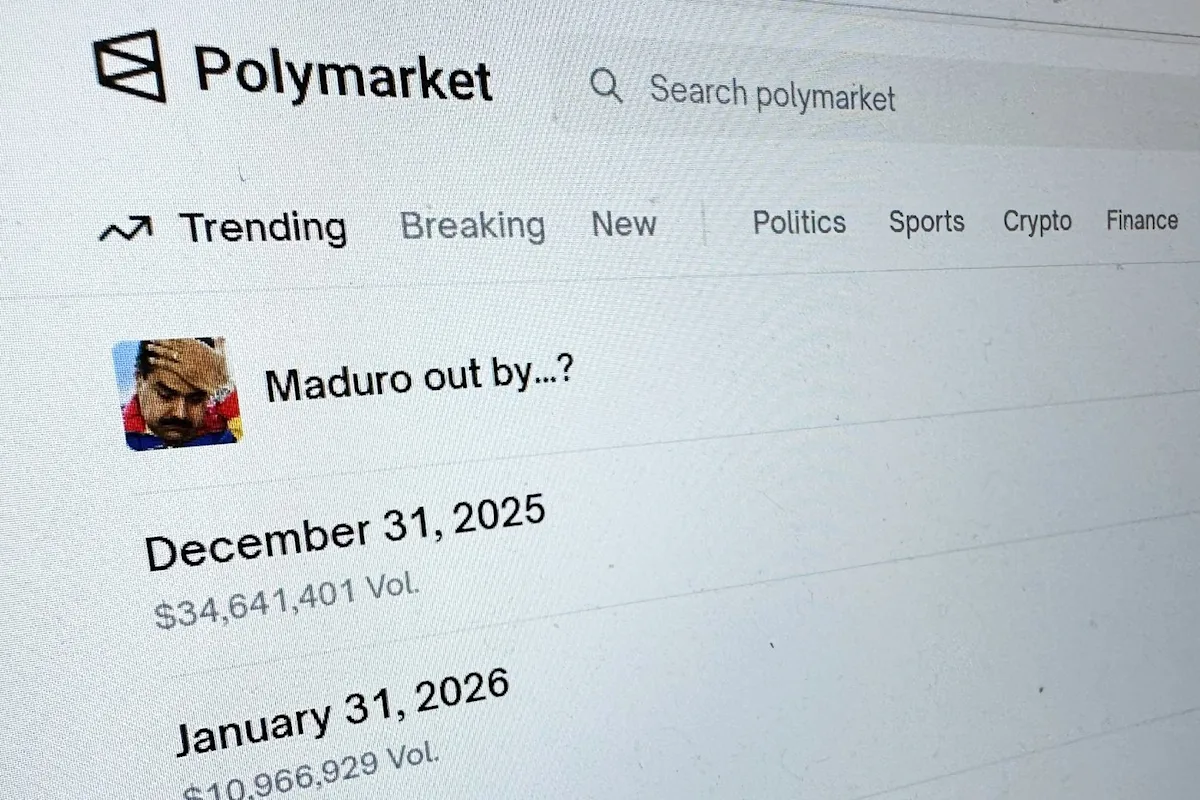
WASHINGTON (AP) — A U.S. special forces soldier involved in the military operation to capture Venezuelan President Nicolás Maduro has been charged with using classified information about the mission to win more than $400,000 in an online betting market, federal officials announced Thursday.
Gannon Ken Van Dyke was part of the operation to capture Maduro in January and used his access to classified information to make money on the prediction market site Polymarket, the federal prosecutor’s office in New York said.
He has been charged by the Justice Department with unlawful use of confidential government information for personal gain, theft of nonpublic government information, commodities fraud, wire fraud and making an unlawful monetary transaction. He could face years in prison.
Van Dyke, 38, was involved in the planning and execution of capturing Maduro for about a month beginning Dec. 8, 2025, according to the federal prosecutor’s office. Even though he signed nondisclosure agreements promising to not divulge “any classified or sensitive information” related to the operations, prosecutors say the Army soldier used this information to make a series of bets related to Maduro being out of power by Jan. 31, 2026.
“This involved a U.S. soldier who allegedly took advantage of his position to profit off of a righteous military operation,” FBI Director Kash Patel said in a post to social media.
A telephone number listed for Van Dyke in public records was not in service. There was not yet an attorney listed for him in court documents.
Polymarket, one of the largest prediction markets in the world, said it had found someone trading on classified government information, alerted the U.S. Department of Justice and “cooperated with their investigation.”
“Insider trading has no place on Polymarket,” the company said in a statement.
Second complaint filed against the soldier
The Commodity Futures Trading Commission, the federal agency that regulates prediction markets, announced Thursday it had filed a parallel complaint against Van Dyke.
That complaint alleges that Van Dyke moved $35,000 from his personal bank account into a cryptocurrency exchange account on Dec. 26 — a little over a week before U.S. forces would fly into Caracas and seize Maduro.
Van Dyke used more than $32,500 to make a series of bets on when Maduro might be removed from power, according to the complaint. He placed those bets between Dec. 30 and Jan. 2, with the vast majority occurring the night of Jan. 2 — just hours before the first missiles would fall on Caracas.
In the early hours of Jan. 3, President Donald Trump posted on his social media platform a photo of the now-captured Venezuelan leader, wearing a gray sweatsuit, headphones and a blindfold.
The bets Van Dyke made on Maduro leaving power resulted in “more than $404,000 of profits,” the complaint said. Bets on three other Venezuela-related contracts netted the solider more than $5,000, according to the document.
“The defendant was entrusted with confidential information about U.S. operations and yet took action that endangered U.S. national security and put the lives of American service members in harm’s way,” said Michael Selig, the commission’s chairman.
The massive profits from the well-timed bets aroused public attention days after the raid and brought bipartisan calls for stricter regulation of the markets where people can wager on just about anything.
Officials allege that shortly after the operation, Van Dyke put most of the money he won in a foreign cryptocurrency vault and then into a new brokerage account. He also asked Polymarket to delete his account, saying he had lost access to his email associated with the account, according to the federal prosecutor’s office.
Trump, when asked about the case Thursday, drew parallels between the embattled soldier and late professional baseball player Pete Rose, who was banned from the sport amid accusations that he placed bets on his own team.
“The whole world, unfortunately, has become somewhat of a casino, and you look at what’s going on all over the world and Europe and every place, they’re doing these betting things,” Trump told reporters.
The Trump administration has been a key ally of the growing prediction market industry in a critical legal fight with states seeking to ban the platforms. The president’s eldest son is an adviser for both Polymarket and its competitor Kalshi, and a Polymarket investor. Trump’s social media platform Truth Social is also launching its own cryptocurrency-based prediction market called Truth Predict.
Nearly two decades in the Army
Van Dyke joined the Army in 2008 and, in 2023, was promoted to the rank of master sergeant, the second-highest enlisted rank in the Army, according to the indictment. Federal prosecutors said he was part of the special forces community and was stationed at Fort Bragg near Fayetteville, North Carolina, but their indictment offered little other details about his military service.
The document said Van Dyke was photographed following the raid on the deck of a ship “wearing U.S. military fatigues, and carrying a rifle, standing alongside three other individuals wearing U.S. military fatigues.”
The Pentagon referred questions on the case to the Army and the Justice Department.
Army officials declined to provide Van Dyke’s service record. Typically, the military services are reticent to offer details about members of the special forces and take measures to keep their identities secret.
Bets on geopolitical tensions draw scrutiny
The high-profile indictment comes as bipartisan lawmakers are considering legislation to ban prediction markets from allowing bets on war, assassinations or terrorist attacks.
Earlier this month, The Associated Press reported that a group of new accounts on Polymarket made highly specific, well-timed bets on whether the U.S. and Iran would reach a ceasefire on April 7, resulting in hundreds of thousands of dollars in profits for the new customers. On the same day the AP published the report, the White House warned staff against using private information to trade on prediction markets.
On Wednesday, Kalshi fined and suspended three congressional candidates who the company said wagered on the outcome of their own elections.
__
Golden reported from Seattle, and Schoenbaum from Salt Lake City.
Hallie Golden, Konstantin Toropin And Hannah Schoenbaum, The Associated Press


 dailynewsnblog