dailynewsnblog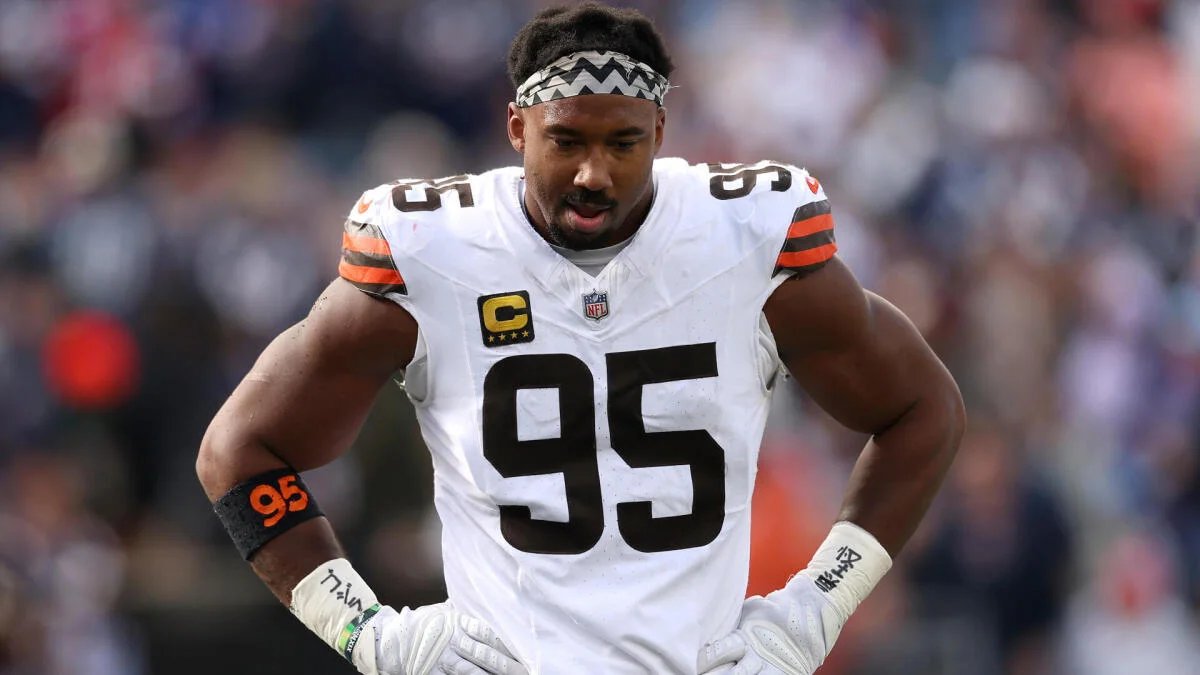
The Cleveland Browns and Myles Garrett made a surprising modification to his contract during the latter part of March. The deadline for the options in 2026, 2027 and 2028 to pick up respective dummy/voiding 2031, 2032 and 2033 contract years was pushed back from the 15th day of the league year annually to seven days before the start of the regular season in each of the next three years. More specifically, the 2026 deadline moved from March 25 to Sept. 2.
The option bonuses associated with the exercise of each option are still paid in three installments where the initial payment in each year is delayed with the deadline moving. Garrett was originally scheduled to receive $10 million within 30 days of the 2031 option being picked up (by April 24 this year), $9.2 million equally over a 36-week period concurrent with his 2026 base salary and $10 million on March 31, 2027. Base salary is paid weekly or bi-weekly once the regular season begins in September with the final payment coming in May. The within-30-days language is in the new contract, but the outside payment date has become Nov. 1 and $2 million was taken from the third installment making the first installment $12 million instead of $10 million.
The same thing occurs in 2027 and 2028. Payment no longer starts in the latter part of April and doesn’t happen until late October or early November depending on the start date of those regular seasons. Garrett’s first payment in 2027 increases from $13 million to $15 million with the extra $2 million coming from the money due on the following March 31. The initial 2028 payment goes from $7 million to $9 million.
There were some additional changes to Garrett’s contract. Third day of the league year roster bonuses for $8 million each were inserted in 2029 and 2030, the final two real contract years of Garrett’s deal, reducing the base salaries in those years by a corresponding amount (from $38 million to $30 million). These roster bonuses are paid within 30 days of being earned, so Garrett should get this money by the middle of April in 2029 and 2030.
Two more dummy/voiding contract years in 2034 and 2035 were added. There’s a $20 million payment (i.e.; option bonus) necessary for first of these years reducing Garrett’s 2029 base salary to $10 million. To get the second new dummy/voiding year, a $15 million payment is required dropping Garrett’s 2030 base salary to $15 million. The deadline for these options is also seven days before the start of the 2029 and 2030 regular seasons.
Garrett doesn’t get paid any sooner with money being shifted into option bonuses. Payment is over 36 weeks like his base salary.
Garrett’s respective 2029 and 2030 salary cap numbers are lowered by $15 million and $8 million in the process. That’s because option bonuses are prorated over the life of a contract (up to a maximum of five years), including the option years, beginning in the league year when the option is exercised. From a salary cap standpoint, the presumption is option years will be picked up.
Money wasn’t added in Garrett’s reworked contract. Garrett’s 2026 salary cap number hasn’t changed either. It remains $23.474 million.
The immediate impact is the window to trade Garrett has been extended for several months. It would have been too cost prohibitive to trade Garrett between now and June 1 if the option exercise date in 2026 hadn’t been moved. The Browns would have had $69,490,225 in 2026 dead money, a salary cap charge for a player no longer on a team’s roster, with the $29.2 million option bonus becoming a sunk cost. Increasing Garrett’s 2026 cap charge $46,016,225 would have been virtually impossible when the Browns currently have $22.605 million of cap room, according to NFLPA data.
Myles Garrett landing spots: Why trade rumors could heat up after Browns modify his contract
John Breech
The Browns will now lose $16,816,225 of cap space by trading Garrett before June 2, which is more manageable. The 2026 dead money would be $40,290,225 versus a $23.474 million cap number with retaining Garrett. A majority of the lost cap space could be offset by restructuring cornerback Denzel Ward’s contract. Ward has Cleveland’s second biggest 2026 cap number at $30,893,412. Converting $15.6 million of Ward’s $16.9 million 2026 base salary into a signing bonus, all except his $1.3 million league-minimum salary, would create $12.48 million of 2026 cap room.
The March contract revisions, along with some other developments, have prompted speculation that Garrett’s days in Cleveland could soon be numbered. Garrett lobbied for Jim Schwartz to be named head coach instead of Todd Monken. Schwartz being passed over led to his resignation as defensive coordinator.
Garrett being a no-show to the offseason workouts under these circumstances and the financial ramifications has raised some eyebrows. He has had $1 million at stake. In order to earn the $1 million in the respective year, Garrett must take part in at least 84.375% of the workout sessions, participate in all minicamps and all of the organized team activity days (OTAs). Garrett has already lost the $1 million for this year because he is skipping the voluntary veteran minicamp being held April 21 through April 23.
Forfeiting a $1 million workout bonus last year because of too many absences obviously didn’t affect Garrett’s performance. Garrett was named NFL Defensive Player of the Year for the second time in the last three years after his 23 sacks set a NFL single-season record.
Monken revealed during a media session after the first day of the minicamp that he hasn’t spoken to Garrett in person, let alone over the phone, since he was hired at the end of January. He has exchanged text messages with Garrett.
Browns general manager Andrew Berry has been adamant that Garrett won’t be dealt. Berry indicated at the NFL annual owners meeting in late March that Garrett will be “a career Brown.” This is the same stance Berry took last year when Garrett made a public trade demand during the early part of last offseason.
There is merit to trading Garrett as soon as possible. The Browns only won five games in 2025 with Garrett having the best season of nine-year NFL career and eight games over the last two seasons. Teams making major one-season turnarounds recently, like the New England Patriots and Washington Commanders, have done so with potential franchise quarterbacks on rookie contracts. That isn’t the Browns. The long-term answer at quarterback doesn’t appear to be on the roster between Dillon Gabriel, Shedeur Sanders and Deshaun Watson. Cleveland should have $86,206,864 of dead money with Watson expected to be released in 2027 using a post-June 1 designation. Watson’s dead money will be split into $34,663,514 in 2027 and $51,543,350 in 2028.
Everybody has a price. A four-year, $160 million contract extension, averaging $40 million per year to reset the non-quarterback market by close to 13%, was Garrett’s price to rescind his trade demand. Offensive tackle Laremy Tunsil was off limits until the Houston Texans made then-Miami Dolphins general manager Chris Grier an offer that couldn’t be refused in the days leading up to the start of the 2019 regular season. Grier got a 2020 first-round pick (26th overall), a 2021 first-round pick (third overall), a 2021 second-round pick, safety Johnson Bademosi and offensive tackle Julién Davenport in exchange for Tunsil, wide receiver Kenny Stills, a 2020 fourth-round pick and a 2021 sixth-round pick.
Micah Parsons-type trade compensation wouldn’t be sufficient for Berry to part ways with arguably the NFL’s best player regardless of position. Garrett is the superior player. The Green Bay Packers acquired the All-Pro edge rusher from the Dallas Cowboys for a 2026 first-round pick (20th overall), a 2027 first-round pick and defensive tackle Kenny Clark, a solid starter, at the end of the preseason last August.
An offer Berry couldn’t refuse for the league’s single-season sack leader and reigning NFL Defensive Player of the Year should be more than three first-round picks. A young Pro Bowl-caliber player who is still on his rookie contract could be a partial substitute for one of the first-round picks.
An acquiring team would be getting Garrett for $179 million over the next five years (2026 through 2030). Garrett’s compensation is $31.5 million, $42,703,875, $24,796,125, $40 million and $40 million, respectively, in 2026, 2027, 2028, 2029 and 2030.
Playoff-caliber teams that view Garrett as a missing piece to a championship puzzle would likely be his most serious suitors. These teams are picking in the bottom third of 2026 NFL Draft (21st and below) and presumably closer to the end of the first round in the following years. The Bengals just giving the 10th overall pick in this year’s draft for Giants defensive tackle Dexter Lawrence, who doesn’t play a premium position, only complicates matters.
Garrett would have some say in the process. He has veto power over any trade thanks to his no-trade clause. Garrett would have to waive the no-trade clause to be dealt.
The odds of Garrett being traded before the end of this year’s first round are remote. The Browns taking an edge rusher with the sixth overall pick would add fuel to the trade fire.
There is a school of thought that Garrett will attempt to leverage the current dynamics into a contract adjustment. The top of the non-quarterback market has increased by 25% since Garrett signed his deal last March. The three-year, $150 million extension, averaging $50 million per year, Houston Texans edge rusher Will Anderson Jr. just received is the new non-quarterback salary standard. Garrett is the NFL’s eighth-highest-paid non-quarterback at $40 million per year. For example, adding $20 million over the life of Garrett’s contract would essentially give him a four-year, $180 million extension, averaging $45 million per year.
It would be out of the ordinary for a team to give a player a raise with five years left on his existing contract. Interestingly, Anderson and Garrett are both represented by Klutch Sports’ Nicole Lynn.
The speculation about Garrett potentially being dealt this year is probably going to continue until the 2026 option deadline passes on Sept. 2 where Garrett is still with the Browns. Garrett could put the issue to bed for this season, assuming he shows up when OTAs start on May 19 or for the mandatory minicamp being held June 9 through 11, by stating he’s looking forward to continue playing in Cleveland or something along those lines. Garrett missing the June minicamp, without his absence being excused, would speak volumes about whether a change of scenery is inevitable.