dailynewsnblog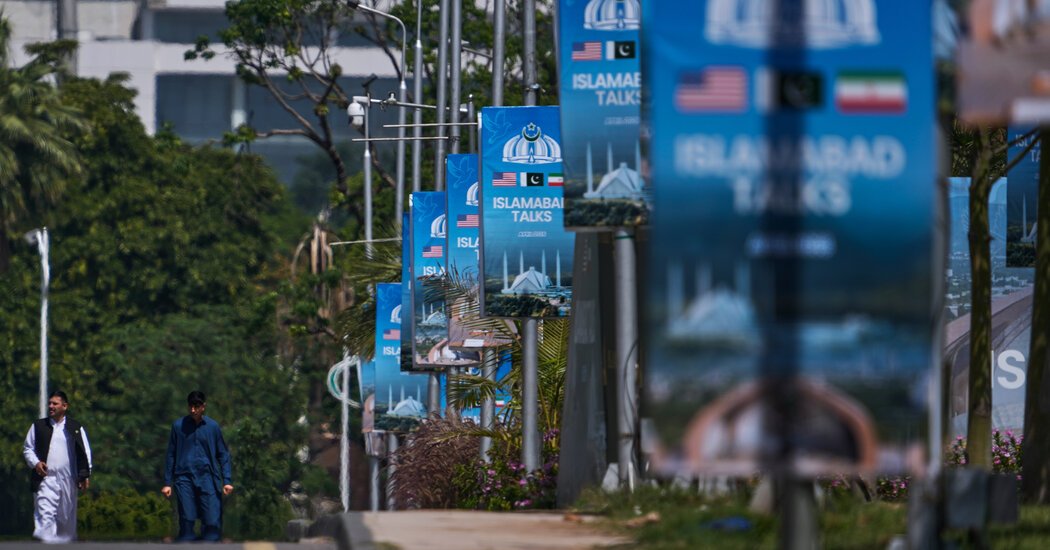
Pakistani officials remained optimistic on Wednesday they could still bring the United States and Iran back to the negotiating table even after Iran’s seizure of two cargo ships in the Strait of Hormuz posed a new obstacle to their efforts to broker a long-term peace.
Prime Minister Shehbaz Sharif of Pakistan met with Iran’s ambassador on Wednesday. One Pakistani official who was briefed on talks said a second round of negotiations could happen within the next few days.
The capture of two cargo ships by the Iran’s Revolutionary Guards in the Strait of Hormuz has cast doubt on the viability of the current cease-fire, which President Trump extended on Tuesday after receiving a request from Mr. Sharif and Pakistan’s army commander, Field Marshal Asim Munir.
The extension came just hours after Vice President JD Vance had postponed a highly anticipated trip to Islamabad, where he led the U.S. delegation for a first round of talks earlier this month.
“The cease-fire has opened a space that Pakistan thinks is enough for the diplomatic path to resume,” said Maleeha Lodhi, a former Pakistani ambassador to the United States and Britain who was also briefed on continuing diplomatic efforts. “Neither side has rejected talks.”
Another Pakistani official, who was also briefed on the talks and requested anonymity to discuss Pakistan’s role, said Pakistani mediators had received positive signals from Iran to restart face-to-face negotiations after the cease-fire was extended. The official didn’t elaborate on what the signals were, or say whether Iran had told Pakistani mediators that the lifting of the U.S. blockade of the Strait of Hormuz was a precondition to participate in a second round of talks.
Iranian officials have called the U.S. blockade an act of war and said it is evidence that the United States is not respecting the cease-fire.
The Islamic Revolutionary Guards Corps Navy said on Wednesday that it had seized the two cargo vessels after the ships tried to pass through the strait “without the necessary permits.”
“Disrupting the order and security of the Strait of Hormuz is our red line,” it said in a statement shared by the Tasnim news agency, which is affiliated with the Revolutionary Guards.
Earlier on Wednesday, a British naval agency that monitors maritime security said that two cargo vessels had come under attack in the area of the strait.
A spokesman for Iran’s foreign ministry, Esmail Baghaei, said in a post on X on Wednesday that Iran “has not decided” whether to join a new round of talks with the United States because of changing positions from the American side. In an interview with the BBC on Wednesday, Mr. Baghaei said, “We have made it clear that if we conclude that going to Islamabad is in our national interest, we will go.”
Two other Pakistani officials with direct knowledge of the mediation efforts said Pakistani leaders have been trying in recent days to bridge gaps not only between the Iran and the United States but also among U.S. officials and between different factions in Iran.
Asfandyar Mir, a senior fellow in the South Asia program at the Stimson Center, a Washington-based research institute, said Pakistan was concerned about the divisions between Iran’s political leadership and the Islamic Revolutionary Guards Corps. “They think it’s a house divided with different preferences on the pace at which the war ought to be ended,” Mr. Mir said, in a panel discussion about Pakistan’s role in the U.S.-Iran crisis.
Last week, Field Marshal Munir, met Iran’s top military and political leadership in Tehran, including President Masoud Pezeshkian and Maj. Gen. Ali Abdollahi, who leads the military joint command that oversees Iran’s army and Revolutionary Guards, to secure Iran’s commitment to another round of talks.
Field Marshal Munir, who has been a central mediator in the crisis, cemented relations with the Iranian intelligence and security apparatus when he served as head of Pakistan’s two most powerful intelligence agencies from 2017 to 2019.
The army chief was accompanied in Tehran by Pakistan’s interior minister, Mohsin Naqvi, a Shiite Muslim who has played an important role in mediation with the Iranian side, according to the two officials.
There are an estimated 35 million Shiites in Pakistan, many of whom have deep ties to Iran’s supreme leader, who is also a spiritual guide for many Shiites worldwide.
Zia ur-Rehman contributed reporting.