dailynewsnblog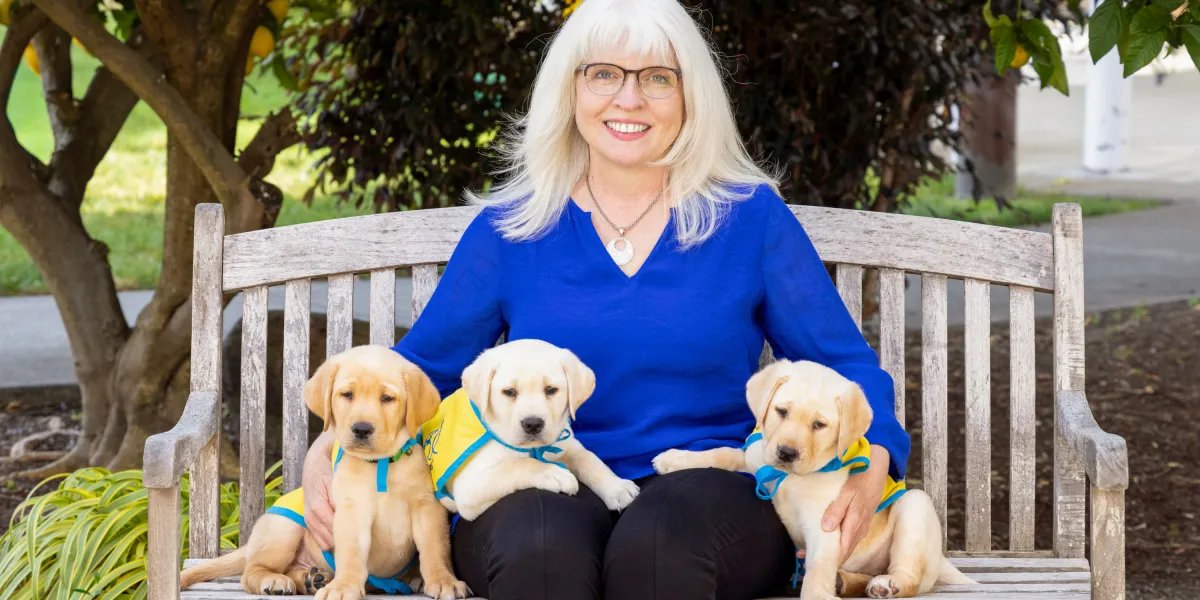
While service dogs might be best known for guiding the blind, Canine Companions trains dogs to do such things as open doors for wheelchair users or alert deaf people to doorbells, fire alarms, and other key sounds. Its psychiatric service dogs help veterans suffering from post-traumatic stress disorder—waking them from nightmares, for example. To date, it’s paired more than 7,000 dogs with people in need.
It’s critical to ensure that every service dog placed is healthy, and Kennedy—a veterinarian—spearheads the organization’s efforts to breed dogs with that in mind. “We wouldn’t place a dog that might have a life-shortening or a significant medical issue that a person might have to manage,” she says.
Kennedy also takes the lead in developing tech to support Canine Companions’ work. She is a co-inventor of CanineAlert, a patented device that sends a signal to a dog’s collar so the dog can interrupt a nightmare when its owner’s heart rate spikes. The technology may soon expand to address daytime anxiety episodes.
“These dogs can really be not only life-transforming in terms of providing people with independence, but critically essential and even life-saving,” she says.
An animal lover since childhood, Kennedy earned her undergraduate degree from Northwestern University before coming to MIT for her master’s in biology. “I found incredible mentors at MIT,” she says, noting that she particularly enjoyed working with Professor Hazel Sive, whose lab studied African clawed frogs.
The research was fascinating, but Kennedy wanted to work in hands-on medicine, so she obtained her veterinary degree from Tufts University. She then spent 16 years in private practice. Today, she is delighted to combine animal care with research at Canine Companions. “I had a passion for doing something really mission-oriented,” she says. “I love the idea of helping people through the human-canine bond.”
In additional to providing service, dogs also offer something elemental, Kennedy says: “Dogs add unconditional love to the mix. They support emotional and mental health for people and can be bridges to the community.”