dailynewsnblog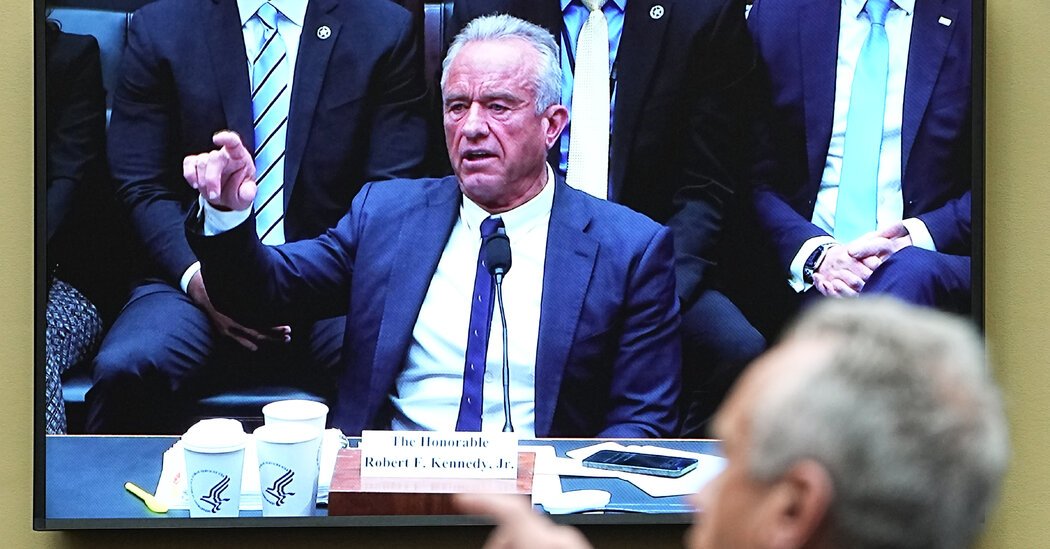
Health Secretary Robert F. Kennedy Jr. on Tuesday refused to commit to supporting the vaccine recommendations of President Trump’s nominee to lead the Centers for Disease Control and Prevention. The nominee, Dr. Erica Schwartz, has publicly supported immunizations and drawn applause from mainstream public health leaders.
“If Dr. Schwartz is confirmed, will you commit on the record today to implement whatever vaccine guidance she issues without interference?” Representative Raul Ruiz, Democrat of California, asked Mr. Kennedy during a tense hearing on Capitol Hill, the secretary’s fourth congressional hearing since last Thursday.
“I’m not going to make that kind of commitment,” Mr. Kennedy replied. In response to other questions from Dr. Ruiz, a physician, Mr. Kennedy said that he approved of Dr. Schwartz’s nomination and had spoken to her multiple times, but had not spoken directly to Mr. Trump about her selection.
During the hearing before the House Energy and Commerce Committee, Mr. Kennedy pushed back on Democrats’ assertions that he bore some responsibility for the measles outbreak in the United States, the worst the country has experienced in decades. He told members of the panel that the outbreak is global, that it started before he took office and that those who were sick were mostly 5 or older, which meant their parents had decided against vaccination before he was in office.
The back-and-forth highlighted the challenges Mr. Kennedy faces in trying to sidestep the unpopular vaccine skepticism he has espoused in office, as the White House pressures him to focus on more popular topics, such as healthier eating and fighting fraud. By defending himself on his measles record and his failure to support a mainstream C.D.C. director, he gave congressional Democrats the fodder they were seeking.
“It’s real life, Mr. Secretary, and you have blood on your hands,” said Representative Marc Veasey, Democrat of Texas. He noted that Mr. Kennedy’s lengthy opening statement had made no mention of vaccines, “which is odd, because you’ve basically spent your entire career and life trying to shatter American trust in vaccines.”
As Democrats battered Mr. Kennedy, often cutting him off before he could answer their questions, the secretary lobbed insults back, which prompted Representative Diana Harshbarger, Republican of Tennessee, who led the hearing, to tell everyone to “simmer down.”
Republicans defended Mr. Kennedy, citing his transformation of the country’s dietary guidelines and his work to improve rural health care. Ms. Harshbarger, a pharmacist, praised Mr. Kennedy’s work to expand access to peptides, often unproven compounds that are popular in the wellness industry.
She said his record on measles had been distorted by “a lot of misleading commentary,” and asked him to “explain how H.H.S. is strengthening measles trust with patients and families.” Mr. Kennedy thanked her, saying he wanted to address the “talking point for Democrats that somehow I caused the measles epidemic.”
Mr. Kennedy’s views on vaccines have dominated his tenure. Last summer, he fired all 17 members of the committee that advises the C.D.C. on vaccines, and replaced them with a number of vaccine skeptics. A court recently invalidated the firings. Mr. Kennedy has responded by changing the committee’s charter so that he can avoid the court ruling.
Two months after the mass firings, Mr. Kennedy fired the C.D.C. director, Susan Monarez, who had been confirmed by the Senate less than a month earlier. Dr. Monarez told lawmakers she was pushed out because she would not commit to approving the recommendations of the secretary’s handpicked vaccine advisers.
In his testimony on Tuesday, Mr. Kennedy, as he has in the past, insisted that he fired Dr. Monarez because she had refused to say she was “trustworthy.” He said the move had nothing to do with vaccines.
On Tuesday, and in two hearings last week, Mr. Kennedy offered a misleading defense of his record on the continuing measles outbreaks across the United States. Last year, two children in Texas died of the disease, and there were 2,288 confirmed cases. So far this year, there have been more than 1,700 cases, according to the C.D.C.
Mr. Kennedy maintained that his views on vaccines had not influenced the Mennonites, an insular community that shuns vaccination and suffered a measles outbreak.. “The Mennonites have not vaccinated since 1796. That was long before I was born,” he said.
Anabaptist Christian sects, including the Mennonites and the Amish, do have historically low vaccination rates. But studies show that their rates of vaccination dipped precipitously over the last decade, and especially after the coronavirus pandemic.
During that time, Mr. Kennedy has been an outspoken activist on vaccines, and has questioned their safety publicly and repeatedly.
As the chairman of Children’s Health Defense, the nonprofit he ran until he launched a bid for the presidency in 2023, Mr. Kennedy often traveled to the locations of measles outbreaks.
He went to American Samoa in 2019 after measles vaccination rates there plummeted, and proposed to set up a data-tracking system for what he described as a “natural experiment” that would potentially prove vaccination was not necessary for good health. Soon afterward, 83 Samoans, mostly young children, died of measles. In questions he answered after his confirmation hearings in January 2025, he suggested that an “experimental measles vaccine imported from India” caused the deaths.
After measles had spread widely in an Orthodox Jewish community in Brooklyn and Rockland County, N.Y., in 2019, he filed a volley of lawsuits challenging efforts to require vaccinations.
Mr. Kennedy faced intense questioning during his confirmation hearings, showing signs that he continued to view the research of known vaccine critics as more convincing than more establishment science.
Two weeks after he was sworn in as health secretary, a child died of measles in a rural cotton town in West Texas. Unlike previous health secretaries, he did not encourage parents to protect their children through vaccination.
In a Fox Digital column on March 2 last year, he called vaccination the most effective way to prevent the spread of measles, but said: “The decision to vaccinate is a personal one.”