dailynewsnblog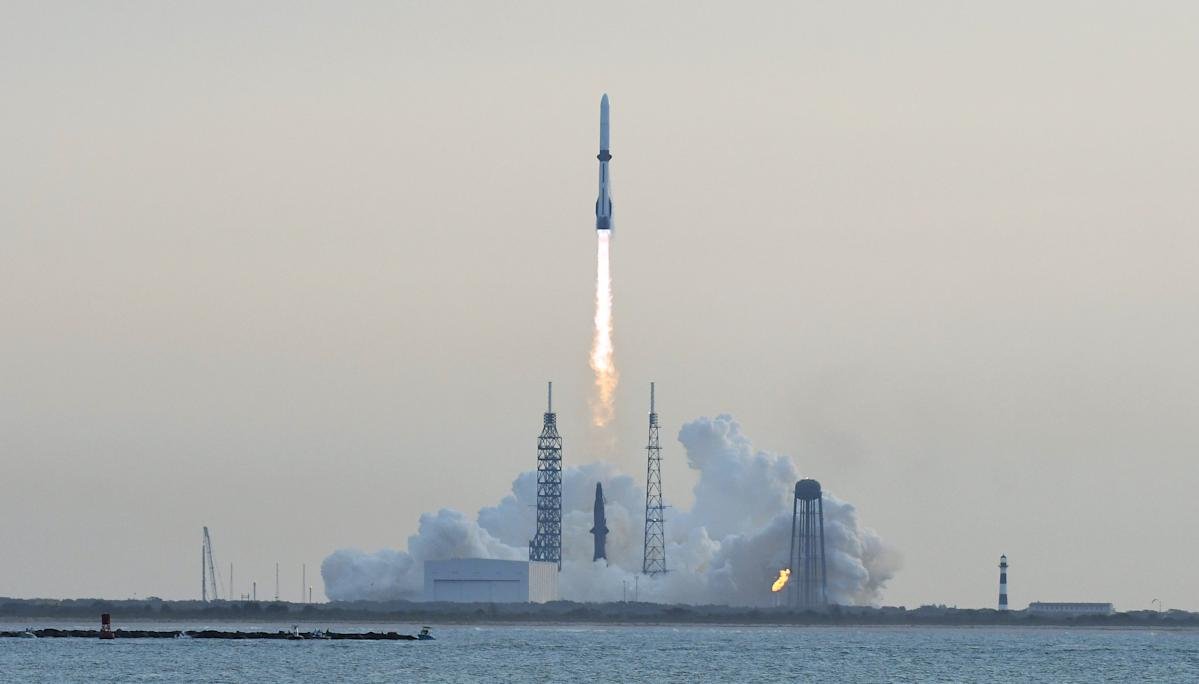
Blue Origin has successfully reused its first-stage New Glenn booster for the first time after it landed in a cloud of smoke and fire on a recovery ship. It marks the second flight and reuse of Never Tell me the Odds, after the booster was recovered from New Glenn’s previous launch in November last year. However, the rocket company’s first commercial mission was marred by a failure to place the communications satellite payload into orbit.
The launch went smoothly to start with, with the first-stage GS1 booster separating from New Glenn after three minutes and landing smoothly 10 minutes after launch following two braking burns, as shown in a post on X from Blue Origin’s owner, Jeff Bezos.
However, several hours later the Blue Origin team and satellite manufacturer, AST SpaceMobile, announced that the payload had failed to reach orbit. “We have confirmed payload separation,” Blue Origin announced on X. “AST SpaceMobile has confirmed the satellite has powered on. The payload was placed into an off-nominal orbit. We are currently assessing and will update when we have more detailed information.”
Later on in a press release, AST SpaceMobile revealed that “the satellite separated from the launch vehicle and powered on, [but] the altitude [was] too low to sustain operations with its on-board thruster technology and will de-orbited. The cost of the satellite is expected to be recovered under the company’s insurance policy.”
The upper stage was supposed to position the satellite into a 285 mile orbit after completing two burns. It would have then unfolded a 2,400 square-foot antenna and linked with six other satellites in a test for AST’s high-speed direct-to-cell network. However, early telemetry data showed that the satellite only reached 95 miles, well below a sustainable orbit. It’s not yet clear how the failure occurred.
Despite that, Blue Origin can take some solace in its successful first-stage reuse, particularly since it happened on just the third New Glenn mission (NG-3). It took SpaceX, by comparison, 32 flights before its first successful reflight of a previously flown orbital-class booster.
Blue Origin will definitely want to solve the upper stage issue soon. Its next flight is the first New Glenn launch of Amazon Leo (formerly Project Kuiper) broadband satellites. It plans to put 48 of those into orbit to significantly expand the Starlink rival’s constellation, which currently sits at 241 satellites.