dailynewsnblog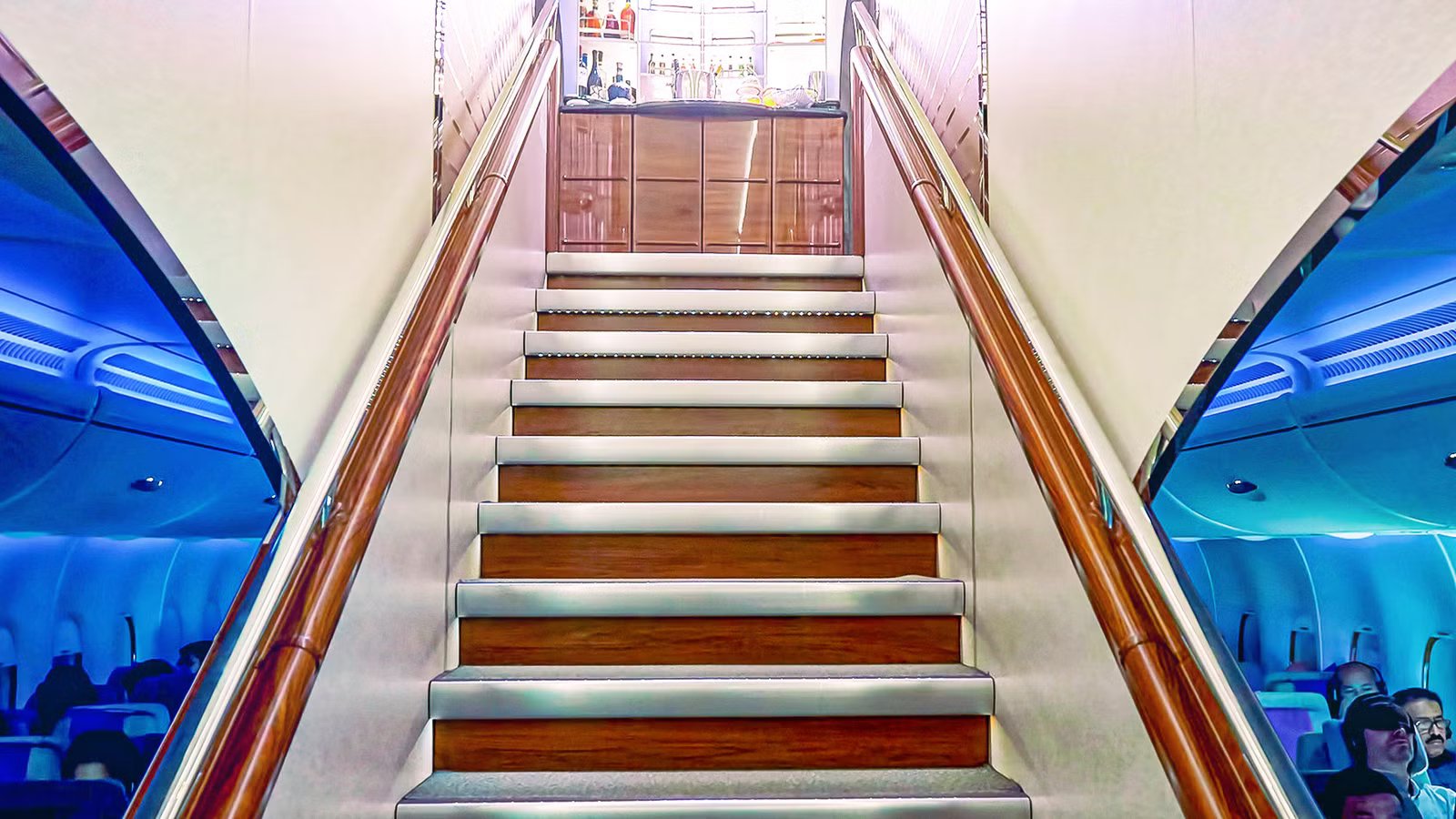
The Boeing 747 and Airbus A380 may both be double-deck icons, but the staircases leading to the upper deck reflect two very different design philosophies. On the early 747, the spiral staircase was part of a premium lounge concept that helped make the upper deck feel exclusive and glamorous, whereas the A380’s staircases were designed from the start to move far more passengers between two full-length decks.
The scale difference is substantial and has allowed Airbus to install two wide staircases, whereas the 747 traditionally relied on a much smaller single staircase. The contrast is so significant that the FAA issued special conditions for the A380’s between-deck stairs because existing rules were not considered sufficient for an aircraft of its size. In many ways, these staircases summarize the wider story of both aircraft: the 747 turned the upper deck into an exclusive space, while the A380 made it an integral part of the passenger cabin.
The Differences Between The Upper-Deck Staircases

The staircase design of the Boeing 747 and Airbus A380 is strongly influenced by the respective aircraft’s original design philosophies. For the classic generation of 747 aircraft, the -100 and -200, the spiral staircase design wasn’t a practical coincidence or a stylistic choice. The upper deck was primarily intended as a lounge area, and the aircraft’s launch customer, Pan Am, wanted to strengthen this feeling with a spiral staircase, creating the ambiance of a luxury hotel. However, with the introduction of the Boeing 747-300, this elegant spiral staircase was replaced with a straight, wide staircase to accommodate more passengers and provide the cabin crew with greater convenience.
Compared to the A380, the 747’s staircase to the upper-deck is smaller. This is perhaps no surprise, as the 747 seats significantly fewer people on its partial upper-deck compared to the full-length upper-deck of the A380. Besides, the A380 features not one, but two staircases to get to the upper-deck. Both staircases in the front and the rear are wide and large enough for two passengers to comfortably pass each other, something that is barely possible on the 747, and a design choice that reinforces the aircraft’s exceptional, spacious passenger experience. The scale of these stairs was so significant that regulators decided existing regulations were not suited, and special conditions were required for the safe passage of passengers during turbulence, in-flight emergencies, or evacuations.
The Passenger Experience Onboard The A380

The Airbus A380 was designed with passenger comfort as a priority, leading to a quieter, smoother, and more spacious experience. In fact, the A380 is widely considered one of the quietest commercial aircraft cabins ever built, thanks to strategic engine placements and heavy insulation that reduce vibration and noise. Onboard the A380, and in particular on the upper deck, noise levels can be as low as 68 decibels, noticeably below many other widebody cabins. Furthermore, the aircraft’s massive wings and weight provide a stable flight experience and reduce disturbances caused by turbulence.
|
Overview of Aircraft Noise Levels |
|
|---|---|
|
Aircraft Type |
Mid-Cabin Cruise Noise Approx. (dB) |
|
Airbus A380 (Upper Deck) |
68 dB |
|
Airbus A350-1000 |
70 dB |
|
Boeing 787 Dreamliner |
71 dB |
|
Boeing 747-8 |
72 dB |
|
Boeing 777-300ER |
73 dB |
However, one of the most notable aspects influencing the passenger experience is perhaps the aircraft’s spaciousness. The two full passenger decks and straight sidewalls, combined with an already wide fuselage, create a large open cabin feel. Contributing to this spacious feeling are the aircraft’s large windows, which create a brighter cabin. For passengers, especially on the upper deck, the aircraft also offers ample storage space, which can help passengers stay more organized on long-haul flights.
Besides the passenger experience designed by Airbus, a huge differentiator is, of course, also what some airlines decide to do with the aircraft themselves. Especially in premium cabins, airlines such as Qatar Airways and Emirates have introduced unique features. Both Qatar and Emirates feature a full-fledged bar on board their A380s, allowing passengers to stretch and enjoy a different environment than just their seats. And perhaps even more unique is Emirates’ shower experience for first-class passengers.

Here’s Why The Airbus A380’s Upper Deck Is Different Than Other Double-Deckers
Explore how the A380’s upper deck width enables airlines to reimagine the in-flight experience with luxurious amenities like onboard showers.
How Does The 747’s Passenger Experience Compare?

While the Boeing 747 is certainly an iconic aircraft, for passengers, it might feel outdated. This is especially true compared to most modern aircraft, such as the Boeing 787, the Airbus A350, and the A380. However, this shouldn’t come as a large surprise, as the aircraft was designed decades before the A380 first took flight. The 747 perhaps differs most from the A380 in terms of passenger experience is engine noise, which is significantly louder. This is especially the case when flying on older 747 models such as the 747-400.
However, where the 747 stands out the most, however, is, of course, the small upper deck, which on most airlines features premium cabins such as business class or first class. For many passengers, sitting in this partial upper-deck feels like an exclusive and cozy experience, making you almost forget you are traveling on one of the largest airlines in the world. These differences go beyond the staircase leading up to the upper deck. Compared to the A380, the largest difference is, of course, that the A380 is purposely designed as a full-length double-decker, instead of the partial “hump” of the 747. The main reason the 747 is not a full double-decker is that its upper deck was originally a byproduct of its cargo-focused design and raised cockpit.
Since the A380’s upper deck was a dedicated design choice, rather than a “byproduct”, the A380’s upper deck is designed much wider and more uniform, at about 19 feet wide (5.8 meters), compared to roughly 11 feet 4 inches (3.5 meters) on the 747’s upper deck, giving airlines much more flexibility in cabin layouts. Its straighter sidewalls make the cabin feel more spacious, while also allowing for practical storage lockers along the windows. Furthermore, the A380 also offers a more independent upper-deck experience through dedicated dual-level boarding bridges, separate boarding flows, and its own evacuation systems.
Additionally, the 747 will feel less spacious to passengers because its fuselage is narrower and its windows are smaller than those of the A380. However, compared to most aircraft, the aircraft still provides a more spacious feeling. Due to the aircraft’s age and the fact that most airlines have already retired the type, or are planning to do so, there are also fewer non-special features, such as showers or bars, on today’s 747s.

This Is How Much Bigger The Airbus A380 Is Compared To The Boeing 747
The Airbus A380 and Boeing 747 are giants of the sky, but does the A380 truly reign supreme in size?
How The Two Aircraft Compare Beyond Cabin Design

The Airbus A380 has a range of up to 7,991 nautical miles (14,800 kilometers) and typically seats around 525 passengers in a three-class configuration, whereas the Boeing 747-8 can reach up to 7,730 nautical miles (14,310 kilometers) with 467 passengers. While the A380 is the world’s largest commercial aircraft, the title of the world’s longest commercial aircraft goes to the 747-8. The Boeing 747-8 has a 246 feet, 10 inches (75.23 meters) long fuselage with a wingspan of 224 feet, 5 inches (68.40 meters), compared to 239 feet (72.72 meters) and 261 feet, 3 inches (79.75 meters) respectively for the A380.
To ensure an aircraft as large as the A380 or B747 is efficient, large, powerful engines are an obvious requirement as they need to maximize takeoff weight (MTOW) and cruise efficiency while managing high payloads. For the A380, these engines are either the Rolls-Royce Trent 900 or Engine Alliance GP7000, a joint venture of General Electric and Pratt & Whitney. Each engine produces approximately 70,000 lbf (340 kN) of thrust, allowing the aircraft to operate fast and efficiently despite its size, and they enable a cruise speed of Mach 0.85 and a maximum cruise speed of Mach 0.89.
|
Boeing 747-8 |
A380-800 |
|
|---|---|---|
|
Capacity |
467 passengers (three-class) |
525 (three-class) |
|
Length |
246 feet, 10 inches (75.23 meters) |
239 feet (72.72 meters) |
|
Wingspan |
224 feet, 5 inches (68.40 meters) |
261 feet, 3 inches (79.75 meters) |
|
Height |
64 feet (19.51 meters) |
79 feet (24.09 meters) |
|
Wing area |
5,960 sq feet (554 m²) |
9,100 sq ft (845 m2) |
|
Maximum takeoff weight (MTOW) |
987,000 lb (448 tons) |
1,268,000 lb (575 tons) |
|
Powerplant |
4 × General Electric GEnx-2B67 |
4 x Rolls-Royce Trent 900 / 4 x Engine Alliance GP7000 |
|
Maximum speed |
Mach 0.9 |
Mach 0.89 |
|
Range |
7,730 nautical miles (14,310 km) |
7,991 nautical miles (14,800 km) |
The Boeing 747-8 Intercontinental has the fastest cruise speed of any commercial aircraft. On a regular cruise, the aircraft has a speed of Mach 0.86, while its maximum speed can reach upward of Mach 0.90. In contrast to older 747 variants, the 747-8 offered only one engine option: the General Electric GEnx-2B67. Each of these engines produces around 66,500 pounds (296 kN) of thrust. The reason for the fact that the 747-8 only had one engine option was to reduce production costs and leverage newer technology, as the engine is a more efficient, smaller version of the General Electric GEnx turbofan engine from the 787.

The Striking Differences Between The Boeing 747-8 & Airbus A380
Both quadjets are massive and serve several high-capacity routes.
These Passenger Airlines Still Fly Double-Deck Aircraft

While both the B747 and A380 are two of the most iconic aircraft ever made. However, due to changing market dynamics, airlines are less interested in aircraft as large as these double-deckers. And while the two aircraft types won’t disappear overnight, time is limited for those who still want to try the staircases leading to the upper deck.
As of writing, there are still eleven airlines operating the A380. The most notable operator is, of course, the Dubai-based carrier Emirates, which operates by far the largest part of the global A380 fleet. With 116 aircraft in its current fleet, Emirates is the largest operator of the type, followed by British Airways and Singapore Airlines, which operate 12 aircraft as of writing. Launch customer Singapore Airlines, previously operated 24 aircraft, but retired half during the pandemic. Qantas currently operates ten aircraft of the type, which will be replaced by the Airbus A350-1000 in 2032. Etihad Airways is currently operating nine aircraft, after having recently re-activated two additional aircraft of the type that had previously been stored.
|
The Largest Double-Decker Operators in 2026 |
||||
|---|---|---|---|---|
|
Airline |
A380-800 |
Boeing 747-8i |
Boeing 747-400 |
Total |
|
Emirates |
116 |
116 |
||
|
Lufthansa |
8 |
18 |
8 |
32 |
|
British Airways |
12 |
12 |
||
|
Singapore Airlines |
12 |
12 |
||
|
Qantas |
10 |
10 |
||
In contrast to the A380, there are even fewer carriers still flying the aircraft. As a matter of fact, there are only four airlines left in the world operating the passenger version of the Boeing 747. Combined, only 45 747s for regular passenger operations remain worldwide, with many already scheduled for retirement. The majority of these aircraft fly for the German flag carrier Lufthansa, which plans to operate their -8s into the 2030s. Lufthansa currently still operates eighteen 747-8I and eight 747-400 aircraft. Other operators include Korean Air, Air China, and the sanctioned Russian airline Rossiya Airlines. The second-largest operator, Air China, operates seven -8s and two -400s. Korean Air and Rossiya Airlines still operate five aircraft, with Korean Air having a fleet of -8s and Rossiya flying the -400.