dailynewsnblog
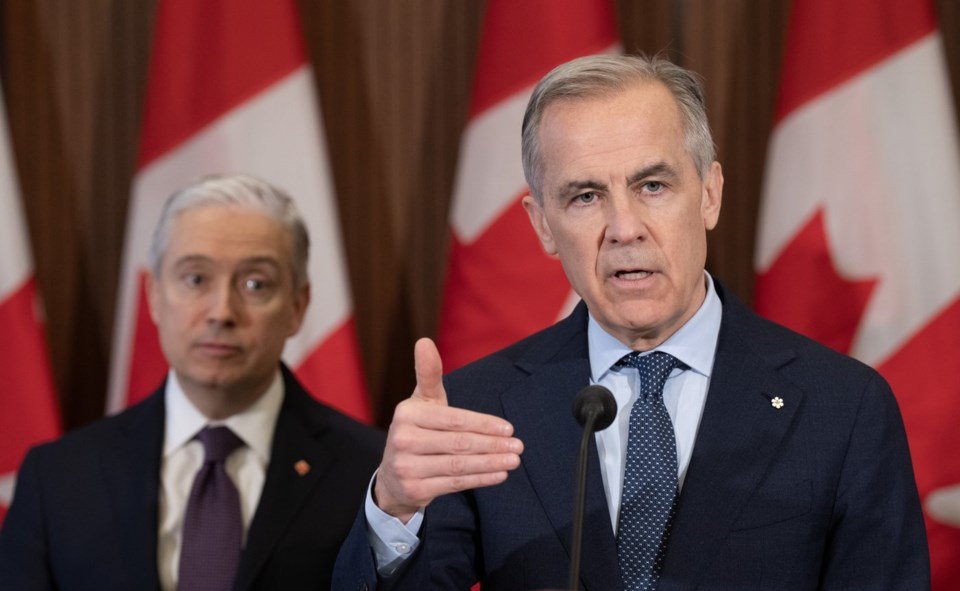
OTTAWA — The morning after the Liberals secured a majority government, Prime Minister Mark Carney said Canadians can expect Parliament to be more substantive and less performative.
“There’s a difference between real testimony, real substance, getting to issues, debating aspects of law, advancing — that’s the job of parliamentarians — and showboating,” he said.
The governing party held seats in three byelections on Monday in Terrebonne, north of Montreal, and Scarborough Southwest and University—Rosedale, both in Toronto. Once the winning candidates are sworn in, the Liberal benches in the House of Commons will have 174 MPs, two more than the minimum needed for a majority.
Those bolstered numbers — five more seats than the Liberals won in last April’s election — come courtesy of the five MPs who’ve crossed the aisle from the opposition benches. Since November, four Conservatives and one New Democrat have joined the Liberal ranks.
Conservative Leader Pierre Poilievre accused Carney on Monday night of manufacturing a majority through “backroom deals with politicians who betrayed the people who voted for them.” He described the historic shift from minority to majority government as a “cynical power grab.”
Carney said Tuesday his government’s new power is the product of “increasing support” for Liberal candidates in the byelections.
“Canadians elect deputies, deputies vote with their conscience and support the program that they see best for their constituents and for the country,” he said.
He also said the government is “open to ideas from anyone” and promised to work collaboratively with the other parties.
It will take a few weeks for the byelection results to be certified and the newly elected MPs to be sworn into office. Once that happens, the Liberals will have far greater control over the House of Commons.
The next federal election doesn’t have to be called until 2029, and the government will be able to pass confidence votes without the support of another party for the first time since 2019.
The government will no longer need to rely on opposition support to pass legislation, and the Liberals can now speed legislation through Parliament by limiting debate and taking control of House committees.
Changing the makeup of the committees would require a majority vote to change the Standing Orders, the rules that govern the House of Commons.
Hinting that such a change might come, Carney told reporters that over the last year, some legislation had been bogged down for political reasons.
He also said he is not considering calling an election at this time.
Susan Smith, a Liberal commentator and founder of Blue Sky Strategy Group, said Monday’s byelection results show there is support for stability in Ottawa.
“With these byelection results and the effect of the floor crossings, you see what Canadians want, which is a stable government and they want Mark Carney at the helm,” she said.
Canada hasn’t had a majority government since 2019, when former prime minister Justin Trudeau’s Liberals were reduced to a minority in an election.
But the slim majority comes with its own headaches.
It gives Liberal MPs greater leverage inside their own caucus, but also creates problems with winning votes when a caucus member gets sick or is travelling abroad.
That puts greater pressure on the party whip, who will need to ensure MPs don’t miss key votes and see that Liberals who defected from other parties don’t step out of line.
Speculation about more floor crossers is still running rampant on Parliament Hill.
Conservative MP Billy Morin told The Canadian Press on Monday the Liberals were trying to “poach” him. He later said in a social media post that he is “proud to be a part of a strong opposition.”
Liberal MP Wayne Long denied that the party was trying to poach Morin and said he wasn’t aware of more floor-crossings to come.
A number of Conservative MPs have posted to social media in recent days to assure their constituents they plan to remain with the Tories.
Poilievre, whose party is lagging in the polls, has faced questions about his leadership as the defections have continued.
He said in his Monday social media post that he plans to carry on leading the Conservatives in Parliament and into the next election.
More byelections are also expected in the future, which could result in further fluctuations in Parliament.
Liberal MP Nate Erskine-Smith is exploring a run for the Ontario Liberal leadership and is expected to step down from his seat of Beaches — East York once Premier Doug Ford calls a byelection for a vacant Ontario seat.
This report by The Canadian Press was first published April 14, 2026.
— With files from Catherine Morrison and Kyle Duggan
Sarah Ritchie, The Canadian Press