dailynewsnblog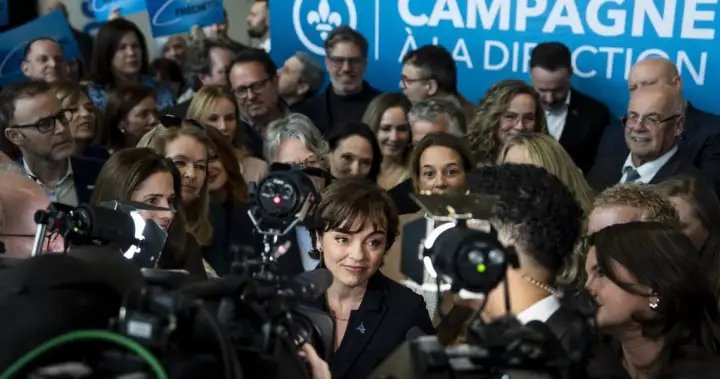
Christine Fréchette, newly elected Coalition Avenir Québec leader and premier-designate, has a bit more than five months to revive her party before the provincial elections, and to define herself in a crowded political field.

Her election over the weekend to replace departing premier François Legault comes at a precarious moment for her party, which is deeply unpopular after back-to-back majority mandates. Polling aggregator Qc125 predicts the CAQ, which Legault had positioned as a right-leaning nationalist but federalist party, is on track to win zero seats on Oct. 5.
“I feel a bit nervous because it’s my first day in my new role as premier,” Fréchette told reporters upon her arrival on Monday at the premier’s office in Quebec City. “It’s a wonderful challenge, an immense challenge, and I feel truly moved to be entrusted with this responsibility.”

First elected in 2022, Fréchette held the immigration and economy portfolios under Legault. The coming months will be decisive: she is already known to Quebecers but will need to quickly build a political program in contrast to the other parties that are way ahead in the polls, says political scientist Éric Bélanger. And she’ll need to define her leadership while distinguishing herself from Legault’s legacy, Bélanger, McGill professor and co-holder of research chair on democracy, social cohesion and shared values in Quebec, said in an interview Monday.
“She has to step out of his shadow,” he said.

Get daily National news
Get daily Canada news delivered to your inbox so you’ll never miss the day’s top stories.
The challenge is compounded by increasing competition for votes — Fréchette will need to fend off attempts by the Parti Québécois and the Conservatives to court disaffected CAQ voters, Bélanger said.
Much of her campaign focused on economic issues — an area where Bélanger said she appears most comfortable — including reopening the debate around shale gas and hydraulic fracturing. “She presents herself as someone concerned about the economic situation, about affordability,” he said. “But also she wants to appear as someone reliable.”
That positioning could also make it harder for her to distinguish herself from Liberal Leader Charles Milliard, who is also emphasizing economic credibility.
During the leadership campaign, she seemed more shaky on nationalist ground compared to her leadership challenger, Bernard Drainville, whom she beat on Sunday with almost 58 per cent of the vote. Drainville had positioned himself as the best suited to defend Quebecers’ language and culture.
On Monday, PQ Leader Paul St-Pierre Plamondon took to social media to address Quebec nationalists who may no longer see themselves in a party run by Fréchette. “To all nationalists who care deeply about defending Quebec values, your place is with the Parti Québécois.”
Meanwhile, Conservative Leader Eric Duhaime attacked the CAQ’s right flank, suggesting the party had borrowed much of his ideas, including on resource exploitation. “I’m extending a hand to all Quebecers who want to rethink the bureaucratic model and increase Quebec’s power within the Canadian Confederation.”
Bélanger also pointed to parallels with federal politics, suggesting Fréchette may be aiming to replicate the kind of party reset seen with Prime Minister Mark Carney, who helped revive the federal Liberals last year after taking over from an unpopular leader by emphasizing economic credibility.
”Will we see a ‘Fréchette effect’?” he asked.
But Bélanger cautioned that Quebec’s political landscape is fragmented, with multiple competitive parties, rather than a largely two-party dynamic between the Conservatives and Liberals at the federal level.
“If the CAQ comes back, it becomes a three-way race,” he said. “But the question is: where will those votes come from?”
Aggregator Qc125 puts the Liberals and PQ neck and neck, within the margin of error of most recent polls. The CAQ is fourth, behind the Conservatives.
Beyond strategy, those who have worked with Fréchette described someone known for her discipline and attention to detail. Stéphane Paquet, president and CEO of Montréal International, an agency focused on attracting foreign investment to the Montreal area — and Fréchette’s former employer — described her as ”studious.”
“She’s someone who knows her files, reads her briefings and comes back with good questions,” he said, adding that her work style reminded him of former Quebec premier Pauline Marois, whom he also worked with during his career. Marois is the only other woman to serve as Quebec premier, with the PQ from 2012-14.
For Paquet, Fréchette’s decision to enter politics reflects a broader motivation. “If you look at her path, she’s someone who wants to make a difference,” he said.
Jean-Denis Charest, who succeeded Fréchette as head of the Chambre de commerce de l’Est de Montréal, a business association that promotes economic development in the city’s east end, offered a similar assessment. She demonstrated a strong command of her files and ensured a smooth transition when she left the role, he said.
“She was very generous and had a real concern for continuity and the success of the organization,” he said, noting she remained available for advice even after her departure.
Fréchette served as president and CEO of the Chambre de commerce de l’Est de Montréal from 2016 until entering politics in 2022. Charest also pointed to her leadership during the COVID-19 pandemic, when she oversaw the organization through a period of economic uncertainty for local businesses.
At the same time, he said he saw a side of her personality that is less visible publicly. “She has a dry sense of humour and a quick wit,” he said.
Fréchette is to be sworn as the second CAQ leader in the 15-year history of the party, before the Quebec legislature resumes early next month, but a date has not yet been officially set.
This report by The Canadian Press was first published April 13, 2026.
— With files from Thomas Laberge and Patrice Bergeron