dailynewsnblog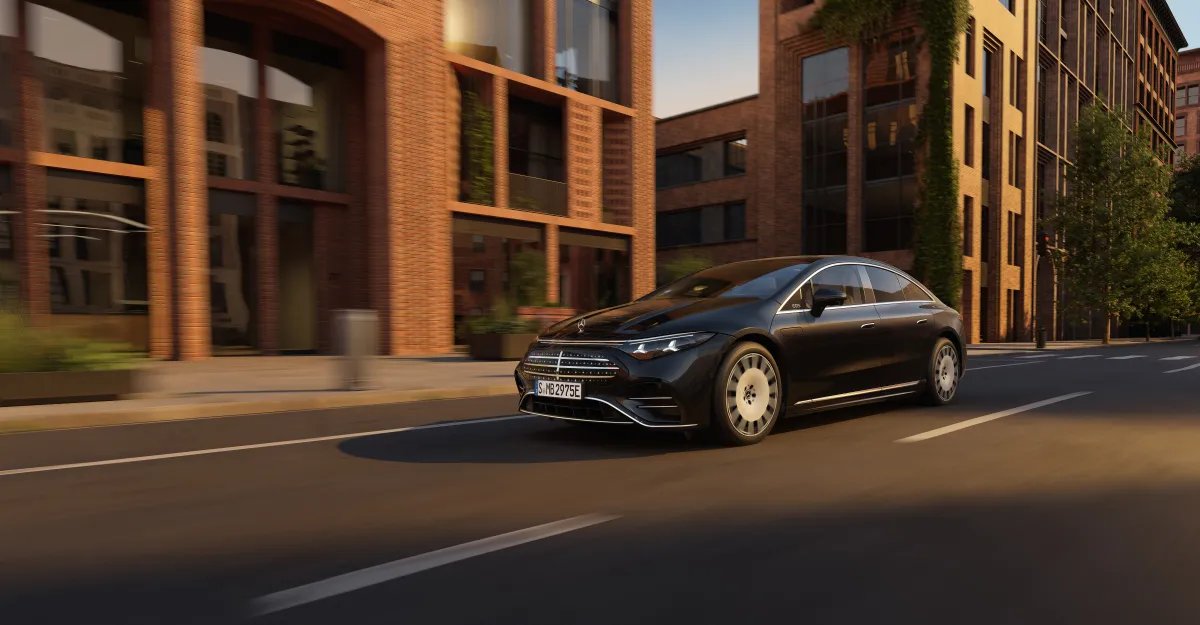
A year ago, Mercedes-Benz did the prudent thing and paused its EQ lineup of electric vehicles in the US. With customer demand drying up for luxury EVs, and federal incentives getting axed by vengeful Republicans, Mercedes put its first-generation EVs on ice.
But then, in January, Mercedes quietly reintroduced the EQS brand in the US, with The Drive declaring that the “blobs are back” — a reference to the sedan’s much-maligned jelly-bean shape that prioritized aerodynamics over a more traditional profile. But we didn’t yet realize how back the EQS truly was.
Today, Mercedes is reintroducing its electric sedan to a wary, cash-strapped market, and it’s sweetening the pot with a crazy range estimate and an innovative steer-by-wire technology, a first for the German automaker. The 2027 EQS is scheduled to arrive at US dealerships in the second half of 2026.
Mercedes is truly not screwing around with the new EQS. The sedan is estimated to have 925km (575 miles) of range on the WLTP cycle (which tends to be around 10–20 percent more generous than the EPA’s estimates). This can be achieved thanks to a battery with a new chemistry that blends silicon oxide with graphite for the anodes, enabling a usable capacity of 122kWh. Mercedes is also cutting back on its use of cobalt, which has been called the “blood diamond of batteries” due to its ties to human rights abuses.

Charging will be much improved with the refreshed EQS, too. The automaker upgraded architecture to 800 volts, allowing for 350 kW DC fast charging, adding 320 km of range in just 10 minutes. When charging at a 400-volt station, the EQS’s intelligent control system virtually divides the battery into two parts, charing each half with 400 volts and up to 175kW of energy.
The inclusion of steer-by-wire is certainly a big risk. Steer-by-wire, in which the vehicle can be steered electronically rather than through a physical connection between the steering wheel and steering rack, could lead to improved maneuverability and enhanced comfort. Or it could lead to latency issues — although Mercedes says it has thoroughly tested its system for safety. A new steering yoke could help attract race enthusiasts to the dealership. But if you prefer a good old fashioned round-shape steering wheel and reliable electromechanical steering, Mercedes will be happy to sell you an EQS with those too.
The silhouette is still decidedly blob-like, but Mercedes maintains that the one-bow design enables an industry-leading drag coefficient of 0.20 — which is further optimized by “refined exterior mirrors.” This likely helps with range gains, but it could be a tough sell among shoppers who would prefer a few more sharp angles. Mercedes also boosted the regenerative braking power by a third for 385kW of recuperation.

And, of course, there’s more AI integration, including Mercedes’ improved MB.OS operating system that features an AI-powered assistant and over-the-air software updates. The now standard 55-inch Hyperscreen has a “Zero Layer” interface for easier navigation. The operating system uses AI to learn which features you use the most, then surfaces those features as individual widgets on the main screen. Ideally, you don’t have to rummage through too many submenus to find what you want.
Mercedes plans on offering the EQS in a variety of packages. The EQS 450+ is the range leader, with a single, rear-wheel drive motor providing the most efficiency of all the versions. The EQS 500 4MATIC and EQS 580 4MATIC are both all-wheel drive, with an Integrated Disconnect Unit in the front motor. This allows the car to decouple the front motor when not needed to save energy, then activate it at “lightning speed” when the driver needs extra traction or a burst of acceleration. And these models will feature the most regen thanks to their ability to harvest energy from both axles during braking.

Image: Mercedes-Benz
The new EQS will come standard with MB.Drive Assist, the automaker’s advanced driver-assist system, that uses 10 cameras and 27 sensors for automatic lane changing, evasive steering, and automated parking. What it’s not, however, is Mercedes’ new Level 2++ feature called Drive Pilot Assist that is rolling out to the CLA electric sedan later this year. The system is similar to Tesla’s FSD in that it can be used hands-free in cities but requires the driver to stay attentive.
Mercedes hasn’t revealed the EQS’s price yet, but it is offering seemingly bottomless options for configuration and customization. This will be through the automaker’s Manufaktur Made to Measure program, which includes over 100 paint colors and other bespoke interior options. This could help shift the vibe around the EQS from a “series production” feel into “tailor-made” territory, allowing for combinations that wouldn’t be found on a standard dealership lot.
All in all, the new EQS will certainly help round out Mercedes’ EV lineup in the US, which is fluctuating right now. The automaker hasn’t said whether it will also resurrect the EQS SUV, or the EQE sedan and SUV. The CLA is doing a good job of turning heads. And Mercedes is sticking to its promise of introducing several new EVs in the US in the coming years, including variants of its GLC crossover and E-Class sedan.