dailynewsnblog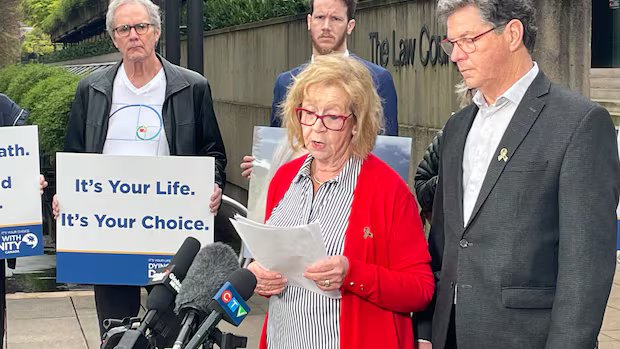
Closing arguments started Monday in a trial that will determine whether faith-based health-care facilities can continue to prohibit medical assistance in dying (MAID) in B.C.
The trial, being heard by B.C. Supreme Court Chief Justice Ronald Skolrood, could have national implications, as a verdict either way is likely to be appealed to the Supreme Court of Canada.
Here are the closing arguments.
The plaintiffs
The story at the centre of the case is that of Samantha O’Neill, who suffered from Stage 4 cervical cancer and had to be transferred out of Vancouver’s St. Paul’s Hospital in her final hours to receive MAID in April 2023.

St. Paul’s is run by the Providence Health Care Society, a Catholic organization that does not allow MAID on its premises.
O’Neill’s mother Gaye, a plaintiff in the case, and father Jim said the need for O’Neill to be transferred denied them the chance to say a meaningful and dignified goodbye to their daughter. The last time they saw her conscious, she was seated on a commode.
In a press conference outside B.C. Supreme Court on Monday, Gaye O’Neill called the transfer process “traumatic and unbearably cruel to witness.”
“It stripped Sam of her dignity and caused unnecessary pain and suffering,” she said.
The three plaintiffs – Gaye O’Neill, Dying With Dignity Canada and Dr. Jyothi Jayaraman, a Vancouver palliative care physician – are asking the court to strike down the provision of the B.C. Ministry of Health’s MAID policy that allows publicly funded faith-based organizations to opt out of allowing the procedure in their facilities.
“While patients in most hospitals can choose to have MAID provided at their bedside without the attendant risk and disruption of a transfer, those at St. Paul’s and other PHC facilities are denied that choice on the basis of someone else’s religious beliefs,” the plaintiffs’ lawyers wrote in their closing arguments.
“It is the plaintiffs’ position that the Ministry’s MAID policy breaches the Charter insofar as it gives [Providence Health Care] the authority to determine whether to prohibit MAID in publicly-funded facilities that it operates.”

During the evidentiary portion of the trial, held earlier this year, the court heard from several other families who also allege their loved ones suffered in their final hours as a result of the Ministry’s MAID policy.
The plaintiffs also argue the policy creates moral distress for physicians such as Dr. Jayaraman, who chose to resign from her palliative care position at a Vancouver hospice rather than authorize such transfers when its administration was transferred to Providence.

“Authorizing the move was something I could not be involved with as a matter of principle. No patient under my care would be forced to move based solely on the organization’s religious mission.”
Should the plaintiffs’ challenge succeed, it would not force employees of faith-based providers such as Providence to participate in medical assistance in dying. It would mean outside providers would be allowed to perform the procedure within those facilities.
The defence
There are three defendants in the case: the provincial government, Providence Health Care Society and Vancouver Coastal Health.
In its closing submissions, the B.C. government argues medical transfers are a routine and necessary part of health-care delivery in the province, because no facility offers every service a patient may need.
The plaintiffs are seeking to insert the court into the minutiae of health-care delivery, which would set a dangerous precedent, the province’s lawyers argue.
“They ask the Court to dictate that patients cannot be transferred to receive a healthcare service, not even if they remain in the same hospital bed,” the submissions say.
“The Charter does not require, and our healthcare system cannot guarantee, that patients receive medical care at a specific location.”
The province and Vancouver Coastal Health both argue the government has sought to minimize the disruptions associated with such transfers by constructing spaces in close proximity to faith-based facilities where MAID can take place.
In November 2023, the Ministry of Health ordered Providence to transfer a portion of the lands adjacent to St. Paul’s Hospital to Vancouver Coastal Health to facilitate construction of a purpose-built space for MAID provisions. That space, known as Shoreline, opened in 2025.

Vancouver Coastal Health has opened a space connected to St. Paul’s Hospital to facilitate medical assistance in dying (MAID) requests.
Since then, Shoreline has accommodated all St. Paul’s patients who have requested MAID, Vancouver Coastal Health said in its submissions. This means patients no longer have to be transferred by vehicle to another facility.
A similar space is under construction at the new St. Paul’s Hospital on the False Creek Flats.
The health authority has arranged for similar adjacent spaces at the two Vancouver hospices operated by Providence. There is no such space at Vancouver’s Mount St. Joseph’s Hospital, another Providence-run facility, nor at multiple other faith-based care homes throughout Metro Vancouver that do not allow MAID.
Both the government and Providence say faith-based providers make significant contributions to health-care provision in B.C., especially through St. Paul’s Hospital, and argue forcing such institutions to act against their values could put this at risk.

The government also argues that while family members may have suffered as a result of transfers to access MAID, the evidence presented at trial does not prove the patients themselves suffered.
In O’Neill’s case, the government argues O’Neill herself directed when and how friends and family were allowed to visit her. The transfer process, which the family said made their final goodbyes feel rushed, had to happen the way it did in order to fulfill O’Neill’s request to receive MAID that day, the government argues.
Closing arguments are expected to end later this week. A verdict is not expected for several months.