dailynewsnblog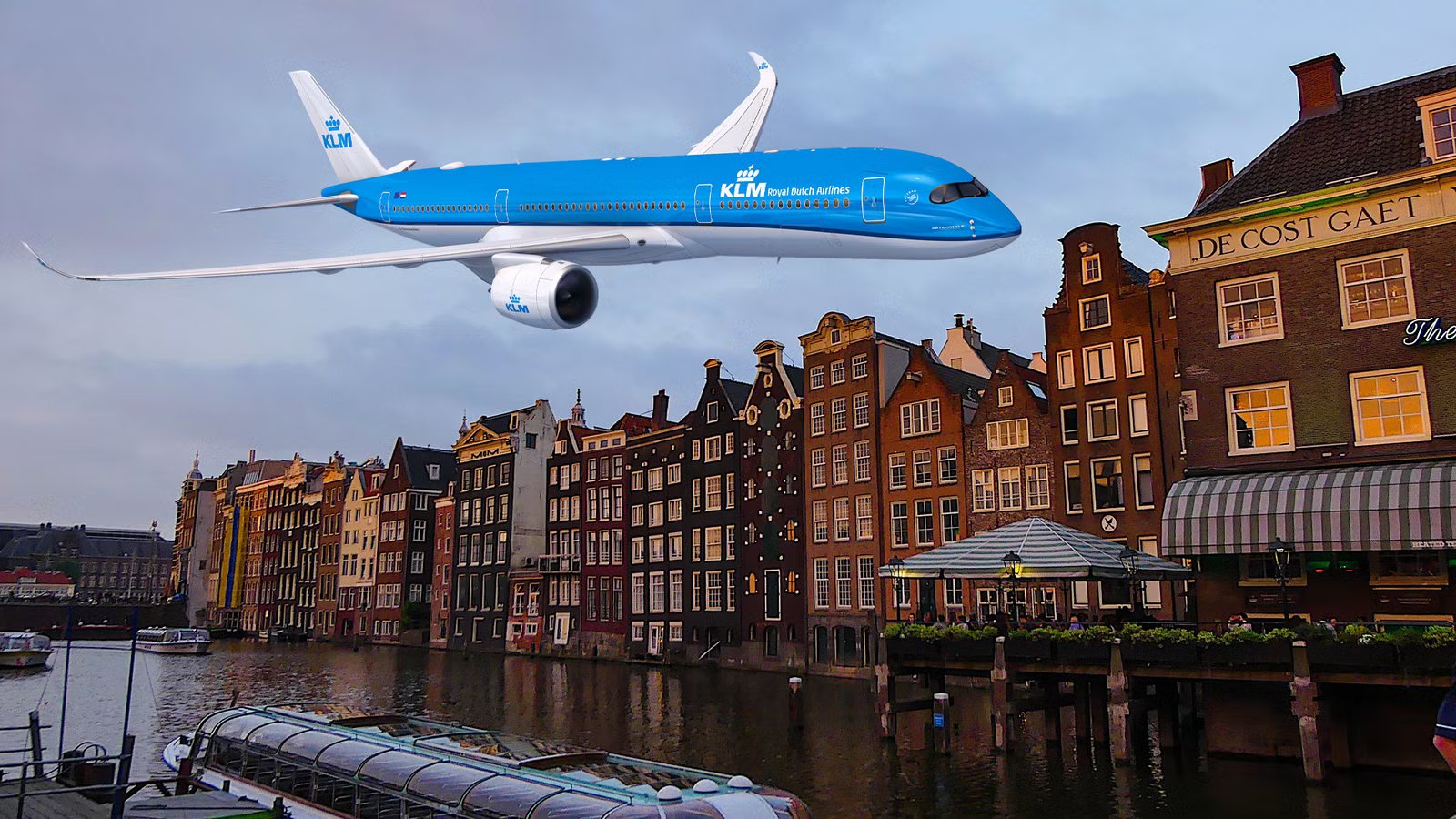
On Simple Flying, we frequently report on jets entering carriers’ fleets and speculate on how the orders and deliveries will augment an airline’s strategy; how the new aircraft will make a carrier more efficient and change how its network operates. Yet, KLM Royal Dutch Airlines’ fleet renewal, featuring the incredibly quiet Airbus A350-900, suggests something more fundamental. It suggests that the carrier is investing to survive an increasingly stringent regulatory environment. In particular,  Amsterdam Airport Schiphol (AMS) noise regulations.
Read on to discover the actions that the Dutch Government and Schiphol are taking to force airlines to cut back on noise, and how KLM is responding through a fleet renewal, which will include the A350-900. I then explore what makes the A350 such a quiet jet for passengers and those on the ground alike.
Amsterdam’s War On Aviation Noise

The Dutch Government has long been responding to public pressure to reduce the enormous noise pollution caused by aviation. KLM’s fleet renewal responds to this pressure while trying to work around new measures introduced by the government. In 2025, it forced Schiphol to cut night flights by 5,000. The government also turns its attention to noise and outdated superjumbos, ensuring that the Boeing 747-400 would not take to the skies above Amsterdam between 11 pm and 7 am.
These measures were an escalation of similar attempts to make Amsterdam’s airspace quieter. In 2019, Schiphol reduced its operations by 10%. It has also tried to motivate carriers to operate modern jets, with a surcharge in place for the loudest aircraft. Schiphol has had to introduce these measures because regulators are considering completely shutting it down at night as early as November 2026.
The efforts have also extended to private aviation. In 2023, the government announced plans to cut private flights from Schiphol in half. The move followed data showing that 20% of Schiphol’s noise nuisance is caused by private jets. It is also a sign of a broader Dutch frustration at the industry. RTL Nieuws, a Dutch news company, found that 10% of private flights originate within 124 miles (200 km), with the majority serving as repositioning flights rather than carrying passengers. EBAA, a private aviation trade organization, responded, “The corporate aviation industry is an important engine and provides 9,000 jobs in the sector and 2 billion euros [$2.1 billion] per year in economic growth in the Netherlands.”
KLM’s Plan To Reduce Noise Pollution

As the Netherlands’ flag carrier, KLM is also taking on responsibility for cutting its noise pollution. In the summer of 2024, the airline announced its response to proposed government regulations at Schiphol, aiming to meet Amsterdammers’ needs without taking an economic hit. In its strategy outline, the carrier proposed focusing on fleet renewal (of which the A350 is a central part), new operational procedures, and flying only the quietest jets at night. Meanwhile, the carrier continues to oppose flight caps, which it believes would sever the Netherlands’ international connections, stating that they should be a last resort.
Barry ter Voert, CXO & EVP Business Development, said, “We believe this is the best way to develop a balanced and effective package of measures to reduce noise impact, while ensuring that we maintain the excellent international connections.” KLM and the aviation industry have succeeded in selling this balanced approach, as the Dutch Government dropped plans for a summer flight cap in November 2023.
CV
KLM’s noise reduction strategy is laid out in full in its Cleaner, Quieter, More Efficient plan. It aligns with the four elements of the International Air Transportation Association’s (IATA) ‘Balanced Approach’. The IATA proposes reducing noise emissions through new technologies and aircraft, better land-use planning, optimized operational procedures, and, as a last resort, flight caps and restrictions.

KLM Submits Plan For Noise Reduction At Amsterdam Schiphol Airport
The airline is at odds with certain aspects of the government’s proposals.
When The A350-900 Is Arriving

The center of KLM’s noise-reduction strategy will be its first A350-900 set to arrive this summer, though it won’t necessarily enter service this quickly. Simple Flying’s Luke Diaz recently reported on the arrival of KLM’s A350 at final assembly in Toulouse. Named MSN809, the jet’s carbon-fiber wings and landing gear had been installed. Now, its cabin must be installed before the fuselage is painted in KLM’s distinctive blue.
KLM’s A350 fleet will feature 34 business-class seats in a 1-2-1 configuration. These will be lie-flat seats. Premium economy will be available for premium passengers on a lower budget. There will be 26 of these seats in the premium economy cabin with a 2-4-2 layout.
Behind premium economy, but in front of standard economy, will be 33 economy comfort class seats. Passengers can enjoy extra legroom and twice the recline, UHD touchscreen inflight entertainment, USB-C power sockets, and a spacious 3-3-3 layout.
Air France-KLM’s A350 Order

MSN809 is an initial step in KLM’s seven billion-euro fleet renewal.
“We are in the midst of a huge transformation of our fleet… From regional and medium-haul to long-haul and cargo, every part of our fleet is evolving,” Bas Brouns, CFO of KLM, told Airways Magazine.
The airline will get its A350s as part of a larger order from the Air France-KLM group. The group initially ordered 39 A350-900s and 11 A350-1000. Simple Flying previously reported that eight of the -1000 orders had been switched to -900s. The carrier will bring in these aircraft to replace its A330s and Boeing 777s.
|
Aircraft |
Count |
Average Age |
|
Airbus A330-200 |
6 |
19.5 years |
|
Airbus A330-300 |
5 |
12.8 years |
|
Boeing 777-300ER |
16 |
11.6 years |
|
Boeing 777-200ER |
15 |
20.6 years |
Air France-KLM believes that the A350-900s will be transformative for both airlines, going beyond simply accessing quieter aircraft.
CEO, Benjamin Smith, said that the A350 “is the perfect fit for the network needs of the Group and boasts outstanding performances: it is a quieter, more fuel-efficient and more cost-effective aircraft compared to previous generations.”

Here’s How Far The Ultra-Long-Range Airbus A350s Can Fly
Find out the exact ranges for each A350 variant. You can then learn more about how advanced materials and design decisions facilitate the range.
Why The A350-900 Is So Quiet

Both A350 variants are among the world’s quietest widebody aircraft for passengers, crew, and those on the ground. Cabin noise is 5dB lower than that of previous-generation widebody aircraft, extending to 9dB for passengers in the front section. For people on the ground, the advances made by the Rolls-Royce Trent XWB are the main contributors to the reduced noise. The turbofans have acoustic liners and cutting-edge fan blade geometry that absorb much of the sound. The fans also rotate more slowly, producing less air and engine noise while maintaining the necessary power. These elements work together to reduce sound, with the most noticeable impact during takeoff, when the engines reach peak power.
Inside the cabin, the focus is different. Airbus has designed a fuselage that isolates and absorbs most sound before it reaches passengers. Inside the floors, sidewalls, and ceiling are multiple layers of insulation to keep sound from the outside of the aircraft out. Air ducts and ventilation systems have been modified to eliminate noisy airflow. Finally, Airbus’ engineers chose softer materials that dampen vibration. That helps prevent noise from traveling down the cabin.
The engine and cabin features combine to create a more comfortable atmosphere inside, allowing passengers to relax, work, and sleep. Meanwhile, carriers flying this jet will be less hampered by noise restrictions as they operate.
The A350 Could Help KLM Maintain Its Ultra-Long-Haul Routes

The A350 is known for its ridiculous range of 8,500 nautical miles (15,750 km). Its arrival into the KLM fleet could help the Dutch flag carrier maintain its longest routes from Schiphol as the airport’s noise legislation becomes increasingly restrictive. An example of such an ultra-long route is Amsterdam to Jakarta, which had 26 flights in each direction in January 2026. 24 of these flights were flown by modern and quiet 787-9 Dreamliner, yet two were operated by the carrier’s aging 777-200ER. It should be said that this is not a direct route, yet the first leg, Amsterdam to Kuala Lumpur, is still incredibly long at 12 hours and 15 minutes.
The other one-stop Asian flight offered by KLM from Amsterdam is the route to Denpasar (DPS). This destination is 7,553 miles (12,155 km) from the Dutch capital. The flight has a stop in Singapore Changi Airport (SIN). The first leg takes 12 hours and 35 minutes, while the shorter second leg takes two hours and 45 minutes. Beyond Asia, KLM also flies an impressively long route to South America from Amsterdam. It serves Santiago (SCL) via Buenos Aires. This final destination is a massive 7,445 miles (11,981 km) from Amsterdam. The first leg is a substantial 13 hours and 55 minutes, while the second leg is substantially shorter at two hours and 10 minutes.
Given that the A350 has a further range than both the 787-9 and 777-200ER, it is interesting to speculate if KLM might attempt these one-stop Asian routes as direct services. That would reduce per-seat costs and allow the carrier’s passengers to reach their destination sooner.