dailynewsnblog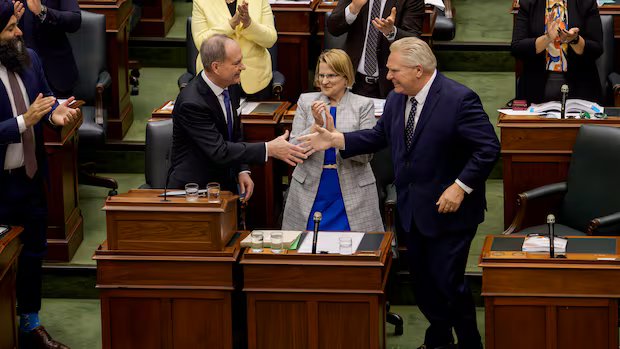
As the cost of living rises in the province, Ontario’s government finds itself under increasing pressure to address affordability just weeks after it delivered its latest budget.
Opposition parties and anti-poverty advocates are questioning the wisdom of holding off on immediate measures to provide cost-of-living relief.
On budget day, Finance Minister Peter Bethlenfalvy acknowledged that Ontarians have been hit by rising costs because of U.S. tariffs, the war in Iran and general global economic uncertainty. But he found himself defending the lack of affordability measures in the spending plan, pointing to a time-limited HST cut for new home buyers, amongst a mix of previously announced policies.
“People are feeling very anxious,” Bethlenfalvy said on budget day. “It’s a challenging world that we live in, and the uncertainty has hit our shores.”
When pressed by reporters, Bethlenfalvy pointed to measures the province announced, in some cases years before the 2026 budget, as evidence that the Ford government moved to address affordability.

Farrah Merali and Shawn Jeffords break down everything you need to know from the 2026 Ontario budget.
Ontario cut gas tax in 2022, made it permanent last year
Bethlenfalvy said the province first cut the provincial portion of the gas tax by 5.7 cents per litre in 2022, then made the move permanent last year. It has also removed tolls from the provincially-owned portion of Highway 407 East in Durham Region, he said.
“I understand how many people are feeling the pinch, how they’re feeling anxiety about the environment that we’re in,” he said. “That’s why we acted early, to put more money back in the pockets of those families and individuals.”
Opposition leaders have been quick to criticize the lack of new affordability measures in the spending plan, questioning why the government is holding back in the weeks following the budget.
“Ontarians want to know that their government is going to lower their rent and their grocery costs,” NDP leader Marit Stiles said. “None of that was in the 2026 budget, life is harder and more expensive for almost every Ontarian.”
Liberal Parliamentary Leader John Fraser slammed the government for a lack of affordability measures, calling for action to address home heating costs and rising unemployment rates.
“We can see a government that’s tired and out of ideas,” he said.

Tenant advocates call for rent control improvements
Their concerns have been echoed by both anti-poverty and tenant advocates in recent days, who say they were disappointed the budget did not deliver direct relief for some of the province’s lowest income residents.
Craig Pickthorne, communications director for the Ontario Living Wage Network, said addressing the rising cost of rent doesn’t have to wait until the next budget cycle.
“Rent control would be the single biggest thing that anybody could do to impact affordability in Ontario,” Pickthorne said. “We have an HST credit for home buyers and people are in a position to purchase homes, which is fine, that’s a positive thing. But we would like to see some measures for relief for people who rent their home.”
Dania Majid, a lawyer with the Advocacy Centre for Tenants Ontario, said providing security for those fearing eviction would help address the rising cost of living.
“What we really wanted the government to recognize is that over 31 per cent of Ontario households are renter households,” she said.
Majid said the government should close loopholes in its rent control policies, including Ontario’s law exempting units built after 2018 from all rent control and rules that permit “renovictions” that allow landlords to evict tenants, alleging a renovation is taking place.
“Closing the loopholes would go a really long way in terms of providing affordability and predictability for renters,” she said.
Food bank use rising across province: Feed Ontario CEO
The organization that represents Ontario’s food banks says its members have been seeing a sharp rise in use in recent years. Its clients cover a broad cross-section of society from students to workers with multiple jobs, to seniors on fixed incomes.
“Our biggest concern is there’s many people who are just getting by right now, and these extra exponential costs are really going to push them over the edge and they’ll be turning to our services,” said Feed Ontario CEO Carolyn Stewart.
Stewart said the province’s 140 food banks were disappointed there were no new measures in the budget aimed at lowering the cost of living. But they were happy to see the continuation of some policies, like tying Ontario Disability Support Program (ODSP) rates to inflation, she said.
Food banks have urged the government to increase the cap on earnings for people on social assistance. Right now, people receiving Ontario Works or ODSP can only earn up to $200 a month before the province starts to claw back any additional income.
“It’s dis-incentivizing any work that they had because people are comparing a guaranteed income when you’re on social assistance with uncertain hours,” she said. “You’re going to go for safety.”
Holding back on relief measures could be a political risk: minister
Former Liberal cabinet minister John Milloy said he was surprised there wasn’t a “gimmicky” affordability measure introduced in the budget.
“A little over a year ago, we all got $200 to help with groceries,” said Milloy, who is currently the director of the Centre for Public Ethics at Martin Luther University College.
“People want something that’s measurable, that they can say, ‘hey, I received a cheque for $200. It may not be a lot, but it’s $200 more than I got from some other government.’”
Milloy said there’s political risk for the Ford government if it appears out of touch.
“There is that vulnerability, people are going to say, ‘Where’s the government?’,” he said.
Conservative strategist Mitch Heimpel said he thinks the province has held back more direct — and potentially expensive — cost of living help with an eye to delivering it down the road.
The Ford government may want to see how the next six months unfold in the face of uncertain CUSMA talks, the continued war in Iran and contentious labour talks with its largest teacher’s unions looming, he said.
“I think Peter Bethlenfalvy has a chance to deliver a Fall Economic Statement that might be more consequential than his budget,” said Heimpel, who is a vice president at Texture Communications.
“He won’t be facing short-term oil shocks in Iran and there’s a chance that the economic outlook will be more stable in six months,” he said.