dailynewsnblog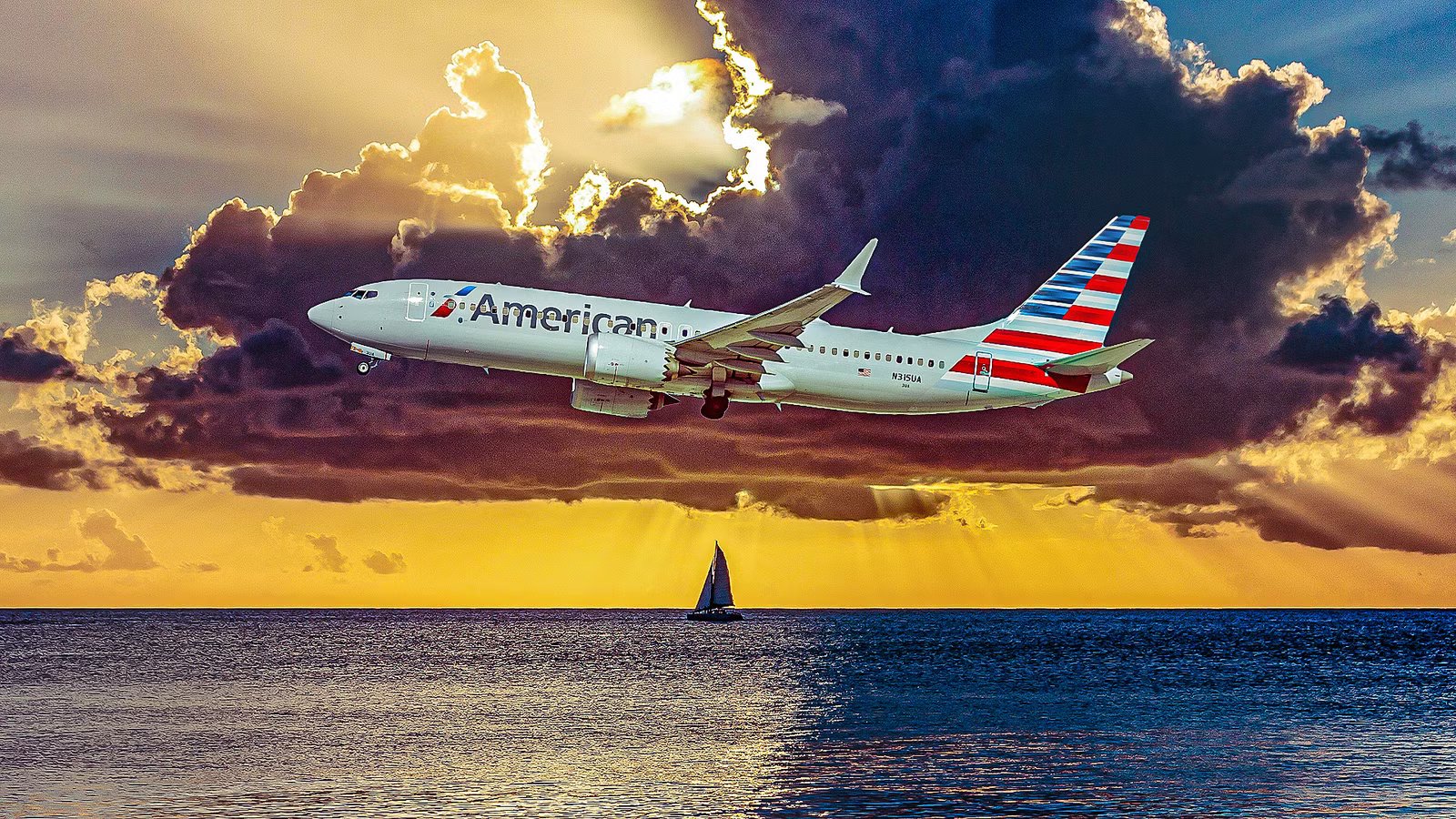
Boeing 737 MAX 8s are a regular feature of  American Airlines’ fleet. Behind the 737-800, Airbus A321 and A319, the 737 MAX 8 accounts for the fourth-largest portion of American’s 1,000-plus airplanes. However, as with many of its other narrowbodies, these are largely confined to domestic or overland routes within the US, despite boasting a range suitable for longer journeys, such as those over the Atlantic to Europe or the other way to Hawaii.
On the surface, it appears American is missing out on a huge opportunity by not flying its MAXs overseas. These aircraft are already capable of making such journeys. However, as is often the case across the aviation industry, it is not as simple as the airline packing up one of these aircraft and waving it off to cross either the Atlantic or the Pacific, and American does not currently have the option to do so.
What Is ETOPS?

One might not be blamed for wondering: if the 737 MAX 8s in American’s ranks can physically make long journeys east or west from the US, then what is to stop route planners from selecting, or at least considering, them for such journeys? We know the massive complexities airlines face in finding viable planes for differing routes at the right time, so the more options the better, surely?
Unfortunately, for American at least, there is a hefty regulatory barrier that restricts the use of planes for transoceanic flights. This is known as the Extended Range Twin-engine Operational Performance Standards (ETOPS) and essentially means that both an aircraft and an airline must adhere to strict maintenance and certification conditions.
The reason for this is to ensure twin-engine jets operating far from diversion airports are up to standard if an emergency arises – if an engine fails, for instance. Under Federal Aviation Administration (FAA) rules, twin-engine aircraft operating for more than 60 minutes outside the catchment area of an emergency airport must be ETOPS-certified. Such certification requires an in-depth review of specific airplane-engine combinations, alongside an operator’s own ETOPS programs. These include maintenance practices, crew and dispatcher training, operating manuals, and flight planning procedures.
737 MAX 8 Can Be ETOPS Certified

So, for long-distance flights using twin-engine aircraft, it is not just the equipment that needs to be certified, but also the airline. The irony is that the 737 MAX 8 itself is ETOPS-capable and is used by several airlines for transoceanic flights.
It achieved such status after 2,000 test flight hours and 180-minute ETOPS testing, which required 3,000 simulated flight cycles. These covered engine-failure scenarios and ensured critical fuel, hydraulic, and electrical systems would still operate reliably for the 60-plus minutes required to reach a suitable diversion airport.
|
Boeing 737 MAX Series |
||||
|
Specifications |
MAX 7 |
MAX 8 |
MAX 9 |
MAX 10 |
|
Seats (2-class) |
138-153 |
162-178 |
178-193 |
188-204 |
|
Maximum seats |
172 |
210 |
220 |
230 |
|
Nautical Mile Range (km) |
3,800 (7,040) |
3,500 (6,480) |
3,300 (6,110) |
3,100 (5,740) |
|
Length |
35.56 meters (116 feet, 8 inches) |
39.52 meters (129 feet, 8 inches) |
42.16 meters (138 feet, 4 inches) |
43.8 meters (143 feet, 8 inches) |
|
Wingspan |
35.9 meters (117 feet, 10 inches) |
35.9 meters (117 feet, 10 inches) |
35.9 meters (117 feet, 10 inches) |
35.9 meters (117 feet, 10 inches) |
|
Engine |
CFM LEAP-1B |
CFM LEAP-1B |
CFM LEAP-1B |
CFM LEAP-1B |
Among airlines that have sought ETOPS approval for the MAX 8, several examples come to mind. Canadian carrier WestJet regularly flies the aircraft from Halifax to several European destinations, including Amsterdam, Dublin, Edinburgh, and Paris. Air Canada, which boasts 50 737 MAX 8s in its fleet, also uses the model on routes to Dublin and London. All this goes to say, the MAX 8 is suited for such journeys, just as American does not use it for this purpose.

What Plane Has The Highest ETOPS Rating?
The A350 has the highest ETOPS rating of 370, meaning it can fly up to six hours and 10 minutes from the nearest usable landing strip.
It Does Not Need To

Technicalities aside, the reason American does not fly its 737 MAX 8s either west to Hawaii or east towards Europe is that it realistically does not need to. Or at least it does not need to yet. The airline had 89 of the jets as of December. This is out of a total of 392  Boeing 737 variants that American boasts.
While a substantial figure, it is almost matched by the number of Airbus A321neos in American’s fleet. Of these, the airline had 84 new-engine option models as of late last year, as part of its 304-strong A321 family fleet. Many of these, importantly, are ETOPS-certified and regularly make the transpacific crossing, while various widebodies like the 777 and 787 are used to head east over the Atlantic. The Airbus A321XLR is also set to be increasingly used by American for transatlantic flights as deliveries are filled over the coming months and years.
|
American Airlines Fleet |
|
|
Aircraft |
Count |
|
A319 |
132 |
|
A320 |
48 |
|
A321 |
218 |
|
A321neo |
84 |
|
A321XLR |
2 |
|
737-800 |
303 |
|
737 MAX 8 |
89 |
|
777-200ER |
47 |
|
777-300ER |
20 |
|
787-8 |
37 |
|
787-9 |
33 |
|
Total |
1,013 |
So, while the likes of  Alaska Airlines and
  Southwest Airlines offer examples of airlines that heavily deploy the 737 on Hawaiian routes, this is because they do not have the option of other aircraft types, unlike American. Indeed, Alaska’s fleet is mainly made up of 737 variants, while Southwest’s fleet solely features models from the family.
Could American Airlines Seek ETOPS Certification For The Jet One Day?

For the sake of argument, consider the distance between John F. Kennedy International Airport (JFK) and London Heathrow Airport (LHR). At approximately 3,450 nautical miles, the MAX 8’s standard 3,500 nautical mile range – which could be stretched depending on payload – means it could make it in theory. Of course, this excludes matters of comfort and slot availability at either end, but it raises an interesting question: whether American Airlines might one day consider ETOPS approval for its arguably substantial MAX 8 fleet.
The MAX 8 itself is said to be more fuel-efficient than predecessors, offering a 20% drop in both burn and carbon emissions, per Boeing. It can also trump widebodies on short-to-medium-haul routes, namely those under 3,500 miles, despite being designed for the frequency-over-range requirements of the single-aisle market. That said, in the case of the New York-to-London example above, an argument could be made for its viability.
The use of single-aisle narrowbodies for similar transatlantic, medium-haul routes has actually increased of late, according to aviation intelligence firm IBA.
“Recent years have seen the emergence and growth of a new player in the transatlantic market – the long-haul narrowbody […] This trend has been largely enabled by the emergence of efficient, long-range versions of existing aircraft, such as the A321neo LR/XLR and some Boeing 737 MAX models.”
Seating configurations, oil prices, load factors, and passenger trends are all said to play a huge role in the profitability of the transatlantic narrowbody option, so it is really a game of finding routes where lower demand might deter widebody operators.
American Airlines Might Be Headed In A Different Direction

While American Airlines does, in fact, appear to be targeting this emerging market, a look at the airline’s recent orders suggests it will not do so with the MAX 8. Having ordered some 260 new aircraft in early 2024, the MAX 8 was notably excluded. Instead, 85 Airbus A321neos, 85 Boeing 737 MAX 10s, and 90 Embraer E175 aircraft were purchased.
As part of the deal with Boeing, American also “upgauged 30 existing 737 MAX 8 orders to 737 MAX 10 aircraft”. Note, the 10s will boast higher capacities than the 8s once certified, but at the expense of range, so in reality, they are set to make for an even better option within the short-haul space.
It would appear then, perhaps unsurprisingly, that American has opted to pursue the long-haul narrowbody strategy by bolstering its A321neo fleet. Given that the airline is already ETOPS-certified on several CFM LEAP-1A-powered A321neos and announced in February that CFM International would supply engines for its incoming Airbus jets, the headache of obtaining additional approval for the MAX 8s would seem somewhat unnecessary.

Is It True That American Airlines Accidentally Flew A Non-ETOPS Airbus A321 To Hawaii?
This certainly is cause for concern.
If It Ain’t Broke

All told, the phrase ‘if it ain’t broke’ appears very relevant in American’s case. It has gotten by thus far without seeking ETOPS approval for its MAX 8s; doing so might represent more of a solution in search of a problem than the other way around.
American has had a run-in with the FAA regarding ETOPS certification. Back in August 2015, a non-ETOPS-certified A321 was mistakenly sent from Los Angeles International Airport (LAX) to Honolulu’s Daniel K. Inouye International Airport (HNL). Though American management contacted regulators immediately upon noticing the issue, and the flight was, luckily, without incident, any efforts to reduce the risk of a repeat might be the sensible course of action for the airline. This is especially relevant given the lack of commercial drivers for American to get its 737 MAX 8s ETOPS-certified.