dailynewsnblog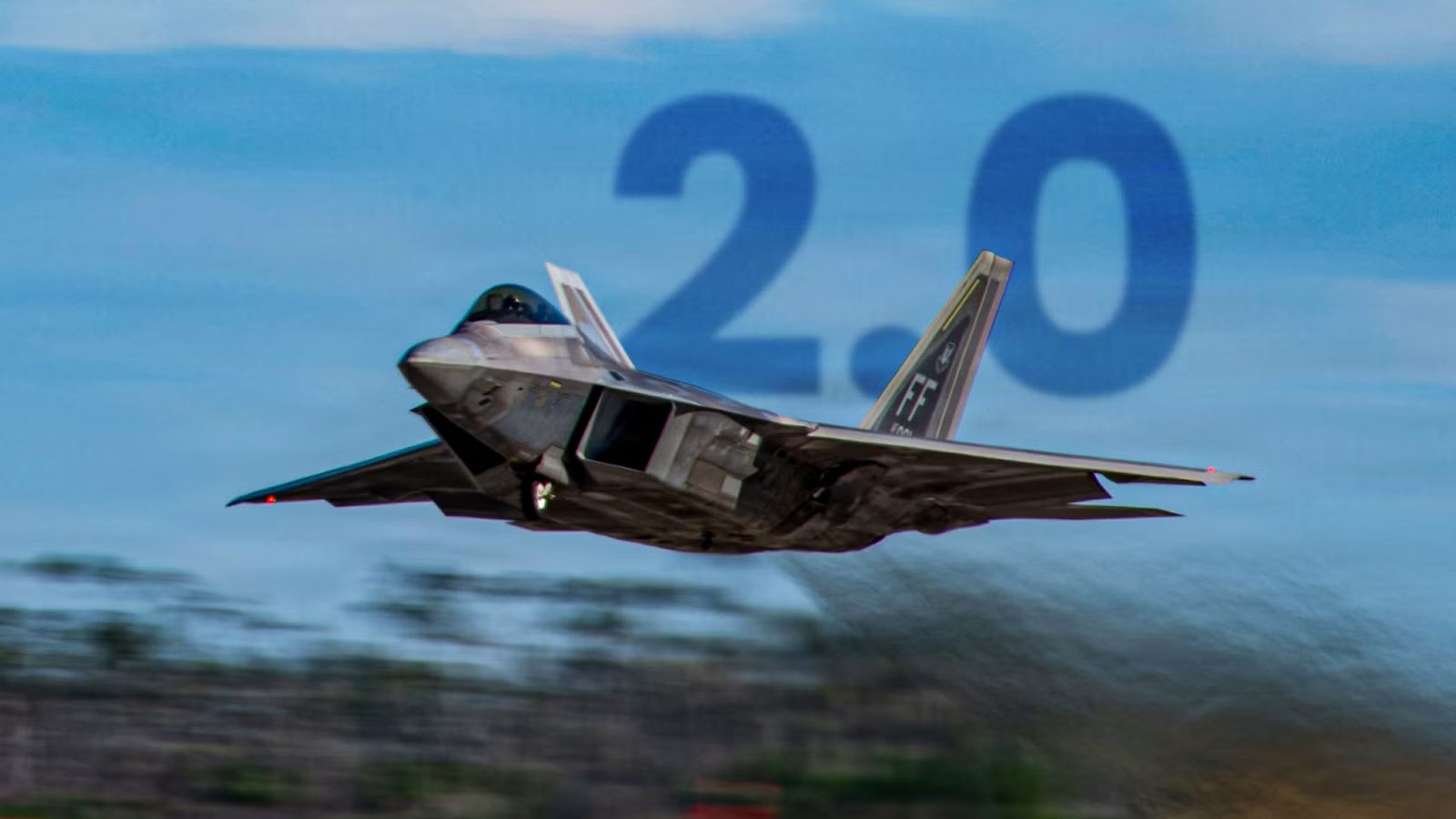
The United States Air Force is upgrading the Lockheed MartinF-22 Raptor under its modernization program, with $90.34 million requested in the FY2026 budget, adding stealthy external fuel tanks, Infrared Search and Track (IRST) pods, and a new helmet-mounted display to keep the fighter operational into the 2030s. The upgrades, often referred to as “Raptor 2.0”, focus on increasing range, passive detection, and networking rather than pure stealth, a major shift driven by the vast distances of the Indo-Pacific and the rise of stealth aircraft like the Chengdu J-20 and Sukhoi Su-57. The modernization effort shows how the Air Force plans to keep roughly 185 F-22s relevant until the next-generation fighter arrives.
This shift is significant because the F-22 was originally designed around one core principle: maximum stealth and air dominance. The new upgrades show that modern air combat is no longer just about radar invisibility, but about range, sensors, data sharing, and passive detection. Instead of being optimized purely for stealth penetration missions, the F-22 is evolving into a long-range, networked air superiority platform capable of detecting enemy stealth aircraft and operating across the Pacific theater.
The F-22 Raptor Is Entering A New Upgrade Era

The US Air Force is upgrading the F-22 into what many analysts are calling a “Raptor 2.0” configuration. This upgrade package includes new stealthy external fuel tanks, underwing infrared search and track pods, avionics upgrades, and a helmet-mounted display system. These upgrades are part of the F-22 “Viability” modernization program designed to keep the aircraft operationally relevant until the sixth-generation fighter enters service.
One of the most notable changes is the introduction of the Low-Drag Tank and Pylon (LDTP) system, which allows the F-22 to carry external fuel tanks with a much smaller radar signature than traditional external tanks. This is a major shift from the original F-22 concept, where the aircraft relied almost entirely on internal fuel to maintain stealth. The new tanks allow the aircraft to significantly extend its range without completely sacrificing stealth characteristics.
The upgrade program also includes avionics refreshes and a helmet-mounted display system to reduce pilot workload and improve situational awareness. As Simple Flying previously covered, the US Air Force requested $90.34 million in its Fiscal Year 2026 budget specifically for the F-22 Viability upgrade package. This demonstrates that the Air Force intends to keep the Raptor operational for many more years rather than retiring it early as previously considered.
Why Range Is Now More Important Than Ever

One of the biggest limitations of the F-22 has always been its range. The aircraft was designed primarily for the European and Middle Eastern theaters, where air bases are relatively close to potential combat zones. However, the strategic focus of the United States has shifted toward the Indo-Pacific, where distances between bases and operational areas are enormous.
The new Low-Drag Tank and Pylon system is specifically designed to address this problem. Traditional external fuel tanks used on fighters dramatically increase radar signature and are usually jettisoned before combat. However, the new stealth-shaped tanks are designed to remain attached during missions without severely compromising the aircraft’s stealth profile. According to The War Zone, older 600-gallon tanks significantly increased radar cross-section and had to be dropped before entering contested airspace, which reduced mission flexibility and range.
The new tanks effectively allow the F-22 to operate farther from base, escort bombers longer, and remain on patrol for extended periods. This is especially important in a potential conflict over the Pacific, where an air tanker may be vulnerable, and bases may be far from combat zones.

How Lockheed Martin Fighters Stack Up Against Each Other In 2026
Lockheed Martin’s fighters continue to define the shape of Western airpower, but how do the F-22, F-35, and F-16 compare in evolving scenarios?
Passive Detection: The IRST Advantage

Another major upgrade for the F-22 is the addition of underwing Infrared Search and Track (IRST) pods. These systems allow the aircraft to detect enemy aircraft by tracking heat signatures rather than using radar. Instead of searching for radar reflections, IRST sensors look for infrared emissions generated by aircraft engines, exhaust plumes, and even airframe heating caused by high-speed flight through the atmosphere. This is a major advantage in modern air combat, especially when facing enemy stealth fighters, because stealth aircraft are primarily designed to reduce radar detection, not infrared signatures. By adding IRST capability, the F-22 gains an entirely new method of finding and tracking targets that does not rely on traditional radar systems.
Traditional radar systems emit radio waves, which can be detected by enemy radar warning receivers. This means that when a fighter uses its radar, it may reveal its position, direction, and sometimes even aircraft type to the enemy. In beyond-visual-range combat, this can be a significant disadvantage because it alerts the opponent that they are being tracked or targeted. IRST systems, however, are passive sensors that do not emit signals, allowing pilots to detect and track enemy aircraft without being detected themselves. According to united24media.com, this capability provides a massive tactical advantage when facing stealth aircraft such as China’s J-20 or Russia’s Su-57, because even low-observable aircraft still generate heat signatures that can be detected at long range under the right conditions.
The addition of IRST pods represents a major shift in air combat philosophy. Instead of relying purely on stealth to avoid detection, the F-22 will now be able to hunt stealth aircraft using passive sensors while remaining electronically silent. This significantly increases its effectiveness in future air superiority missions where both sides may be flying stealth aircraft and trying to avoid radar detection. In such an environment, the aircraft that can detect the opponent first without revealing its own position will have a major tactical advantage. The IRST-equipped F-22, therefore, becomes not just a stealth fighter, but also a stealth hunter designed to find and track low-observable aircraft in a contested airspace environment.
A Strategic Shift: Trading Stealth For Flexibility

The upgrades to the F-22 represent a strategic shift in how the aircraft will be used in future conflicts. When the F-22 was first designed in the 1980s and 1990s, stealth was considered the single most important factor in air combat survivability. The idea was simple: if the enemy cannot see you, they cannot shoot you. As a result, the aircraft was built around internal weapons bays, internal fuel storage, carefully shaped airframe surfaces, and strict limits on external stores that could increase radar signature. Everything about the F-22’s design prioritized minimizing radar cross-section, even if that meant sacrificing range, payload flexibility, or mission endurance. During the early post–Cold War period, this made perfect sense because the aircraft was expected to penetrate heavily defended airspace, destroy enemy fighters, and establish air superiority quickly.
However, modern air combat is changing. Today’s battlespace includes networked sensors, long-range missiles, space-based tracking, and infrared detection systems. This means that stealth alone is no longer enough to guarantee survivability, especially against near-peer adversaries with advanced detection networks. Instead, aircraft must be able to detect enemies first, share data with other aircraft, operate at long distances from base, and remain on station for extended periods. Aircraft now operate as part of a wider combat network that includes satellites, drones, airborne early warning aircraft, and ground-based radar systems, meaning the fighter that has the best information picture often has the advantage even before entering missile range.
According to National Interest, the upgrades represent a deliberate decision to accept a small increase in radar signature in exchange for significantly improved range, passive detection capability, and networking. This reflects a broader shift in air combat strategy where information dominance, sensor capability, endurance, and operational flexibility are becoming more important than pure stealth alone. Rather than designing the F-22 to be as invisible as possible in every scenario, the Air Force is now optimizing the aircraft for real-world operations where range, situational awareness, and the ability to detect stealth aircraft may be more valuable than maintaining the absolute lowest radar cross-section. In other words, the upgraded F-22 is not abandoning stealth, but evolving beyond a single-focus design philosophy toward a more balanced and flexible air superiority platform suited for modern warfare.

6 Aircraft That Represent The Future Of Air Combat
Discover six aircraft redefining modern air warfare, from stealth fighters to missile trucks, shaping the balance of air power in 2026 and beyond.
The Viability Upgrade And Helmet-Mounted Display

One of the most requested upgrades for the F-22 has been the addition of a Helmet-Mounted Display (HMD). Surprisingly, despite being the world’s most advanced fighter for many years, the F-22 never originally received a helmet display system like the Lockheed Martin F-35 or modern F-16s. This was largely due to the aircraft being designed in the 1990s, when helmet display technology was still relatively new and less integrated into fighter avionics than it is today.
As air combat technology evolved, helmet-mounted cueing systems became standard on modern fighters, allowing pilots to cue missiles and sensors simply by looking at a target. The absence of this capability on the F-22 increasingly became a limitation, particularly in within-visual-range combat and high workload environments.
The new helmet-mounted display will allow pilots to see targeting information, navigation data, and sensor information directly on their visor. This reduces the need to look down at cockpit displays and improves situational awareness during high-stress combat situations where pilots must track multiple targets while maneuvering at high speed. The system can display missile targeting cues, threat warnings, flight data, and sensor imagery directly in the pilot’s line of sight, effectively turning the helmet visor into an extension of the aircraft’s avionics system.
The avionics refresh and helmet system are also intended to reduce pilot workload and shorten the kill chain, meaning pilots can detect, track, and engage targets faster without needing to shift their attention between multiple cockpit screens.
These upgrades may not be as visually dramatic as new weapons or engines, but avionics and pilot interface improvements often have the biggest impact on real-world combat effectiveness. In modern air combat, the pilot who can process information faster and maintain better situational awareness often has a decisive advantage, even if the aircraft themselves have similar performance. Faster decision-making, better target tracking, and improved situational awareness can determine the outcome of air combat long before missiles are launched, which is why cockpit technology and human-machine interface upgrades are considered some of the most important improvements in modern fighter aircraft modernization programs.
Bridging The Gap Until The Sixth-Generation Fighter

The F-22 upgrades are not intended to replace the aircraft with a completely new version, but rather to keep it relevant until the next-generation fighter enters service. The US Air Force is currently developing the Next Generation Air Dominance (NGAD) fighter, sometimes referred to as the F-47, which is expected to make its first flight around 2028.
This means the upgraded F-22 will act as a bridge between fifth-generation fighters and sixth-generation air combat systems. The aircraft will likely operate as part of a networked force including F-35s, NGAD fighters, drones, and airborne early warning aircraft. In this environment, the F-22’s role will evolve from being a lone stealth fighter to being a sensor node and air superiority controller within a larger combat network.
The upgrades represent a shift in doctrine, strategy, and the future of air combat. The F-22 is evolving from a pure stealth air dominance fighter into a long-range, networked, sensor-heavy air superiority platform designed for modern warfare. Rather than relying solely on stealth, the future Raptor will rely on information, detection, range, and teamwork with other aircraft and systems. In many ways, this transformation shows how air combat is changing. Stealth is still important, but range, sensors, networking, and passive detection are becoming equally important. The “Raptor 2.0” upgrades ensure that the world’s most famous air superiority fighter will remain relevant and dangerous well into the next decade, bridging the gap until the sixth-generation era fully arrives.