dailynewsnblog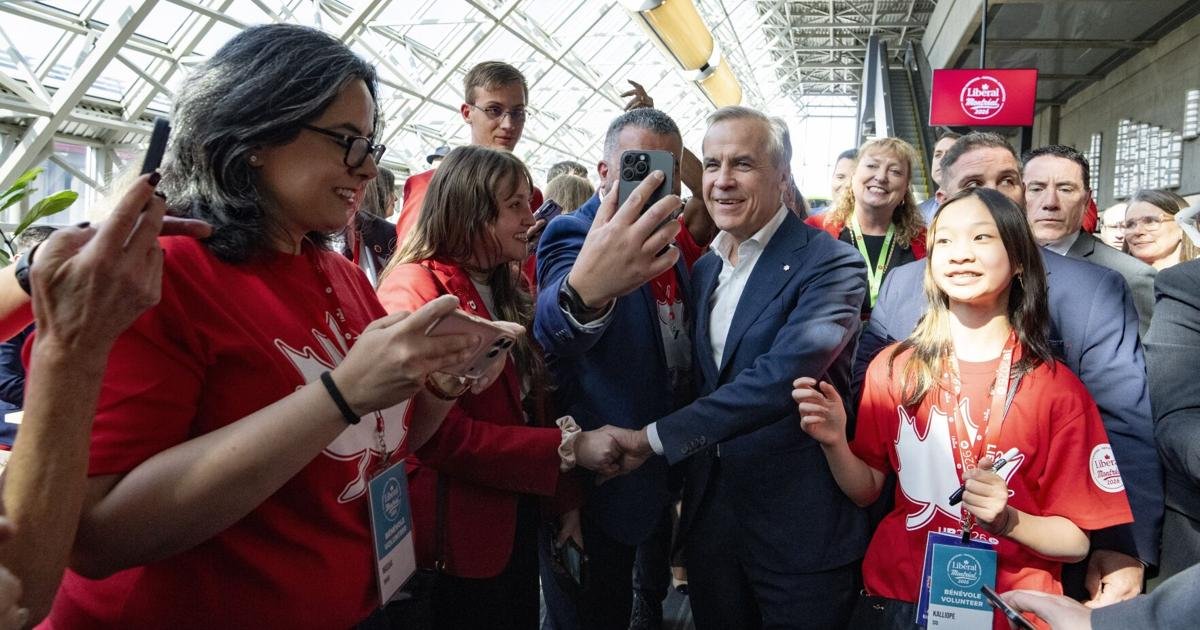
MONTREAL — Prime Minister Mark Carney’s agenda at the party’s 2026 convention was simple: a little byelection politicking, a little schmoozing, a little hockey cheering, sprinkled with a lot of speechifying.
For about 4,500 federal Liberals who gathered, their agenda also seemed simple. They mainly came to hail Carney, the leader whose arrival a year ago threw the Liberal Party of Canada a political lifeline.
Now, having racked up five floor-crossers from opposition benches on the left and right, plus likely two — possibly three — byelection wins Monday, Carney radiates confidence and giddy delight at where he finds himself: on the cusp of a tantalizing elected majority that eluded him last April 28.
Hitting up the Bell Centre after a first night of convention speeches to take in the last two periods of a “fantastic” Montreal Canadiens game, Carney was hyped after the Canadiens clinched a playoff spot.
“I’m going to be honest, I haven’t had that much fun in over a year,” Carney said in the Habs’ post-game dressing room as players laughed.
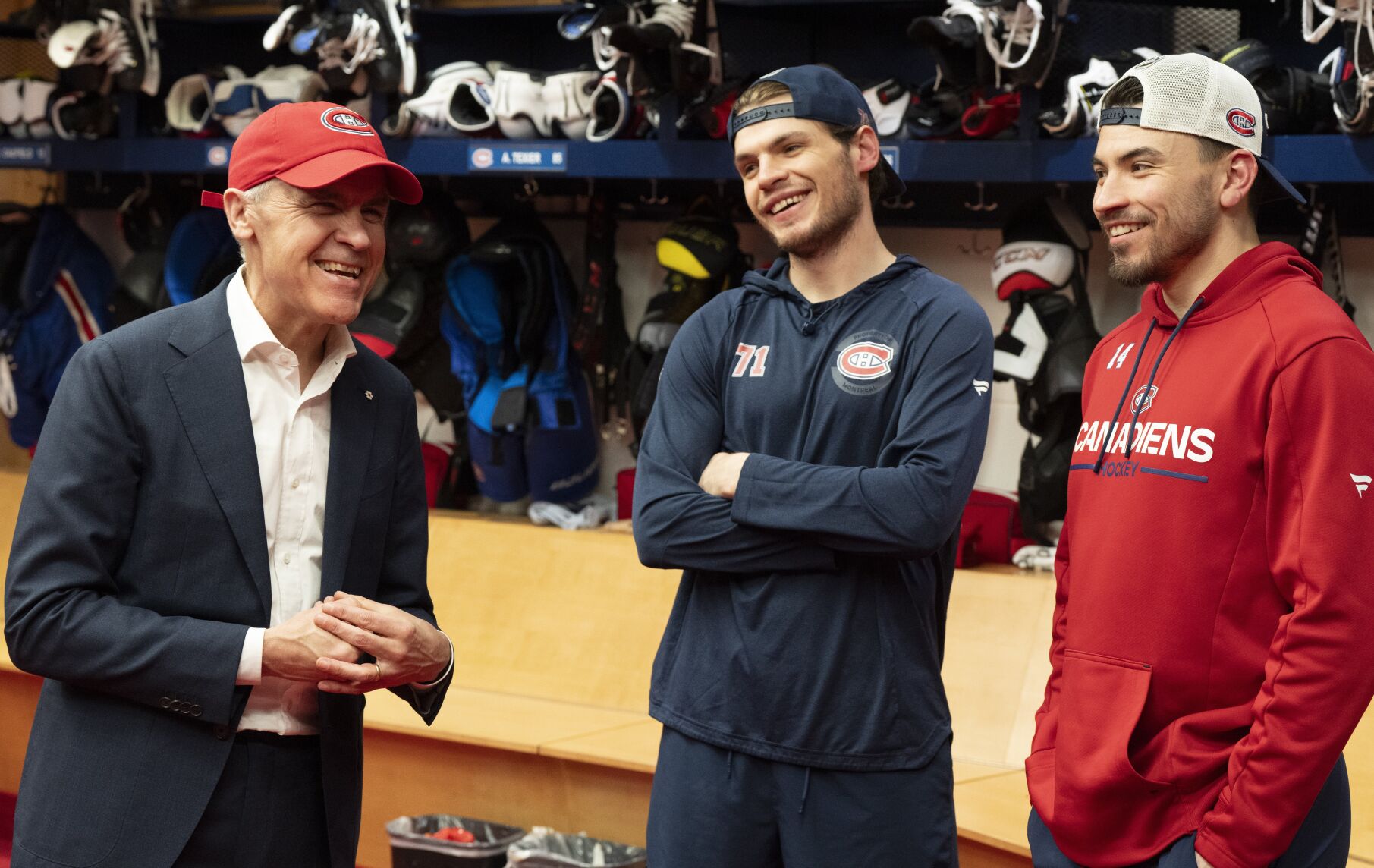
Prime Minister Mark Carney, left, laughs as he meets Montreal Canadiens’ Jake Evans and Nick Suzuki in their dressing room following their NHL game against the Tampa Bay Lightning in Montreal on Thursday, April 9, 2026.
Christinne Muschi/The Canadian Press
Blocks away, the Liberal gathering was billed as a policy convention, but there were precious few heated political debates.
No invited political cousins from the United States’ Democratic Party ranks to help strategize the electoral path ahead.
No ministerial accountability sessions as at past conventions when grassroots could grill cabinet members.
Among the resolutions that made it to the convention floor, there were no potentially divisive or embarrassing proposals on tariffs, trade, borders or defence that might fuel tension in the Canada-U.S. relationship.
The convention was a three-day rally to pat themselves on the back. More than a few fervent, longtime Liberals grumbled that, as a “party” — in the fun sense of the word — this was “meh,” “lame” and even “boring.” And likely intended that way.
No big stars onstage. No live music. There was no tribute to former leader Justin Trudeau, who brought the Liberals out of the political wilderness in 2015 and led them in power for a decade.
Trudeau made only a brief cameo appearance Thursday evening via a short video message shown on the big screen. The room wasn’t full, and the applause was polite.
Instead, this was a three-day celebration of the “non-politician” who galvanized Liberal fortunes after U.S. President Donald Trump galumphed onto the world stage, barge-poling them away from the Trudeau era.

A day before Liberals gather in Montreal for their convention, the prime minister embraced
Carney’s popularity here was tempered only by skeptics who lamented the admission this week of social conservative Marilyn Gladu into their ranks, saying she does not represent Liberal values.
“Why?” asked a Liberal MP whom the Star agreed not to identify in order to discuss caucus dynamics, and who sees Gladu’s brand of politics as unwelcome.
Other delegates shrugged off Gladu’s arrival. “Nobody’s pissed off; they’re like what the f—-? But they get it. It’s a numbers game,” said a longtime Liberal and former Trudeau-era staffer.
What is clear is that this is no longer the Liberal party of Justin Trudeau. It also isn’t a throwback to the Paul Martin or Jean Chrétien years, when the party was seen as tilting between the centre-left and the centre of the political spectrum. Instead, many Liberals place Carney on the centre-right.
Carney himself told Premier Doug Ford, “I’m more conservative than you are.”
Fundamentally, however, Carney rejects simplistic labels, saying his is a “big tent” coalition of people who share the Liberal “mission” of building Canada.
One senior Liberal, granted anonymity to freely discuss the government’s thinking, said Carney’s leadership is not easily characterized as left or right on an ideological spectrum, but is best understood by its economic focus, and its determination to bolster Canadian sovereignty on both the trade and defence fronts.
“I don’t see that as a left-or-right thing. I see it as a pro-Canada thing,” the source said. On defence, the insider pointed out, Liberal and Conservative governments for years ignored allied demands to increase spending, but Carney is drawing support from all kinds of Liberals and Conservatives for doing just that, and from the NDP for boosting Canada’s sovereign capabilities in the face of Trump’s 51st state threats.
Carney is fond of using the term “variable geometry” to describe how Canada must adapt internationally to what he calls a new world order, in which new alliances must be strengthened as superpowers flout the old rules-based order.
The senior Liberal used the same term in describing how Canadians across the political spectrum are looking at Carney, willing to suspend partisan leanings.
A second senior Liberal source, who also spoke on condition they not be identified, put it simply:
“We are an anti-Trump coalition. That’s what we are. And that’s where Canadians want us to be because they are spooked by the guy south of the border,” said this source.
In politics, the source added, there is nothing more unifying than a common villain and right now, the “villain is clear and he’s not in the country.”
Canadian prime ministers are defined by how they handle three perennial concerns: the economy, national unity and the relationship to the U.S., the source said, adding with today’s economy tied to Canada-U.S. relations, the strength of Carney, a former central banker, is his ability and Canadians’ trust that he can address both.
A different test may come on the national unity front one day.
For now, said Finance Minister François-Philippe Champagne, Carney “is bringing hope back to the country, bringing a sense of purpose back to the party.”
“The Liberal Party, if you go back to the history, has always evolved with the time. I think what we’re facing today as a nation, as a world, is very different than the periods that we had before.
Industry Minister Mélanie Joly said it’s difficult to say that Carney is defining the Liberal party because there is always a “give and take” between a party and a leader.
The Liberal Party “is one of the strongest political brands in the West, and I think that it will all survive us,” she said. “ Indeed, it’s been shaped by its leaders but fundamentally, the leaders have been shaped by events.”
Chrétien had to deal with chronic deficits and huge debt, national unity and, eventually, an unpopular Iraq War, Joly said, which shaped how he ran “the government, but also the Liberal Party.”
Trudeau arrived after Stephen Harper “at a time where there were clear issues linked to the environment and Indigenous reconciliation,” cuts following the 2008-2009 financial crisis, and later the pandemic, Trump’s first term, a war in Ukraine, and later the Middle East.
“Carney is arriving at a time where we need somebody that is focused on the economy,” she said.
In Montreal, it was clear Carney’s gravitational pull is so strong that Liberals — including the new floor-crossers — have shape-shifted to fit his vision of who Liberals are.
Gladu said while she has “faith traditions,” she will vote with the Carney Liberals to protect a woman’s right to choose an abortion, claiming her values can find a home in his caucus.
On other policy planks the Liberals embraced as core to the brand, Carney said he will continue protections for national child care and existing dental care plans. As for expansions of the existing programs? To be determined.
For now, Carney’s focus on the economic agenda is reflected in polls showing that it is working for him and his party.
Polling analyst Philippe Fournier, who runs the data aggregator 338Canada.ca, has not seen the kind of positive approval ratings for a federal leader since he started running his poll analysis site in 2017.
Fournier projects that if an election were held now, Carney would get a massive majority, with the Conservatives losing 40 seats. The fear among Conservatives, which the Star reported this week, that up to 40 of them could lose if Poilievre remains at the helm, is grounded in data.
Fournier said if Carney wins the byelections Monday he can claim democratic “legitimacy” for his slim majority.
But why doesn’t Carney just call a national election now and win that massive majority the polls suggest is his for the taking?
Several of Carney’s team say Canadians don’t want a general election, especially heading into talks with the U.S. on reviewing the Canada-U.S.-Mexico deal, and Carney doesn’t want the three-month distraction of a national campaign.
He prefers to get on with the job of governing, diversifying trade relations and trying to reduce Canada’s dependency on the U.S.
Kody Blois, Carney’s parliamentary secretary, said the party has always “tried to plant itself in the middle of the political spectrum and have different value sets that draw in Canadians to say ‘I can see myself reflected in this type of party.’ Call it brokerage, call it pragmatic. That’s exactly how the Prime Minister has governed.”
And yes, Carney is in a hurry to get results.
“I think the Prime Minister is impatient in the best kind of way,” said Blois, “because Canadians are expecting real results, and his entire focus is about delivering on the promises that we’ve identified.”