dailynewsnblog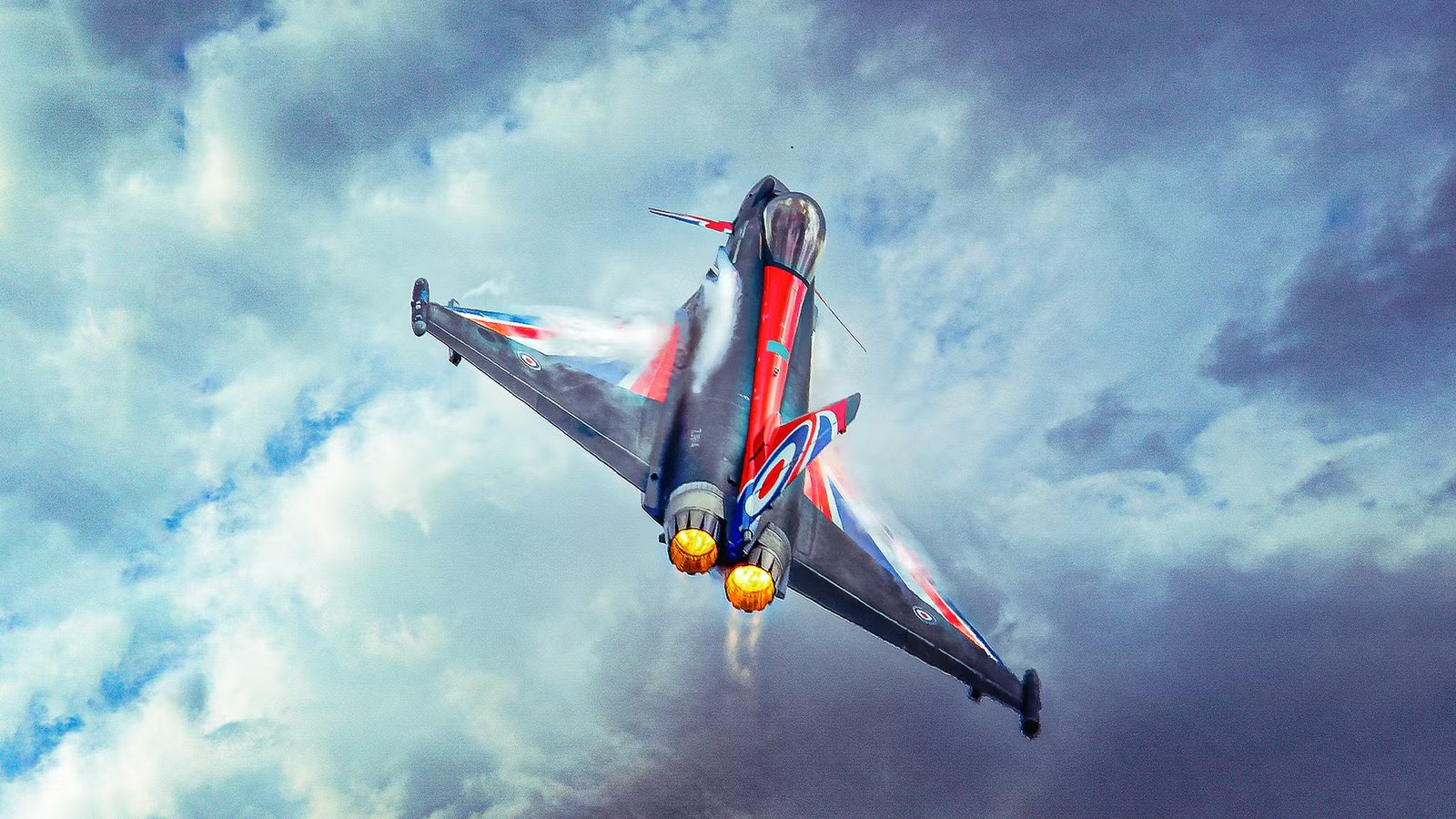
Four decades after the first F-16s entered service and more than twenty years since the Eurofighter Typhoon joined the RAF, Western fighter aviation finds itself at an unusual crossroads. Aircraft that were once expected to be retired long ago are instead being ordered in new batches, upgraded with sensors their original designers never envisioned, and deployed in missions ranging from Baltic air policing to strike operations over the Red Sea.
The Typhoon, the Boeing F-15, the Lockheed Martin F-16, and the Boeing F/A-18 family are all commonly grouped under the label of “fourth-generation” fighters. In reality, that category now spans an enormous range of capabilities, from Cold War airframes still flying after multiple upgrades to brand-new builds equipped with AESA radars and advanced electronic warfare systems approaching the capabilities of fifth-generation aircraft. Understanding how these aircraft compare in 2026 requires looking beyond simple specification sheets.
The comparison matters because governments are actively choosing between these aircraft today. Turkey is waiting for its first Typhoons, Germany has approved additional ones, Egypt is negotiating for F-15EX aircraft, the F-16V remains in production for customers across multiple continents, and the F/A-18 Super Hornet production line is nearing closure as final deliveries reach US Navy squadrons. For defense planners, export customers, and aviation enthusiasts alike, comparing Europe’s premier fighter with its American counterparts is more relevant now than it has been in years.
Origins, Design Philosophy, & Intended Roles

These four fighter jets were designed to meet very different operational requirements, and those original design philosophies still shape how each performs today. The F-15 Eagle was developed in the early 1970s as a dedicated air superiority fighter following lessons learned in Vietnam. The F-16 was conceived as a lightweight, affordable complement to the Eagle, prioritizing maneuverability and lower operating costs.
The F/A-18 Hornet, and later the Super Hornet, was designed for the US Navy as a carrier-capable multirole aircraft able to perform both fleet defense and strike missions. The Eurofighter Typhoon emerged from the European Fighter Aircraft program of the 1980s, a multinational effort to replace aging Phantoms and Lightnings with a next-generation air superiority fighter built around a twin-engine canard-delta design.
As a result, each aircraft has a distinct character. The modern F-15EX Eagle II is the largest and heaviest aircraft in this comparison, with an enormous payload capacity and the ability to carry up to sixteen air-to-air missiles in certain configurations. It also remains the fastest aircraft in the group. The F-16, even in its latest Block 70/72 form, is still fundamentally a lightweight single-engine fighter valued for its affordability, global support network, and agility. The Super Hornet is the only carrier-capable aircraft here, which gives it operational flexibility but also limits its top speed and range compared to land-based fighters.
The Typhoon sits somewhere between the F-16 and F-15 in size but uses two EJ200 engines and a canard-delta configuration that delivers exceptional instantaneous turn performance. It also has a supercruise capability, the ability to sustain supersonic flight without afterburner, something none of the American aircraft in this comparison can do in operational configuration.
Supercruise is not just a marketing term in the Typhoon’s case. The aircraft can sustain roughly Mach 1.2 without afterburner, which expands tactical options during both interception and disengagement phases while reducing fuel consumption and infrared signature. This capability has been particularly relevant in NATO quick-reaction alert missions, a role the Typhoon has performed extensively since the early 2000s.
Who Flies What: Operators And Fleet Size

In terms of numbers, the F-16 remains the most widely used Western fighter in the world. With roughly 2,700 aircraft in service globally, it represents a significant portion of the world’s fighter fleet. Its huge operator base, spanning NATO members, Middle Eastern partners, and Indo-Pacific nations, gives it an unrivaled support network, weapons compatibility system, and pilot training infrastructure.
The F-15 family follows with just under 900 aircraft worldwide, operated by the United States, Saudi Arabia, Japan, Israel, South Korea, Singapore, and Qatar, among others. The F/A-18 family, including both legacy Hornets and Super Hornets, totals roughly 870 aircraft, most of them serving with the US Navy and Marine Corps, as well as Australia, Canada, Malaysia, Finland, Spain, Switzerland, and Kuwait.
The Eurofighter Typhoon has a smaller fleet, with just over 600 operational aircraft as of late 2025, but its order book is growing. The aircraft is operated by the UK, Germany, Italy, Spain, Saudi Arabia, Austria, Oman, Kuwait, and Qatar, with Turkey becoming a new operator following a deal signed in 2025 for 12 jets. Germany and Spain have both placed additional orders, and production is expected to continue well into the 2030s, something that was far from certain only a few years ago.
The operator landscape also reflects geopolitics. The F-16’s global dominance is largely the result of decades of US foreign military sales policy, making it the default Western fighter for many countries seeking affordability and guaranteed logistical support. The F-15EX occupies a higher-end category, comparable in cost to the Typhoon but offering much greater payload capacity and deep integration with US weapons systems. The Typhoon’s growing export base reflects both its performance and Europe’s increasing interest in defense independence.

How the Eurofighter Typhoon Stacks Up Against the US F-35
Dogfight agility meets stealth supremacy. The Eurofighter and F-35 redefine air combat in a clash of speed, power, and cutting-edge tech.
Performance And Technical Comparison

Published performance figures only tell part of the story, since most fighter missions are flown at subsonic speeds, but they still reveal important design priorities. The F-15 remains the fastest aircraft in the group, capable of around Mach 2.5 and very high service ceilings. The Typhoon is close behind in both speed and thrust-to-weight ratio, but in a lighter airframe. The F-16’s single-engine design limits its thrust compared to twin-engine aircraft, while the Super Hornet’s carrier-optimized airframe prioritizes stability and durability over outright speed, limiting it to around Mach 1.8.
Where the Typhoon stands out is in subsonic maneuvering performance. Its canard-delta configuration produces excellent instantaneous turn rate and strong energy retention, particularly in vertical maneuvers. Many NATO exercises have shown the Typhoon performing extremely well in close-range engagements. In general terms, analysts often consider the Typhoon superior in close-in dogfights, while the F-15EX holds a major advantage in payload capacity and long-range missile carriage.
|
Specification |
Eurofighter Typhoon |
F‑15EX Eagle II |
F‑16V Block 70 |
F/A‑18E/F Super Hornet |
|
Max Speed |
Mach 2.35 (~1,520 kt) |
Mach 2.5 (~1,650 kt) |
Mach 2.0 (~1,320 kt) |
Mach 1.8 (~1,190 kt) |
|
Engines |
2× EJ200 |
2× F100‑229 or F110‑129 |
1× F110‑132 |
2× F414‑400 |
|
Thrust‑to‑Weight |
~1.15 |
~1.17 |
~1.11 |
~0.93 |
|
Hardpoints |
13 |
16–23 |
9 |
11 |
|
Max Payload |
~19,841 lbs (9,000 kg) |
28,669 + lbs (13,000+ kg) |
16,975 lbs (7,700 kg) |
17,747 lbs (8,050 kg) |
|
Supercruise |
Yes |
No |
No |
No |
|
AESA Radar |
Captor‑E |
APG‑82(V)1 |
APG‑83 SABR |
APG‑79 |
The F-16 remains a very capable dogfighter thanks to its agility and small size, but it can be at a disadvantage in beyond-visual-range engagements against Typhoons equipped with the Meteor missile, which has a significantly larger no-escape zone than current AMRAAM variants.
Weapons, Sensors, And Electronic Warfare

Weapons and sensors are often more important than raw aircraft performance, and in this area the Typhoon has some significant advantages.
The Eurofighter Typhoon’s main advantage in air-to-air combat is its integration of the Meteor beyond-visual-range missile. Unlike traditional rocket-powered missiles such as the AIM-120 AMRAAM, Meteor uses a ramjet engine that allows it to maintain energy throughout its flight, giving it a significantly larger no-escape zone against maneuvering targets. This is often considered one of the most important advantages the Typhoon has in long-range air combat. At short range, missiles such as ASRAAM and IRIS-T provide highly capable, high off-boresight engagements when used with helmet-mounted sights.
The American aircraft rely primarily on the AIM-120 AMRAAM for beyond-visual-range combat and the AIM-9X Sidewinder for short-range engagements. The F-15EX in particular can carry very large numbers of air-to-air missiles, far more than the other aircraft in this comparison, which supports its growing role as a so-called “missile truck” operating alongside stealth fighters such as the F-22 and F-35.
Electronic warfare systems are becoming just as important as radar performance in modern air combat. The Typhoon’s Praetorian defensive aids system integrates radar warning receivers, missile warning systems, jammers, and countermeasures into a highly automated internal defensive suite. The Super Hornet also has strong electronic warfare capabilities and benefits from the US Navy’s extensive experience in electronic attack operations, especially when operating alongside EA-18G Growler aircraft. The F-15EX includes the EPAWSS electronic warfare system, one of the most advanced fighter self-protection systems currently in service. The F-16, depending on variant, often relies more on external electronic warfare pods, which can reduce available weapon stations but still provide significant capability.
Infrared search and track (IRST) systems are another growing factor in modern air combat. The Typhoon has an internal IRST system, the Pirate, allowing passive detection of aircraft without emitting radar signals. The F-15, the F-16, and the Super Hornet use external pods for this capability.
Cost will likely be one of the biggest factors determining how long these aircraft remain in service. The F-16’s relatively low purchase price and operating costs ensure it will continue to serve with many air forces into the 2040s, particularly in the Block 70/72 configuration with AESA radar and modern avionics.
The F/A-18 Super Hornet sits in a similar cost category but faces a more limited production future as the US Navy transitions toward the F-35C and future carrier aircraft. At the higher end, the Eurofighter Typhoon and F-15EX represent a different philosophy: large, powerful, non-stealth fighters capable of carrying heavy payloads and operating alongside stealth aircraft. These aircraft are expensive to purchase and operate: the F-15EX, for example, has operating costs reported at around $29,000 per flight hour, but they offer capabilities that smaller fighters cannot match, particularly in long-range air-to-air combat and heavy strike missions.

This Is The Oldest Fighter Jet In The US Air Force Still Flying
We are now in the final chapter of an iconic aircraft as it prepares for retirement from active duty.
Combat Records And Operational Use

One major difference between the Eurofighter Typhoon and its American counterparts is its combat record. The F-15 Eagle family still holds one of the most remarkable air-to-air combat records in aviation history, with more than 100 confirmed aerial victories. The newer F-15EX Eagle II, however, has not yet been used in combat as of 2026.
The aircraft has begun forward deployments to the Indo-Pacific, with initial aircraft deployed to Kadena Air Base in Japan in 2025 ahead of a planned permanent deployment beginning in 2026, primarily for air defense and deterrence missions against China and regional threats. These deployments are focused on air policing, large force exercises, and integration with F-22 and F-35 units rather than combat operations, meaning the F-15EX’s operational credibility still largely derives from the long combat history of the F-15C and F-15E variants rather than its own combat record.
The F-16 remains one of the most operationally active fighters in the world in 2026. While most of its historical air-to-air victories come from Israeli and US operations in the 1980s–2000s, the aircraft is still heavily used today for air policing, interception, and strike missions. Modern F-16V Block 70/72 aircraft are now operational with several NATO and allied countries and regularly conduct air-defense sorties, particularly in Eastern Europe and the Western Pacific. In Europe, newly delivered F-16s have participated in NATO air-policing missions over the Black Sea region in response to the war in Ukraine, while Ukrainian Air Force F-16s began combat operations in 2024 and have since been used for air defense, cruise missile interception, and strike missions.
On June 7, 2025, Ukrainian sources reported an F-16 shooting down a Russian Su-35 Flanker during a long-range air engagement, which marked the first air-to-air kill by an F-16 in the Ukraine war and one of the first Western fighter kills against a modern Russian fighter in the conflict.
In Asia, Taiwanese F-16s continue daily interception missions against Chinese aircraft entering Taiwan’s Air Defense Identification Zone, making the F-16 one of the most frequently scrambled fighters in the world today.
The Eurofighter Typhoon and the F/A-18 Super Hornet have both seen significant operational use in the past five years, particularly in the Middle East and maritime security operations, respectively. The Typhoon’s combat history has been primarily focused on air-to-ground missions rather than air-to-air combat. It first saw combat during the 2011 Libya intervention and has since been used extensively in operations over Iraq and Syria, Baltic Air Policing missions, and Middle Eastern operations.
RAF Typhoons have conducted strike missions against Houthi targets in Yemen and were involved in air defense operations during the Iranian drone and missile attacks in April 2024, where Typhoons shot down several UAVs.
During the 2026 Iran Crisis, Typhoons deployed to Cyprus and Qatar continued air-defense patrols, including successful interceptions of Iranian drones approaching coalition bases. These engagements mean the Typhoon has now recorded multiple air-to-air kills against UAVs, even though it still has no confirmed kills against manned aircraft.
The F/A-18E/F Super Hornet, meanwhile, remains heavily used by the US Navy for carrier strike operations, Red Sea security missions, and Indo-Pacific patrols, flying combat air patrols and strike missions from carrier groups operating in the Middle East and Pacific.
Future Upgrades And Long-Term Relevance

There is no single winner among the Typhoon, F-15, F-16, and F/A-18, and that is the key point. Each aircraft was designed for a different purpose, and each still performs best in that role even after decades of upgrades.
Perhaps the most important aspect of this comparison is how these aircraft will evolve over the next decade or two. The F-16 will continue flying worldwide into the 2040s, especially newer Block 70/72 aircraft with AESA radars and modern avionics. However, its position at the high end of air combat capability will gradually decline as newer aircraft enter service.
The F/A-18 Super Hornet has a more defined future, with the US Navy gradually transitioning toward the F-35C and future next-generation aircraft. Although the Super Hornet will remain in service for decades, new production is expected to end in 2027.
The Typhoon, by contrast, is still being upgraded and ordered. Newer Tranche 4 and Tranche 5 aircraft feature upgraded avionics, new electronic warfare systems, and open architecture software designed for future upgrades and integration with next-generation European fighter programs. These upgrades are expected to keep the Typhoon operationally relevant into the 2040s.
The F-15EX represents another path: a very large, very capable non-stealth aircraft designed to carry large numbers of missiles, operate as a “missile truck” alongside stealth fighters, and deliver heavy strike payloads. In many ways, it is the most capable non-stealth multirole fighter currently in Western service.