dailynewsnblog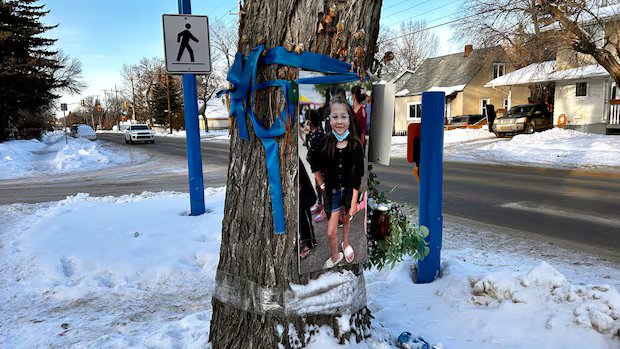

Listen to this article
Estimated 4 minutes
The audio version of this article is generated by AI-based technology. Mispronunciations can occur. We are working with our partners to continually review and improve the results.
The Saskatchewan Court of Appeal has dismissed the Crown’s request to overturn a judge’s decision to stay a fatal impaired driving charge in the death of nine-year-old Baeleigh Maurice.
In a written decision released Friday, a panel of three judges unanimously agreed the Crown failed to prove Taylor Kennedy did not face unreasonable delays before and during her trial.
While they did buy the Crown’s argument that the original judge miscalculated the total time the case was delayed, the revised amount still fell short.
“We agree with the Crown that the judge erred by not extending the reasonable time to trial on account of the COVID-19 pandemic,” the appeal court decision said. “However, even adjusting for this and one other matter, Ms. Kennedy was still not tried within a reasonable time. For this reason, the Crown’s appeal must be dismissed.”
On Sept. 9, 2021, Maurice was crossing the street in front of her house when Kennedy hit her with her truck, killing the nine-year-old. Kennedy told police she had vaped cannabis and microdosed psilocybin mushrooms the day before.
Kennedy was charged on March 15, 2022, and the case went to trial in provincial court with final arguments taking place Aug. 30, 2024.
Judge Jane Wootten stayed the charge on Dec. 13, 2024, ruling the case had taken longer than the 18-month time limit set by the Supreme Court. Kennedy’s case took 899 days, or just short of 30 months, according to the appeal decision.
The Crown filed its appeal a month later in January 2025, arguing that the trial judge erred by concluding there was no evidence allowing for the COVID-19 backlog delay to be counted. The Crown also argued that the trial judge erred by deducting time the judge had taken to render a decision on an application regarding Kennedy’s statement to police.
The appeals court judges ruled that “the judge should have made an allowance of 120 days, to account for the COVID-19 pandemic [and] should also have attributed an additional 14 days as defence delay because of counsel unavailability.”

The ruling is another setback for Maurice’s family, Sarah Smokeyday said.
“We recently just got back Baeleigh’s belongings from the police so it’s been a rough month here,” said Smokeyday, the longtime spokesperson for the family.
“A little Indigenous girl was hit at a marked crosswalk on her way to school, killed by a Caucasian woman [who] admitted to police on scene that she had been using drugs. And somehow through all of this, the victim was lost.”
Some family members attended every court date related to the case, but are convinced they won’t find solace in court anymore.
“Justice isn’t what will happen now,” Smokeyday said. “The justice system has failed Baeleigh and the family. What will happen is the family will start healing and hopefully that’s through little Baeleigh’s big spirit making changes that keep this from ever happening again.”

Kennedy’s lawyer Thomas Hynes said his client is “extremely relieved” with the decision.
“It confirms the Court of Appeal will defer to trial judges’ assessments of whether [circumstances are] truly exceptional or not,” Hynes said.
“And the Court of Appeal said we agree with the trial judge that there was nothing exceptional about how this case unfolded. The trial judge was perfectly within her right to say this wasn’t defence delay, this wasn’t exceptional, so the Crown could have seen this coming.”