dailynewsnblog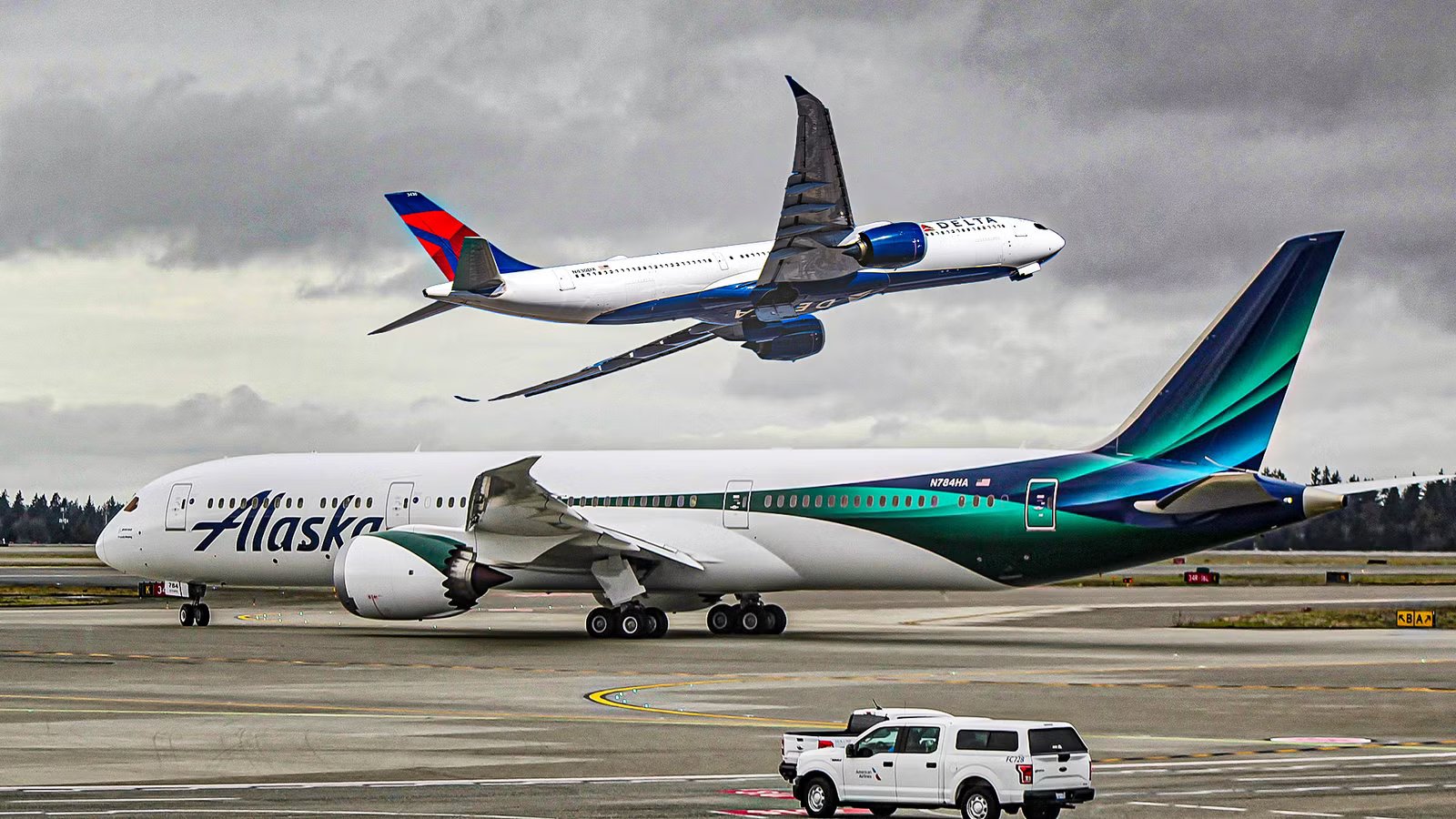
 Alaska Airlines is preparing to cross a symbolic frontier. On April 28, 2026, the Seattle-based carrier will launch its first-ever nonstop flight to Europe, linking Seattle and Rome with a Boeing 787-9 Dreamliner inherited through its merger with Hawaiian Airlines. What could have been a straightforward network expansion story is increasingly becoming something much bigger. This is now a premium transatlantic showdown in one of the West Coast’s most strategically important long-haul markets. Strong early demand prompted Alaska to upgrade the route from its original four-times-weekly plan to daily seasonal service, underscoring its serious view of Seattle as a major global gateway.
That is ultimately where  Delta Air Lines comes into play. Just a few days later, on May 6, Delta will launch its own nonstop service from Seattle-Tacoma International Airport (SEA) to Rome Fiumicino International Airport (FCO) with the Airbus A330-900neo, turning this directly into an unusually direct context between two very different premium propositions. Alaska arrives with a fresh Boeing 787 hard product, including 34 business-class suites with privacy doors, but no true premium economy cabin until planned retrofits later in the decade. Delta, by contrast, counters with its long-established commercial playbook. This includes Delta One Suites, a real Premium Select cabin, and a more complete premium ladder. We aim to discuss this Rome launch not as Alaska’s debut, but rather as a head-to-head battle over product, positioning, and premium relevance in Seattle.
Why Is Alaska Expanding Into Long-Haul Markets?

It seems somewhat paradoxical to see Alaska Airlines choosing to expand into long-haul markets. The carrier has historically focused on short-haul flights and has an alliance partner in American Airlines, which provides intercontinental connectivity. Nonetheless, the carrier has big plans for international expansion. Alaska Airlines is going to be expanding long-haul, primarily because the Hawaiian merger finally gave it the aircraft, scale, and overall network logic to do so credibly. For years, Alaska was a strong West Coast carrier, but not a true intercontinental carrier.
The 2024 acquisition of Hawaiian Airlines changed pretty much everything for the carrier by bringing in long-range widebodies, especially the Boeing 787-9s that Hawaiian had already ordered, which Alaska saw as central to its international ambitions. From there, management built a broader strategy around Seattle. The airline is now looking to turn the airport into a global gateway, use its huge domestic feed to fill long-haul flights, and grow into at least 12 intercontinental destinations from Seattle by 2030.
Alaska has said Seattle is already its largest hub on the West Coast, with 109 nonstop destinations, and it is now creating a dedicated 787 base there while planning for up to 17 Dreamliners across the carrier’s global network. This is not just about the airline adding geography. Rather, it is about repositioning Alaska as a premium global airline, with a new international business-class product, alliance connectivity through oneworld, and a more profitable growth story under its Alaska Accelerate plan. Thus, long-haul is no longer a side project for Alaska. Rather, it is becoming one of the core ways that the airline intends to grow, differentiate itself, and monetize the Hawaiian deal.
Why Did The Airline Choose Rome For Its First European Service?

Wikimedia Commons
Rome fundamentally made sense as Alaska’s first European destination because it sits at the intersection of demand, symbolism, and overall network utility. Alaska itself has said that Rome was the largest European destination a major airline did not already serve from Seattle, and one of the most-requested cities among its loyalty program members. It also works beyond the local Seattle market. The carrier explicitly pitched the route as a one-stop option for travelers across the West Coast and Hawaii, using Seattle as a funneling hub.
Rome’s geography is also a key piece of this puzzle. Fiumicino is a strong gateway not just to the Italian capital but also to Italy, Southern Europe, and the Mediterranean region as a whole. The city’s tourist pull and cruise connectivity make it attractive to both leisure and connecting passengers. Operationally, the route launches April 28, 2026, as a daily seasonal service between Seattle-Tacoma and Rome Fiumicino on Alaska’s Boeing 787-9.
The westbound and eastbound schedules are timed for overall usability. Seattle services depart at 5:30 PM and arrive in Rome the following day at 1:15 PM. Return services are set to leave Rome at 3:25 PM and land back in Seattle at 5:45 PM. The aircraft also gives Alaska a stronger premium story directly out of the gate, with 34 business class suites featuring sliding doors, though there is still no true premium economy cabin until planned retrofits later in the decade.

From Seattle To The World: Where Could Alaska Airlines Fly The Boeing 787-10?
With the 787-10’s impressive capabilities, where will Alaska Airlines soar next? The possibilities are as vast as the skies themselves.
Why Is Delta Responding In Kind?

Delta does not tend to back down from a competitive challenge, and this is no exception. The carrier is responding because Alaska’s Rome launch is not just another route, but rather a direct challenge to Delta’s long-standing effort to establish Seattle as a major intercontinental gateway. Delta has spent a decade investing in its presence at the facility, and by late 2025, the carrier was operating around 162 peak-day departures to 57 destinations from Seattle.
The airline paired its 2026 Rome and Barcelona announcements with new premium lounge investments at the airport, something that shows Seattle is strategically important to the airline far beyond just a leisure route. If Alaska is allowed to dominate this market, Delta risks losing market share, relevance, and pricing power in one of its most contested hubs. There is also a product reason, as Delta wants to challenge Alaska before it builds a proper premium lineup, according to a comparative analysis from The Points Guy.
Alaska’s Boeing 787-9 offers an attractive new business class suite, but it still lacks a true premium economy cabin on its ex-Hawaiian jets. Delta’s A330-900neo offers both Delta One Suites and Premium Select, giving it a fuller premium ladder for corporate travelers, higher-yield leisure passengers, and loyalty customers. Thus, this is not only a defensive response but rather an attempt to frame Delta as the more mature transatlantic option from Seattle, all while preventing Alaska from turning a symbolic first Europe flight into a durable competitive advantage.
What Were The Financial Implications Of This Move?

From a financial perspective, Delta’s response raises the stakes for both carriers. For Alaska, services from Seattle to Rome were supposed to be a high-visibility long-haul growth story built around new 787-9 capacity from the Hawaiian merger. Delta’s entry into the market looks to make that considerably harder. A second carrier on the route increases the risk of fare pressure, heavier launch-period marketing, and lower unit revenue than Alaska might have earned as the only operator.
That matters primarily because Alaska is still building out its long-haul model and, on these aircraft, does not yet have a true premium economy cabin, which limits how much revenue it can capture between business class and standard economy. For Delta, the move is defensive but financially rational. Seattle is already an important strategic station for the airline, and letting Alaska dominate the narrative around a flagship Europe launch could weaken Delta’s overall pricing power, premium market share, and corporate relevance in the market.
Delta also has a stronger premium ladder on the A330-900neo, which improves its ability to monetize affluent leisure and business demand. Even so, competition can dilute margins in the short term, especially as Delta is already dealing with elevated fuel costs and a more selective approach to capacity growth. Thus, the likely near-term result will be pressure on yields, but the longer-term objective is to preserve network economics and premium positioning in Seattle.

Here’s Where Alaska Airlines Will Fly Its Boeing 787 Dreamliners In 2026
The carrier recently converted certain orders to feature the larger 787-10 variant.
Where Will Alaska Airlines Expand Next?

Alaska Airlines has big plans for continued expansion. The carrier will serve London Heathrow Airport (LHF) and Keflavik Airport (KEF), both from its Seattle hub. The carrier says its new Seattle to Rome services will begin on April 28, 2026, followed by daily year-round Seattle-London flights on May 21.
Flights to Iceland are set to operate on a seasonal basis starting on May 28. That ultimately means that Rome is not a one-off experiment but rather the opening phase of a broader Seattle long-haul buildout. Alaska is using Seattle as its new global gateway and has said it plans to serve at least 12 intercontinental destinations from the hub by 2030.
The airline’s wider map is already taking shape. Tokyo Narita Airport (NRT) is seeing daily service, and Seoul Incheon (ICN) is already operating five times per week. The cleanest framing is that Alaska is expanding next, not just to one place but to a sequence of European and Asian markets.
What Is Our Bottom Line?

At the end of the day, Alaska Airlines is an incredibly unique kind of airline. The airline’s decision to purchase Hawaiian Airlines gave it unique access to a fleet that could potentially support its long-haul ambitions, a key factor behind the airline’s decision to engage in the transaction.
Today, the airline has to execute its extremely bold vision, and in doing so, it is facing extensive competitive challenges. The carrier may have elected to launch this service at one of the worst possible times, given the volatile nature of the market and extremely high prices for jet fuel.
Now, in addition to a complex market environment, the carrier faces an extremely difficult competitive challenge. The airline is looking at going head-to-head with the most dominant premium player in the US market, one that is certainly not interested in ceding market share.