dailynewsnblog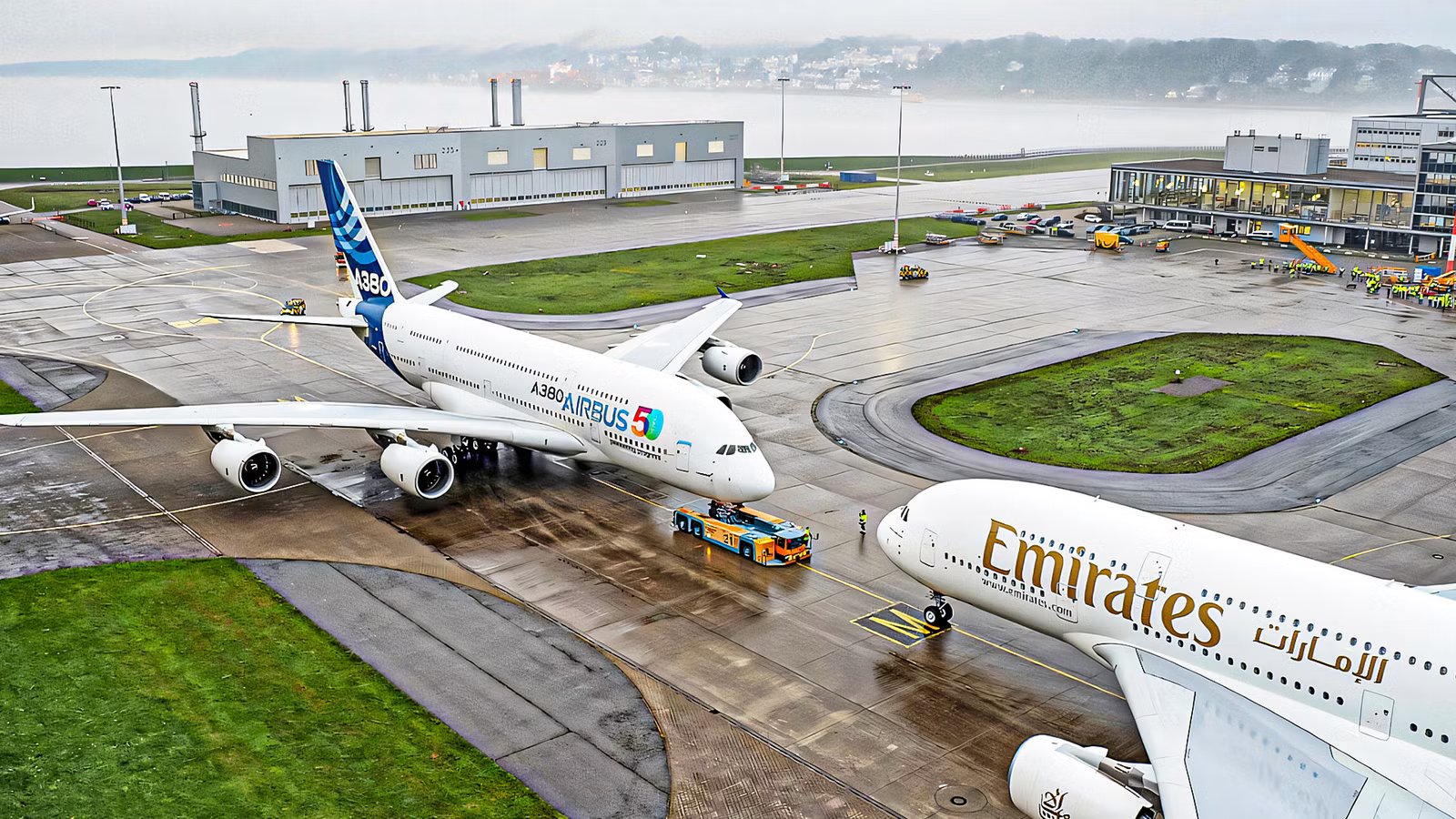
Entered commercial service in 2007, the A380-800 was Airbus’ solution to compete against its American counterpart,  Boeing, and its 747 program, within the space of high-capacity, long-range aircraft. The A380, the only commercial aircraft with two full decks to accommodate passengers, remains iconic alongside other great aircraft designs.
While changing market trends and several other external factors impacted the success of the aircraft type with customers (except for Emirates), the aircraft remains a passenger favorite even 20 years after its entry into the market. This is especially true among passengers traveling in premium cabins, because the A380s feature some of the best and most innovative seat products/experiences available onboard commercial aircraft.
Almost 21 Years Since The A380’s First Flight

The Airbus A380 program was launched by the European manufacturer, Airbus, in the 1990s, with the aim of manufacturing the world’s largest commercial jet, capable of carrying more passengers than any other jet available in the market at the time. The jet took to the skies for the first time on April 27, 2005, and entered commercial service in 2007. Airbus achieved both its objectives, as the A380 remains to this day the largest commercial aircraft with the highest passenger capacity.
So what was wrong with the aircraft? Short answer: Nothing! The aircraft’s unpopularity with airlines was due to shifting market trends during the mid to late 2000s, which saw more carriers shift focus to point-to-point connectivity rather than the hub-and-spoke model which the A380 is designed for. Additionally, the events of that decade, including 9/11, the financial market crash, and changes in fuel prices, all made the four-engined, fuel-guzzling A380 unfeasible for several carriers.
From 2007 to 2021, Airbus delivered a total of 251 aircraft to 14 customers. Most notably, this includes  Singapore Airlines, the launch customer of the type and the second-largest operator, having ordered 24 examples. Then, of course, there is
  Emirates, which was the second airline to take delivery of the type and is the largest operator, having taken delivery of 123 examples.
Technical Specifications For The A380

So how exactly does the A380 perform as the largest aircraft in commercial aviation, designed to carry high passenger volumes on long-haul services? Given the space available, the A380 was designed to accommodate up to 853 passengers in an all-economy configuration. Compared with the Boeing 747-8, which has the second-highest exit limit among passenger aircraft, at 605 in an all-economy configuration. However, no airline took delivery of the A380 at such high densities.
These are the technical specifications from Airbus for the A380 and a few other Boeing and Airbus aircraft it competes with on the market:
|
Aircraft Specifications |
Airbus A380-800 |
Boeing 747-8 |
Boeing 777-300ER |
Boeing 777-9* |
Airbus A350-1000 |
|---|---|---|---|---|---|
|
Capacity |
480-520** three/four class configuration |
320-360** three/four class configuration |
392 Boeing-spec two class configuration |
426 Boeing-spec two class configuration |
400 Airbus-spec three class configuration |
|
Range*** |
8,000 NM (14,816 km) |
7,370 NM (14,649 km) |
7,370 NM (13,649 km) |
7,284 NM (13,500 km) |
9,000 NM (16,700 km) |
|
Number Of Engines |
Four (RR Trent-900/GP7000) |
Four (GEnx) |
Two (GE90) |
Two (GE9X) |
Two (RR XWB-97) |
|
Cruise Speed |
Mach 0.85 |
Mach 0.86 |
Mach 0.84 |
Mach 0.85 |
Mach 0.85 |
*The 777-9 is yet to enter commercial service.
**Capacity based on the typical configuration used by actual operators.
***Range can vary depending on cabin configuration and aircraft weight.
The data from the above table demonstrates the capability of the A380 compared to other widebody aircraft currently on (or about to enter) the market. A key reason why the A380 fell out of favor with airlines is that it has four engines, resulting in considerably higher fuel burn. However, the market is striving to be as efficient as possible, with airlines attempting to reduce fuel costs and carbon footprints.

Why Airlines Don’t Want Their Airbus A380s Anymore
A look at the challenges of operating a fleet of Airbus A380s today, and the future outlook on the type.
Emirates Kept The Production Going

As mentioned above, A380 production ended in 2021, and during the program’s lifetime, a total of 251 examples of the aircraft type were delivered. However, Emirates took delivery of 123 of these aircraft, accounting for 49% of all A380s delivered, making the carrier synonymous with the aircraft type. Furthermore, for the better part of the past decade, the carrier solely operated A380s and Boeing 777-300ERs, until it took delivery of its first Airbus A350-900 in 2024.
Looking at the aircraft numbers, this proves that the A380 program clearly lasted as long only because of Emirates’ commitment to the type. Because Emirates relies heavily on connecting traffic flowing through its hub at  Dubai International Airport (DXB), to support its hub-and-spoke model, the carrier has also invested heavily in the aircraft type. This includes retrofitting a huge portion of its A380 subfleet with newer cabins, investing in maintenance facilities to perform various services in-house with Emirates Engineering, and even building a dedicated A380 concourse (Concourse A) at Emirates’ own Terminal 3 at DXB.
The airline’s need to deliver capacity across its extensive network has led it to have the A380 in its fleet for as long as the 2040s, because no other aircraft in the market currently offers similar levels of passenger capacity to that of the A380. But Emirates is also diversifying its fleet and investing in newer aircraft such as the A350 and the Boeing 777X.
The Best Products In Commercial Aviation

With two full decks onboard the A380 for passengers to utilize, operators did not face the usual space constraints they would have faced on other aircraft. This meant that A380 operators could get creative with the space available to deliver innovative products and services to carriers.
Emirates was the first airline to offer services such as onboard showers (exclusive for first class) and the onboard lounge/bar area at the rear of the upper deck, dedicated only to business and first class passengers. Meanwhile, neighboring carrier  Etihad Airways equipped its A380s with the world-famous Residence product, which is the only product in the sky that comes with a dedicated bedroom and shower, making it a three-roomed residence space in the sky. Only one Residence suite per A380, of which the airline has eight aircraft currently active.
Elsewhere, carriers such as Singapore Airlines designed first-class suites specifically for the A380, which include a recliner seat and also a separate bed. With six suites per A380, in a 1-1 configuration across the first three rows on the upper deck, the suites in rows two and three can be combined to create a double bed, which is perfect for couples traveling together. Other unique amenities include an inflight duty-free section available on board Korean Air’s A380 aircraft, located at the aft of the lower deck, where passengers can browse items and purchase inflight.

Extra Space: 5 Cool Uses Of The Airbus A380’s Cabin
The A380 being the largest passenger jet in the world has allowed airlines to be creative with the space available onboard.
The Status Of The A380s In 2026

Having delivered 251 airframes, Airbus still lost billions due to the costs of the program. According to Aerospace Global News, as of early 2026, there are only around 190 of the airframes in service with ten airlines. A considerable number of A380s were retired during the onset of the COVID-19 pandemic, when passenger numbers declined significantly.
Some carriers, such as Air France, Thai Airways, Malaysia Airlines, and China Southern, have retired the type entirely. In fact, during the pandemic, even more carriers such as Qatar Airways and Etihad, initially stated that the A380s would not return due to the lack of passenger demand. However, other carriers, such as Emirates, Singapore Airlines, Qantas, and  British Airways, were among the first airlines to return their A380s to service.
While these carriers saw a faster bounce in passenger demand through their hubs, they also invested in retrofitting their A380 cabins with new products due to popular demand. Additionally, this also indicates that these airlines see the value in what the A380 can offer, especially at slot-restrained hubs, and can envision the aircraft type remaining operational for the foreseeable future.
A Suitable Replacement For The A380?

While airlines still prefer twin-engined, efficient jets, capable of carrying passengers over long distances, it is an irrefutable fact that an aircraft capable of carrying a large number of passengers is also required. This becomes evident as travel demand keeps trending upwards, and more major airports are starting to face capacity constraints. Once the available slots run out, the only way airlines can increase capacity would be to start using larger aircraft.
This is also an indication as to why carriers (other than Emirates, for obvious reasons) such as British Airways, Singapore Airlines, and Qantas still heavily rely on the A380. Airports such as  London Heathrow Airport (LHR) are so heavily constrained that the airport’s home carrier, British Airways, is amongst the very few carriers that have not retired a single one of its A380 aircraft. Additionally, the A380 provides a competitive advantage by enabling airlines to deploy their best in-flight products and amenities in highly competitive markets.
With both the A380 and the 747 out of production, the next best option close to entering the market is the Boeing 777-9, which is expected to enter commercial operations next year (assuming no further delays in the certification process). However, this is still not enough, with carriers such as Emirates championing Airbus and Boeing to build a larger aircraft. In the past year, this has resulted in talks of potentially developing a stretched 777-9 or A350-1000 aircraft. It is worth keeping in mind that these are just speculations at this point.