dailynewsnblog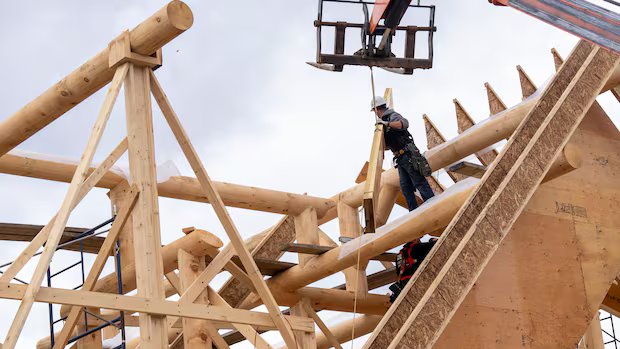
Housing prices are dipping in Canada’s priciest markets, but real estate experts say it’s not necessarily the break for which potential first-time homebuyers have been waiting — and that break may never come.
TD Economics said in a report last week that it expects home prices to slide 0.3 per cent across Canada this year, after a weak performance in the market over the last two quarters, with Ontario and B.C. facing the biggest drops.
Interest rates, which determine mortgage payments, are also low by historical standards, though not as low as they were before and during the COVID-19 pandemic.
And in Ontario, Premier Doug Ford announced a plan to temporarily remove the harmonized sales tax for the next year on new homes valued at up to $1 million, giving eligible buyers a rebate of up to $130,000.
But these incremental measures aren’t making homes more affordable, so long as prices continue to outpace wage growth, said Andrey Pavlov, a Simon Fraser University finance professor.
“We need to have high income growth and stable house prices. We really need both.”

‘Nobody wants to build’
Statistics Canada numbers show median real hourly wages adjusted for inflation grew 20 per cent from 1981 to 2024, while inflation-adjusted home prices grew 163.5 per cent.
TD had previously predicted an increase in home sales and prices for 2026, but adjusted those numbers to call for a 1.8 per cent drop in sales and 0.3 per cent drop in prices.
In the report, economist Rishi Sondhi said affordability is still a challenge in Ontario and B.C., and that potential first-time buyers are likely to keep waiting for the market to bottom out before they buy.
Meanwhile, the Bank of Canada’s interest rate is less than half what it was in 2023, when it reached five per cent. But at 2.25 per cent, it’s still much higher than in 2019, when it was held at 1.75 per cent, and during the pandemic, which saw a historic low of 0.25 per cent.
Meanwhile, Pavlov says the softening of prices has led to a cancellation of housing projects in Vancouver and Toronto. Once the market starts to feel those, he says it could cause another shortage and prices could “blow up quite substantially,” especially in Vancouver.
Thomas Davidoff, director of the University of British Columbia’s Centre for Urban Economics and Real Estate, says that the rising cost of building has also contributed to a slowdown in new-home construction.
He says unless your main concern is the down payment, he’s also “not convinced” that now is an ideal time to buy a home.

“Your interest payments, which are sort of the real economic cost of owning other than property taxes, are still probably higher than they used to be in most markets,” Davidoff said, adding the housing market is not in a “great place.”
He says the federal government’s new immigration limits will put some downward pressure on housing prices, but says that will be more of a benefit to renters in the short term.
“Where you are better off is renting unambiguously, because the way to reduce rents is either to add housing supply or delete housing demand,” he said. “The government pressed delete, delete, delete on demand.”
RBC’s national aggregate affordability measure — which calculates the proportion of median pre-tax household income required to cover the cost of an average home — slowed for an eighth consecutive quarter to 52.4 per cent in Q4 of 2025, from an all-time high of 63 per cent at the end of 2023. (Lower numbers indicate greater affordability.)
But that’s still historically unaffordable. In 2015, when the term “housing crisis” was already in the mainstream Canadian discourse, affordability was about 41 per cent.
And while Toronto and Vancouver are leading an overall drop in prices, RBC says Montreal, Quebec City, Edmonton, Calgary and Winnipeg have seen back-to-back deteriorations in affordability.
Younger generations not getting break: prof
Paul Kershaw, a UBC policy professor, said prospective buyers shouldn’t discount the fact that prices have dropped after “years and years of relentless increases” that were “crushing younger people.”
Those changes are still “not nearly enough” — and the situation isn’t improving anytime soon.
“There isn’t going to be a good time for Gen Z or millennial not-yet homeowners to get into the housing market, by comparison with historic standards from not so long ago — what I paid as a Gen X or what a boomer paid, relative to our earnings,” said Kershaw, who is also the founder of Generation Squeeze, a think-tank that advocates for generational fairness.
“Those norms are gone, and they’re not coming back.”

He says Canadian lawmakers are not keen to see home values drop significantly, due to a political fear it would anger existing homeowners. Statistics Canada said 66.5 per cent of Canadians owned their primary residence in 2021, a drop from 69 per cent a decade earlier.
Kershaw says Gen Z and millennials have become collateral damage in a “political bargain,” taking on bigger mortgages or giving up on dreams of home ownership entirely in order to “protect the housing wealth windfall” of older generations.
Kershaw suggests public policy should focus on how to compensate younger Canadians through policies like rent subsidies, lower income tax payments and lower childcare costs.
“Those of us who benefit, how can we compensate those who are providing a national service by protecting that wealth?” he said. “Let’s honour that service, let’s compensate it and let’s make sure that’s the heart of the national housing strategy conversation going forward. Right now, it’s missing from our national dialogue.”